Need help?
Do you have a question about the Honda BF 60 AK1 LRTU and is the answer not in the manual?
Importance of safety and how manual provides hazard information.
General information on safe operation, potential hazards, and prevention.
Outlines the operator's duties for safe boating and motor operation.
Instructions and warnings for safe refueling procedures to prevent fire or explosion.
Explains the dangers of carbon monoxide exhaust and necessary precautions.
Shows the location of important safety labels on the outboard motor for user reference.
Explains codes for identifying control and feature applications.
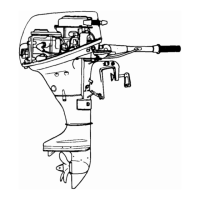
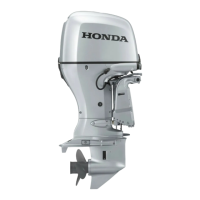
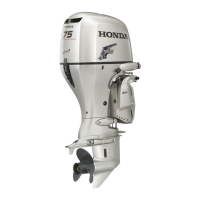
Illustrates and labels the physical locations of components and controls on the motor.
Identifies key indicators like oil pressure, overheat, and malfunction warnings.
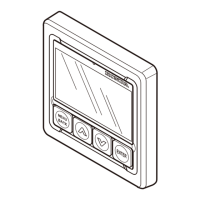
Illustrates and describes various gauges like trim meter and tachometer.
Explains the function of indicators like ACG, Malfunction, Oil Pressure, and Overheat.
Details features such as the Overrev Limiter and Portable Fuel Tank.
Emphasizes preparation and understanding for safe operation before starting.
Checks for leaks, fuel hoses, controls, and parts condition before operation.
Details how to adjust the tiller handle for optimal operator comfort and control.
Emphasizes understanding operation and safety before first use.
Outlines the 10-hour break-in period for optimal engine performance and longevity.
Instructions for placing, securing, and venting the portable fuel tank.
Step-by-step guide for connecting the fuel hose assembly.
Instructions on using the priming bulb to supply fuel to the engine.
Detailed steps for starting the engine, including safety checks and warm-up.
Procedures for both emergency and normal engine stopping.
Explains how to operate the gearshift and throttle controls.
How to steer the boat using tiller or remote controls and adjust steering friction.
Tips for engine speed, trim, and trolling for efficient and stable cruising.
How to activate and adjust the trolling speed control feature.
Instructions on how to adjust the trim tab to compensate for torque steer.
How to tilt the motor to navigate shallow water safely.
Procedures for raising and lowering the outboard motor for docking.
How to use the manual relief valve for tilting the motor without battery power.
Explains why proper maintenance is essential for safe and economical operation.
Safety precautions to follow when performing maintenance tasks.
Lists the tools included and information about the owner's manual.
Detailed schedule for regular service intervals based on time or hours.
Instructions on how to adjust the trim tab for steering balance.
Steps for removing and installing the engine cover.
How to check the engine oil level with the engine stopped.
Step-by-step instructions for draining and refilling engine oil.
Recommends specific types of oil and their properties.
Guide for inspecting, cleaning, and replacing spark plugs.
Identifies points requiring lubrication and the recommended grease.
Instructions for refueling the portable fuel tank.
Specifies recommended fuel types and octane ratings.
How to inspect, clean, or replace the fuel filter/water separator.
Procedures for cleaning the portable fuel tank and its filter.
Instructions for cleaning or replacing the fuel tank filter.
Details on replacing anodes to prevent corrosion.
Step-by-step guide for removing and installing the propeller.
Steps to prepare the motor for storage to prevent damage.
Instructions for washing the exterior and flushing the cooling system.
Information on fuel oxidation, deterioration, and storage life.
How to add fuel stabilizer to extend fuel storage life.
Procedures for draining the fuel tank and vapor separator.
Steps for changing engine oil and preparing cylinders for storage.
How to attach hoist hooks and disconnect/hoist the motor.
Advice on selecting a suitable storage area and storing gasoline containers.
Instructions for checking the motor after storage.
Precautions for trailering a boat with the motor attached.
How to secure the outboard motor when removed from the boat.
Troubleshooting steps for when the engine fails to start.
Troubleshooting steps for difficult starting or engine stalling.
Troubleshooting steps for engine overheating issues.
Information on fuse functions, locations, and replacement procedures.
Explains low oil pressure indicators and engine speed limitations.
Explains overheat indicators and engine speed limitations.
Immediate steps to take if the outboard motor is submerged to prevent corrosion.
Where to find product and engine serial numbers for reference.
Minimum battery requirements and safety precautions for handling.
Explains emission sources, control systems, and PGM-FI.
Provides detailed specifications for BF60A and BFP60A models.
Information on Honda publications, manuals, and customer service contacts.
Explains warranty coverage, service procedures, and exclusions.
Details the limited warranty terms for distributors.
Details the Distributor's Warranty for Canada.
 General
| Cylinders | 3 |
|---|---|
| Engine Configuration | Inline |
| Displacement | 998 cc |
| Full Throttle RPM Range | 5000-6000 RPM |
| Rated Power | 60 HP |
| Max Output | 60 HP |
| Cooling System | Water Cooled |
| Starting System | Electric |
| Lubrication | Wet Sump |
| Recommended Fuel | Unleaded Gasoline (86 Octane) |
| Trim Range | -4° to +16° |
| Tilt Range | 72° |
| Steering | Remote |
| Propeller | Optional |
| Model | BF 60 AK1 LRTU |
| Engine Type | 4-Stroke |
| Bore & Stroke | 73 mm x 79.5 mm |
| Fuel Delivery | PGM-FI (Programmed Fuel Injection) |
| Exhaust | Through Prop Hub |
| Shaft Length | 20 in |
| Alternator Output | 22 Amp |


 To Next Page