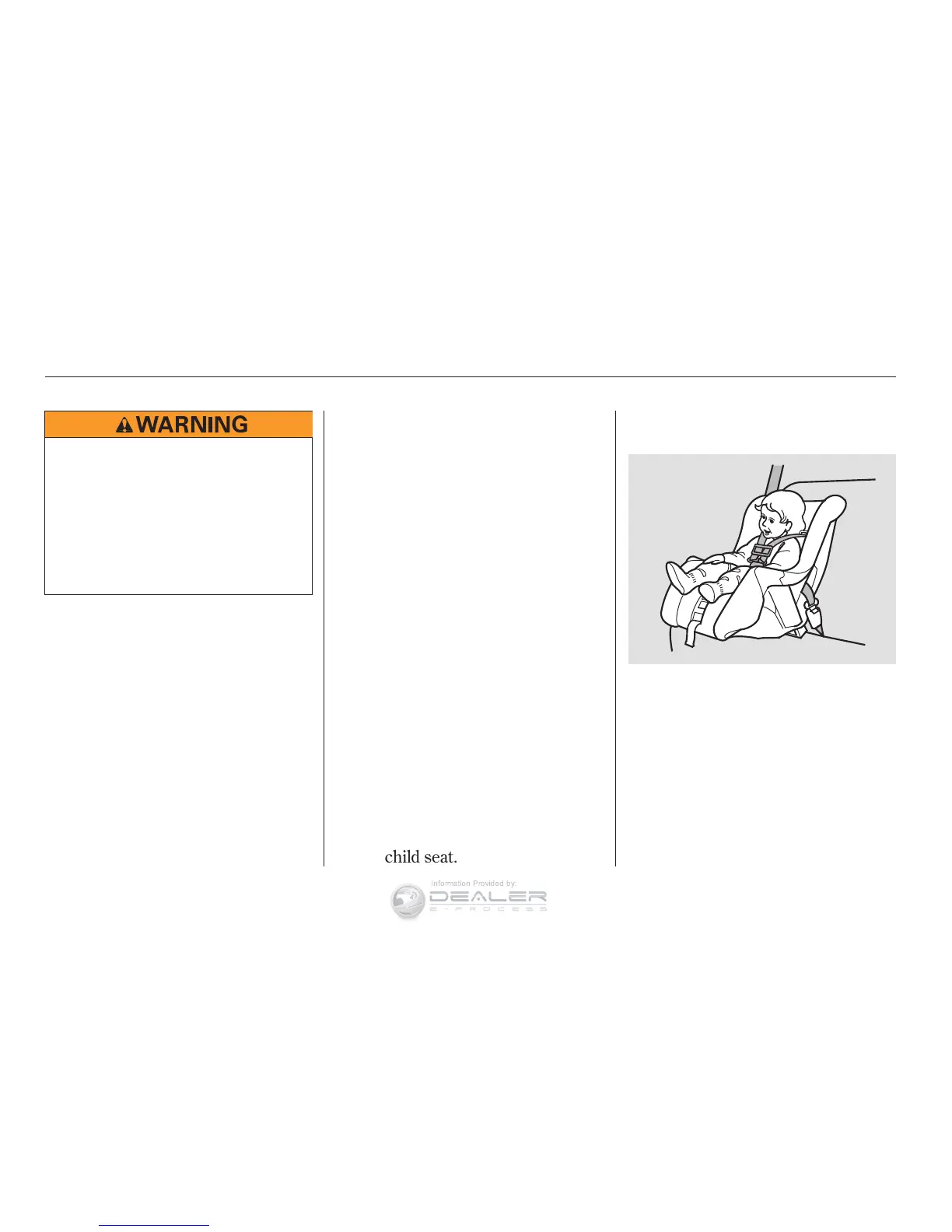
A child who is at least one year old,
and who fits within the child seat
maker’s weight and height limits,
should be restrained in a forward-
facing, upright child seat.
Of the different seats available, we
recommend those that have a five-
point harness system as shown.
We strongly recommend installing a
rear-facing child seat in a back seat.
If the passenger’s
front airbag inflates, it can hit the
back of the child seat with enough
forcetokillorseriouslyinjurean
infant.
When properly installed, a rear-
facing child seat may prevent the
driver or a front passenger from
moving the seat as far back as
recommended, or from locking the
seat-back in the desired position, and
interfering with the proper operation
of the passenger’s advanced front
airbag (see page ).
In any of these situations, we
strongly recommend that you install
the child seat in a different back
seating position or get a smaller rear-
facing child seat.
Two types of seats may be used: a
seat designed exclusively for infants,
or a convertible seat used in the rear-
facing, reclining mode.
If placed
facing forward, an infant could be
very seriously injured during a
frontal collision.
22
Protecting Infants and Small Children
Driver and Passenger Safety
Protecting Small Children
Child Seat Type
Child Seat Placement
Never put a rear-facing child seat in
the front seat.
Do not put a rear-facing child seat in
a forward-facing position.
30
Placing a rear-facing child seat
in the front seat can result in
serious injury or death if the
passenger’s front airbag inflates.
Always place a rear-facing child
seat in the back seat, not the
front.









 To Next Page