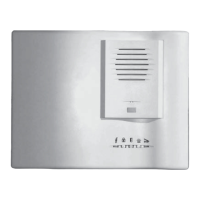
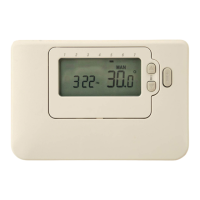
The Honeywell CM737 is an operator control panel designed to manage the supply temperature of a heating system, ensuring optimal indoor comfort and energy efficiency. Upon connection to the power supply, the CM737 automatically detects and verifies connected sensors, subsequently choosing to control the heating system based on either room temperature or outdoor temperature.
Function Description
The CM737 operates as a room thermostat, controlling the heating system's supply temperature. It can function in three distinct operating modes: Automatic (AUTO), Manual (MAN), and Off (OFF). In AUTO mode, the device follows a pre-programmed heating schedule, which can be either a factory default or a user-defined program. This mode is ideal for maintaining consistent comfort while maximizing energy savings. MAN mode allows for a fixed set point temperature to be maintained throughout the day, adjustable between 5°C and 35°C. OFF mode sets the CM737 to control to a minimum temperature, typically 5°C, providing frost protection.
The device incorporates an Outdoor Temperature Compensation (OTC) feature, where it controls the indoor temperature as a function of the measured outside air temperature. The heating curve, which defines the relationship between outside air temperature and calculated supply water temperature, can be adjusted from a ratio of 1 to 40. This allows for customization based on the specific installation type (e.g., radiators, convectors) and the thermal properties of the property. If a room temperature set point other than 20°C is used, the selected heating curve will be parallel compensated, with each degree change in room temperature affecting the supply temperature by approximately 3°C.
The CM737 also includes an installer mode, which allows for the alteration of system settings for specific applications, access to special features, and modification of factory-preset parameters. These parameters are categorized into Room Thermostat Settings, System Settings, Boiler Settings, Transparent Boiler Parameters, and Fault History. This mode provides granular control over the device's operation, enabling installers to fine-tune the system to meet specific requirements.
Usage Features
The CM737 boasts an ergonomic user interface with a large LCD screen and an intuitive 'OK-button'. The LCD display shows the current time, day, temperature, and a heating indicator. Temperature change buttons allow for easy adjustment of set points, while program buttons facilitate navigation and modification of the heating schedule. A 'Copy day' button simplifies programming by allowing users to duplicate a day's schedule to other days of the week. The 'Day select' button helps in choosing specific days for programming.
The device supports a 7-day heating program with four independent temperature levels per day, adjustable from 5°C to 35°C in 0.5°C increments. This flexibility allows users to tailor the heating schedule to their family's lifestyle, optimizing comfort and energy consumption. The built-in memory ensures that the user program is retained indefinitely, even during power outages.
A 'Holiday Function' is integrated, enabling users to set a constant temperature (default 10°C) for a specified number of days (1-99 days). This feature helps save energy and costs when the house is vacant, automatically resuming normal operation on the day of return. The holiday counter reduces by one at midnight each day until the selected number of days has passed.
During normal operation, the CM737 displays the current room temperature. Users can review the programmed target temperature by pressing the info-button, which will flash the value for 5 seconds. In AUTO mode, a temperature override feature allows for manual adjustment of the programmed temperature, which is then cancelled at the next scheduled temperature change. The info-button also provides access to target room temperature, error codes, measured outside temperature, and measured supply water temperature, offering comprehensive system insights.
The CM737 allows for disabling or enabling time periods within the heating program. If users do not require all four daily switch points, periods 2 to 4 can be removed or reinstated, providing further customization of the heating profile.
Maintenance Features
The CM737 includes a troubleshooting section that helps identify and resolve common issues. The device displays fault codes on the LCD screen, indicated by a flashing spanner symbol. Pressing the info-button reveals the specific error code, which can then be cross-referenced with the manual's fault code list for diagnosis.
Common symptoms addressed in the troubleshooting guide include:
- A flashing spanner symbol upon power-up: This indicates that the CM737 is receiving power but no information from the heating appliance, or that the heating appliance is not configured correctly.
- A permanent (non-flashing) spanner symbol: This suggests a communication error or short circuit in the link between the heating appliance and the CM737.
- A blank display: This could be due to no power supply to the heating appliance or an uncharged rechargeable battery.
- A flashing spanner symbol during operation: This signifies an error reported by the heating appliance.
- A flashing spanner symbol with room temperature replaced by "--": This indicates an internal fault in the temperature measuring circuit.
The manual provides possible causes and remedies for each symptom, guiding users through steps such as checking wiring, verifying connections to the OpenTherm terminals, and contacting Alfa Laval for further assistance if needed. Fault codes are categorized by source, including supply water temperature sensor out of range, outside air temperature sensor out of range, case temperature out of range, secondary pump or district heating supply issues, and no OT communication. The fault history, accessible in installer mode, allows users to view past boiler errors, starting with the most recent one. This comprehensive diagnostic capability aids in efficient maintenance and problem-solving.


 To Next Page

 General