EasyManua.ls Logo

Honeywell HOWARD LEIGHT SYNC - Page 2

Honeywell HOWARD LEIGHT SYNC
4 pages
Print Icon
To Next Page IconTo Next Page
To Previous Page IconTo Previous Page
Loading...
usi
USER
INSTRUCTIONS
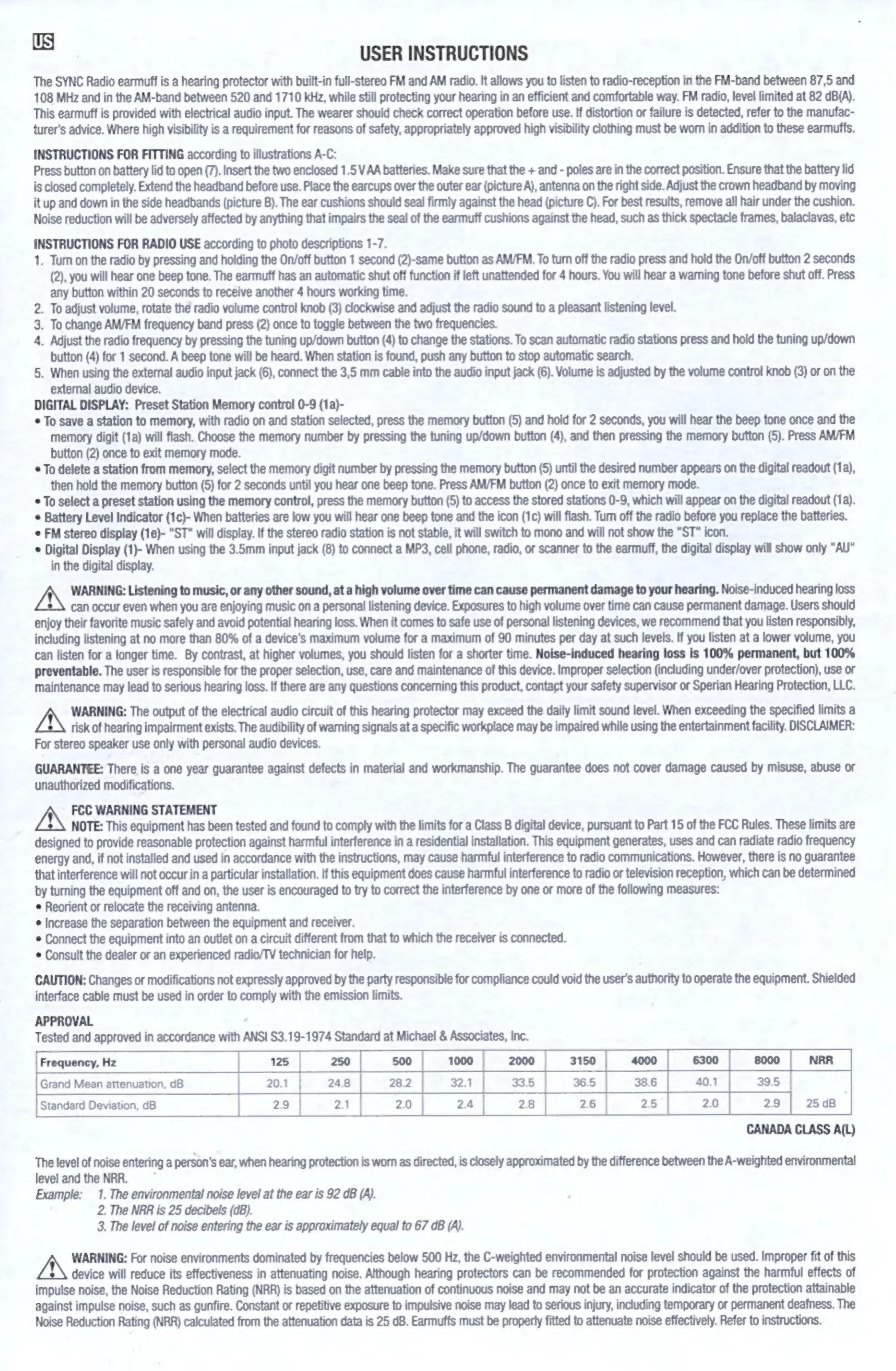
The
SYNC
Radio
earmuff
is
a
hearing
protector
with
built-in
full-stereo
FM
and
AM
radio.
It
allows
you
to
listen
to
radio-reception
in
the
FM-band
between
87,5
and
108
MHz
and
in
the
AM-band
between
520 and
1710
kHz,
while
still
protecting
your
hearing
in
an
efficient
and
comfortable
way.
FM
radio,
level
limited
at
82
dB(A).
This
earmuff
is
provided
with
electrical
audio
input.
The
wearer
should
check
correct
operation
before
use.
If
distortion
or
failure
is
detected,
refer
to
the
manufac-
turer's
advice.
Where
high
visibility
is
a
requirement
for
reasons
of
safety,
appropriately
approved
high
visibility
clothing
must
be
worn
in
addition
to
these
earmuffs.
INSTRUCTIONS
FOR
FITTING
according
to
illustrations
A-C:
Press
button
on
battery
lid
to
open
(7).
Insert
the two
enclosed
1.5
VAA
batteries.
Make
sure that
the
+
and
-
poles
are
in
the
correct
position.
Ensure
that
the
battery
lid
is
closed
completely.
Extend
the
headband
before
use.
Place
the
earcups
over
the
outer
ear
(picture
A),
antenna
on
the
right
side.
Adjust
the
crown
headband
by
moving
it
up
and
down
in
the
side
headbands
(picture
B).
The
ear
cushions
should
seal
firmly
against
the
head
(picture
C).
For
best
results,
remove
all
hair
under
the
cushion.
Noise
reduction
will
be
adversely
affected
by
anything
that
impairs
the
seal
of
the
earmuff
cushions
against
the
head,
such
as
thick
spectacle
frames,
balaclavas,
etc
INSTRUCTIONS
FOR
RADIO
USE
according
to
photo
descriptions
1-7.
1.
Turn
on
the
radio
by
pressing
and
holding
the
On/off
button
1
second
(2)-same
button
as
AM/FM.
To
turn
off the
radio
press
and
hold
the
On/off
button
2
seconds
(2),
you
will
hear
one
beep
tone.
The
earmuff
has
an
automatic
shut
off
function
if
left
unattended
for
4
hours.
You
will
hear
a
warning
tone
before
shut
off.
Press
any
button
within
20
seconds
to
receive
another
4
hours
working
time.
2.
To
adjust
volume,
rotate
the
radio
volume
control
knob
(3)
clockwise
and
adjust
the
radio sound
to
a
pleasant
listening
level.
3.
To
change
AM/FM
frequency
band
press
(2)
once
to
toggle
between
the
two
frequencies.
4.
Adjust
the
radio
frequency
by
pressing
the
tuning
up/down
button
(4)
to
change
the
stations.
To
scan
automatic
radio
stations
press
and
hold
the
tuning
up/down
button
(4)
for
1
second.
A
beep
tone
will
be
heard.
When
station
is
found,
push
any
button
to
stop
automatic
search.
5.
When
using
the
external
audio
input
jack
(6),
connect
the
3,5
mm
cable
into
the
audio
input
jack
(6).
Volume
is
adjusted
by
the
volume
control
knob
(3)
or on
the
extemal
audio
device.
DIGITAL
DISPLAY:
Preset
Station
Memory
control
0-9
(1a)-
+
To
save
a
station
to
memory,
with
radio
on
and
station
selected,
press
the
memory
button
(5)
and
hold
for
2
seconds,
you
will
hear
the
beep tone
once
and
the
memory
digit
(1a)
will
flash.
Choose
the
memory
number
by
pressing
the
tuning
up/down
button
(4),
and
then
pressing
the
memory
button
(5).
Press
AM/FM
button
(2)
once
to
exit
memory
mode.
+
To
delete
a
station
from
memory,
select
the
memory
digit
number
by
pressing
the
memory
button
(5)
until
the
desired
number
appears
on
the
digital
readout
(1a),
then
hold
the
memory
button
(5)
for
2
seconds
until
you
hear
one
beep
tone.
Press
AM/FM
button
(2)
once
to
exit
memory
mode.
+
To
select
a
preset
station
using
the
memory
control,
press
the
memory
button
(5)
to
access
the
stored
stations
0-9,
which
will
appear
on
the
digital
readout
(1a).
+
Battery
Level
Indicator
(1c)-
When
batteries
are low you
will
hear
one
beep tone
and
the
icon
(1c)
will
flash.
Tum off the
radio
before
you
replace
the
batteries.
+
FM
stereo
display
(1e)-
"ST"
will
display.
If
the
stereo
radio
station
is
not
stable,
it
will
switch
to
mono
and
will
not
show
the
“ST”
icon.
©
Digital Display
(1)-
When
using
the
3.5mm
input
jack
(8)
to
connect
a
MP3,
cell
phone,
radio,
or
scanner
to
the
earmuff,
the
digital display
will
show
only
“AU”
in
the
digital
display.
WARNING:
Listening
to
music,
or
any
other
sound,
at
a
high
volume
over
time
can
cause
permanent
damage
to
your
hearing.
Noise-induced
hearing
loss
can
occur
even when
you
are
enjoying
music
on
a
personal
listening
device.
Exposures
to
high
volume
over
time
can
cause
permanent
damage.
Users
should
enjoy
their
favorite
music
safely
and
avoid
potential
hearing
loss.
When
it
comes
to
safe
use
of
personal
listening
devices,
we
recommend
that
you
listen
responsibly,
including
listening
at
no
more
than
80%
of
a
device's
maximum
volume
for
a
maximum
of
90
minutes
per
day
at
such
levels.
If
you
listen
at
a
lower
volume,
you
can
listen
for
a
longer
time.
By
contrast,
at
higher
volumes,
you
should
listen
for
a
shorter
time.
Noise-induced
hearing
loss
is
100%
permanent,
but
100%
preventable.
The
user
is
responsible
for the
proper
selection,
use,
care
and
maintenance
of
this
device.
Improper
selection
(including
under/over
protection),
use
or
maintenance
may
lead
to
serious
hearing
loss.
If
there
are
any
questions
concerning
this
product,
contact
your
safety
supervisor
or
Sperian
Hearing
Protection,
LLC.
A
WARNING:
The
output
of
the
electrical
audio
circuit
of
this
hearing
protector
may
exceed
the
daily
limit
sound
level.
When
exceeding
the
specified
limits
a
risk
of
hearing
impairment
exists.
The
audibility
of
warning
signals
at
a
specific
workplace
may
be
impaired
while
using
the
entertainment
facility.
DISCLAIMER:
For
stereo
speaker
use
only
with
personal
audio
devices.
GUARANTEE:
There
is
a
one
year
guarantee
against
defects
in
material
and
workmanship.
The
guarantee
does
not
cover
damage caused
by
misuse,
abuse
or
unauthorized
modifications.
A
FCC
WARNING
STATEMENT
NOTE:
This
equipment
has
been
tested
and
found
to
comply
with
the
limits
for
a
Class
B
digital
device,
pursuant
to
Part
15
of
the
FCC
Rules.
These
limits
are
designed
to
provide
reasonable
protection
against
harmful
interference
in
a
residential
installation.
This
equipment
generates,
uses
and
can
radiate
radio
frequency
energy
and,
if
not
installed
and
used
in
accordance
with
the
instructions,
may
cause
harmful
interference
to
radio
communications.
However,
there
is
no
guarantee
that
interference
will
not
occur
in
a
particular
installation.
If
this
equipment
does
cause
harmful
interference
to
radio
or
television
reception,
which
can
be
determined
by
turning
the
equipment
off
and
on,
the
user
is
encouraged
to
try
to
correct
the
interference
by
one
or
more
of
the
following
measures:
+
Reorient
or
relocate
the
receiving
antenna.
©
Increase
the
separation
between
the
equipment
and
receiver.
Connect
the
equipment
into
an
outlet
on
a
circuit
different
from
that
to
which
the
receiver
is
connected.
+
Consult
the
dealer
or
an
experienced
radio/TV
technician
for
help.
CAUTION:
Changes
or
modifications
not
expressly
approved
by
the
party
responsible
for
compliance
could
void
the
user's
authority
to
operate
the
equipment.
Shielded
interface
cable
must
be
used
in
order
to
comply
with
the
emission
limits.
in
accordance
with
ANSI
S3.19-1974
Standard
at
Michael
&
Associates,
Inc.
|
Frequency,
Hz
125
|
250
|
soo|
1000
|
2000
|
3150
|
4000
|
6300
|
8000
|
NRR
|
Grand
Mean
attenuation,
d8
20.1
248
|
282
321
|
335
|
365|
386
|
401
395
[Standard
Deviation,
48
29
21[
20
24|
28]
26 25
20
29
|
2508
CANADA
CLASS
A(L)
The
level
of
noise
entering
a
person's
ear,
when
hearing
protection
is
worn
as
directed,
is
closely
approximated
by
the
difference
between
the
A-weighted
environmental
level
and
the
NRR.
Example:
1.
The
environmental
noise
level
at
the
ear
is
92
dB
(A).
2.
The
NAR
is
25
decibels
(dB).
3.
The
level
of
noise
entering
the
ear
is
approximately
equal
to
67 dB
(A).
E
Eres
ere
environments
dominated
by
frequencies
below
500
Hz,
the
C-weighted
environmental
noise
level
should
be
used.
Improper
fit
of
this
device
will
reduce
its
effectiveness
in
attenuating
noise.
Although
hearing
protectors
can
be
recommended
for
protection
against
the
harmful
effects
of
impulse
noise,
the
Noise
Reduction
Rating
(NRR)
is
based
on
the
attenuation
of
continuous
noise
and
may
not
be
an
accurate
indicator
of
the
protection
attainable
against
impulse
noise,
such
as
gunfire.
Constant
or
repetitive
exposure
to
impulsive
noise
may
lead
to
serious
injury,
including
temporary
or
permanent
deafness.
The
Noise
Reduction
Rating
(NRR)
calculated
from
the
attenuation
data
is
25
dB.
Earmuffs
must
be
property
fitted
to
attenuate
noise
effectively.
Refer
to
instructions.

Related product manuals