The HPF902ULADA is a 9 Amp Notification Appliance Circuit (NAC) expander and auxiliary power expander, designed to provide up to 9 amps of filtered, 24-volt power for notification appliances and auxiliary devices. It includes its own AC power connection, a battery charging circuit, and battery connections. This device is compatible with UL listed control units that utilize reverse polarity supervised notification appliance circuits and 24 VDC regulated outputs. It is listed to meet UL 864, UL 2572, and power limiting requirements.
Function Description:
The HPF902ULADA enhances fire alarm and security systems by allowing the connection and distribution of power to more devices than a main control panel might typically support. It features two optically isolated signaling inputs for connection to the main control panel. These inputs monitor the polarity of the voltage from the main panel's NACs to determine when to activate the HPF902ULADA's own NACs. The device emulates the trouble behavior of a normal NAC by interrupting the End-of-Line (EOL) supervision current for internal or output trouble conditions. It can accurately sense the polarity of the main panel's NACs regardless of whether the supervision connection is intact.
The HPF902ULADA offers four power-limited NAC outputs, each rated at 3 amps, with a total current draw not exceeding 9 amps across all four outputs and the auxiliary power. These outputs are short-circuit protected according to UL 864 standards, with overcurrent indicated by yellow LEDs. The output voltage can vary based on the load and input voltage. The NAC outputs can be configured in various combinations of Class A and Class B circuits, including options for Faraday, Gentex, System Sensor, Wheelock, and AMSECO synchronized outputs, eliminating the need for separate synchronization modules. It also provides two configuration options to drive outputs with the ANSI temporal code from a constant input.
A dedicated, power-limited auxiliary output is available, configurable in two ways: non-resettable (always on) or configured to switch off during an AC power failure to conserve battery standby power. If configured to switch off, there is a 30-second delay before the auxiliary power is turned off after AC power failure. The device also includes a Form C trouble relay (Terminals 11-13) that de-energizes for any trouble situation, providing normally open and normally closed contacts rated at 2.5A. This relay can be connected in series with the EOL of the fire alarm control panel to signal a trouble condition.
Earth fault detection is another key feature, monitoring for earth faults to the system power or system ground. When detected, the system de-energizes the trouble relay and the input supervision relays. The ground fault detection feature can be disabled if it interferes with the main control panel's ground fault detection.
Important Technical Specifications:
- AC Input: 120 VAC, 60 Hz, 2A (Terminals TB1-1, TB1-3).
- Earth Ground: Terminal TB1-2.
- Auxiliary Power Output: 27.4 VDC, 3.0 amps (Terminals TB2-1, TB2-2).
- Notification Appliance Circuit Outputs (OUT1-OUT4): 27.4 VDC, 3.0 amps each (Terminals TB2-3 to TB2-10). Total current draw from all 4 outputs and auxiliary power must not exceed 9 amps.
- Trouble Relay Contacts: Normally Closed (TB2-11), Common (TB2-12), Normally Open (TB2-13). Rated at 2.5 A @ 250 VAC or 2.5 A @ 30 VDC.
- Signal Input Terminals (Input 1, Input 2): 9-30 VDC (Terminals TB2-14 to TB2-19). These are polarized signal input terminals.
- Battery: Two 12 VDC, 7 AH gel cell batteries (inside cabinet). For batteries larger than 7 AH (up to 35 AH), an RBB Remote Battery Box is required.
- Operating Temperature: 0° C - 49° C (32° F - 120° F).
- Humidity: 10% - 93% at 30° C (86° F) non-condensing.
- EOL Resistor: 4.7k ohm (for Class B output supervision).
- Wiring: 18 AWG or larger for power connections; 18 AWG to 14 AWG for power-limited circuits. Minimum 0.25" spacing between power-limited and non-power-limited wiring. Non-power-limited wiring must be enclosed in conduit.
Usage Features:
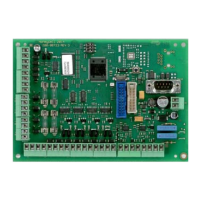
- Input/Output Configurations: Selectable via a 7-position DIP switch on the PC board. This allows customization of which inputs control which outputs, and whether outputs are Class A or Class B.
- Synchronization: Supports synchronized outputs for AMSECO, Faraday, Gentex, System Sensor, and Wheelock appliances. For synchronization, Input 1 serves as the strobe input and Input 2 as the audible input, both requiring DC signals.
- ANSI Temporal Code: Provides configuration options for ANSI temporal-coded outputs from a constant input signal.
- Loss of AC Delay: Configurable delay for reporting loss of AC (normal is 3 hours, test mode is immediate).
- Auxiliary Output Control: Auxiliary power can be set to be always on or to shut down 30 seconds after AC power loss to conserve battery.
- Trouble Indication: LEDs on the board indicate fault conditions for each NAC (OUT1-OUT4), auxiliary power (AUX), earth fault (FLT), low battery (BATT), and AC power status (AC).
Maintenance Features:
- Annual Inspection: The unit should be inspected at least once per year for proper operation.
- Output Voltage Test: Check DC output voltage under normal load conditions.
- Battery Test: Under normal load, ensure the battery is fully charged and check voltage at battery terminals and board terminals. Replace batteries every five years or less as necessary.
- Troubleshooting LEDs: Eight LEDs provide visual indication of fault conditions, including overcurrent on outputs, auxiliary power trouble, earth ground fault, low AC, and low battery.
- Trouble Conditions Table: A detailed table explains various trouble conditions (Low AC, Low Battery, Earth Ground Fault, Power Limit At AUX, Power-limited OUTPUT, EOL supervision trouble) and their corresponding effects and restoration conditions.
- Control Panel Removal/Replacement: Instructions are provided for safely removing and replacing the control panel, emphasizing the use of a grounding strap for static-sensitive components and proper heat sink screw installation for thermal management.

 Need help?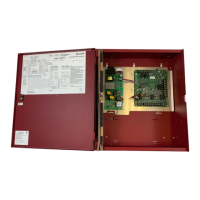


 To Next Page
 General