
 Need help?
Do you have a question about the Honeywell North 5500 and is the answer not in the manual?
Employees are responsible for cleaning and disinfecting respirators for their exclusive use.
Respirators must be cleaned and disinfected as often as necessary to maintain sanitary conditions.
Details on approved cleaning wipes (3M 504, Sani-Cloth AF3) and drying procedures.
Remove HEPA filters from connectors and discard if soiled, wet, or if breathing becomes difficult.
Inspect headbands for wear and check elastomer/rubber parts for pliability and deterioration.
Remove inhalation connectors, valves, headband assembly, exhalation valve guard, and seat from facepiece.
Wash components in cleaner/sanitizer solution, then rinse thoroughly in warm water and air dry.
Reassemble the facepiece by following disassembly steps in reverse order, including filter installation.
Place filter seams on respirator seams and turn the filter clockwise while holding the respirator.
Wrap the strap with the knot clockwise around the filter, expand the loop, and pull it down over the filter.
Adjust the nose-wing shaper to fit over the valve for a proper seal.
Children's masks are recommended for easier handling and better fit with the respirator.
This document provides instructions for the North 5500 Air-Purifying Respirator, covering its cleaning, maintenance, and the attachment of a children's mask for enhanced protection.
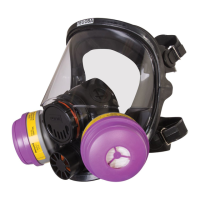
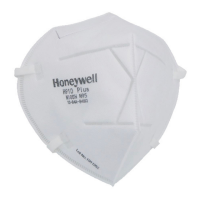
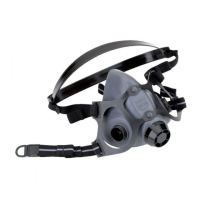
The North 5500 Air-Purifying Respirator is a personal protective device designed to filter airborne particles and gases, providing respiratory protection to the wearer. It is a half-mask respirator, meaning it covers the nose and mouth, and features two replaceable HEPA filters, typically purple in color, which are attached to connectors on either side of the facepiece. The respirator is secured to the wearer's head by an adjustable headband assembly, ensuring a snug and effective seal. The facepiece itself is made of an elastomer material, designed for comfort and durability. The respirator is equipped with inhalation valves, which allow air to enter through the filters, and an exhalation valve with a guard, which releases exhaled air.
For optimal performance and hygiene, the respirator requires regular cleaning and maintenance. Employees are responsible for cleaning and disinfecting their assigned respirators after each use. This involves wiping down the exterior of the mask with a respirator-specific wipe, such as 3M 504 Respirator Cleaning Wipes or Sani-Cloth AF3 (Gray Lids). If Sani-Cloth AF3 wipes are used, the respirator must be allowed to air dry for three minutes. It is crucial to wear appropriate personal protective equipment (PPE), including gloves and eye protection, during the cleaning process. Before donning the respirator after cleaning, it should be inspected for any wetness.
If the facepiece becomes visibly soiled, a more thorough cleaning procedure is required, involving disassembly and immersion cleaning. The first step in this process is to remove the HEPA filters from their connectors. These filters should be discarded and replaced if they are visibly soiled, wet, or if breathing becomes difficult while using them. Next, the headband assembly should be inspected for any signs of wear, and all elastomer and rubber parts should be checked for pliability and signs of deterioration.
Further disassembly involves removing several components from the facepiece: the facepiece inhalation connectors, inhalation valves, headband assembly, exhalation valve guard, exhalation valve, and the exhalation valve seat. The inhalation valves are also to be removed from their respective inhalation connectors. Once disassembled, a cleaning/sanitizer solution, such as North part number 80922, should be prepared according to its specific instructions. The facepiece and all its components are then washed in this cleaning solution.
Thorough rinsing is paramount after washing. All components must be rinsed completely in clean, warm water and then air-dried in a clean area. The manual emphasizes that the importance of thorough rinsing cannot be overstated, as detergents or disinfectants left to dry on the facepieces can lead to dermatitis. Additionally, some disinfectants, if not completely removed, may cause deterioration of the rubber parts of the respirator.
Before reassembly, the exhalation valve should be visually inspected for any damage or wear. If any damage or wear is evident, the valve must be replaced. Reassembly of the facepiece follows the disassembly steps in reverse order. This includes installing the inhalation valves into the inhalation connectors, followed by installing the facepiece inhalation connectors, inhalation valves, headband assembly, exhalation valve guard, exhalation valve, and the exhalation valve seat back into the facepiece. Finally, the headband assembly should be inspected for wear, and all elastomer and rubber parts checked for pliability and signs of deterioration.
After cleaning and reassembly, the HEPA filters are reattached to the respirator. This involves aligning the seams of the filter with the seams on the respirator's connectors. Once aligned, the filter is turned clockwise while holding the respirator firmly, securing it in place.
The document also suggests an additional usage feature: attaching a children's mask to the respirator for enhanced protection. To do this, the strap of the children's mask, specifically the part with a tied knot, is wrapped clockwise around the filter of the respirator. Once the strap reaches the top of the filter, the loop of the mask's ear strap is expanded and then pulled down over the filter, securing the children's mask in front of the respirator's filter. It is noted that the nose-wing shaper of the children's mask may need to be adjusted to fit over the respirator's valve. The manual recommends using children's masks for this purpose, if possible, as they are generally easier to handle and fit the respirator better than adult masks.
 General
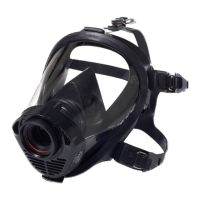
| Product Type | Full Facepiece Respirator |
|---|---|
| Material | Silicone |
| Exhalation Valve | Yes |
| Facepiece Material | Silicone |
| Lens Material | Polycarbonate |
| Communication Diaphragm | Yes |
| Size Options | Large |
| Standards | NIOSH 42 CFR 84 |
| NIOSH Approval | Yes |
| Head Harness | 5-point harness |
| Applications | Industrial |





 To Next Page