
 Need help?
Do you have a question about the Honeywell R7426A and is the answer not in the manual?
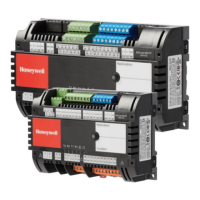
The Honeywell R7426A,B,C,D Temperature and Universal Input Controllers are time-independent controllers designed for precise management of HVAC systems. These devices leverage direct digital control technology to ensure accurate and efficient operation.
The R7426A,B,C Temperature Controllers are primarily used for heating, ventilation, and air conditioning (HVAC) systems. They offer proportional (P) or proportional plus integral (P+I) control, covering a wide range of space, supply air, or water flow applications. These controllers are compatible with standard Pt 1000 or NTC 20K ohm temperature sensors.
The R7426D Universal Input Controller is designed for space or discharge air humidity control and other special applications, such as pressure control, using 0 to 10 Vdc input ranges. It provides input span adjustment to match various transmitter output specifications.
All models feature selectable control actions: proportional, proportional plus integral (P+I), or (for R7426D only) proportional plus integral plus derivative (P+I+D) control. They come with pre-programmed control parameters for plug-and-play operation and offer digital parameter setting. Outputs can be configured for direct or reverse action, and the controllers operate on a 24 Vac power supply.
These models include three inputs for temperature sensors, with automatic identification of Pt 1000 or NTC 20K ohm types. They also have three digital inputs for plant/system On/Off, occupancy (which can also serve as summer/winter changeover), and freeze protection. Dehumidification control is possible via a humidity deviation input.
Output functions are highly versatile, offering selectable floating output, 2, 3, 4, 6, or 15 stage On/Off (TRIAC) control, pulse width modulation (PWM), and analog outputs selectable between 0/2 to 10Vdc. The controllers incorporate a start-up routine and support space/supply limit or cascade control. They can manage sequence control for heating, mixed air dampers or energy recovery systems, and cooling.
The R7426D model provides two analog inputs for transmitters, allowing for master/submaster cascade control or main and optional high/low limit control. It includes a temperature compensation input for main setpoint reset and an analog output for deviation signals. Control output monitoring and manual output signal override are also available.
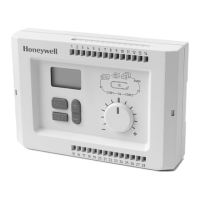
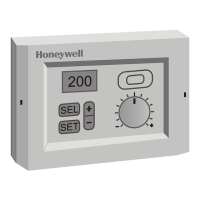
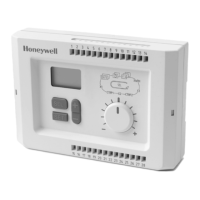
The controllers are designed with an easy-to-operate user interface and an LCD, providing flexibility in control system design, accurate parameter setting, and clear display of actual temperature values, setpoints, and outputs.
The control or setpoint can be adjusted using an internal or external potentiometer connected to the CPA/SPA input. The type of CPA/SPA is selected via the CPATYP control parameter.
To compensate for offsets caused by long wiring lengths, the temperature sensor inputs (I01, I02, and I03) can be individually adjusted using the I01CAL, I02CAL, and I03CAL parameters.
Users can access parameter selection mode by pressing and holding the + and - buttons. Parameters can be scrolled through using +, and SET is used to enter adjustment mode. Values are adjusted with + and -. Changes are saved to EEPROM with SET, or discarded with SEL.
In standard display mode, one of six actual values (e.g., main sensor, main setpoint, limit/cascade setpoint, humidity deviation, or outputs) can be selected and displayed by pressing SEL.
This mode is particularly useful during installation and setup. Users can display output data selection mode by pressing and holding SET and SEL. Desired parameters are selected with +, and SET enters adjustment mode. Outputs are adjusted with + and -. SET saves the output, while SEL discards changes. To disable manual override, users repeat the selection process and press and hold + and - until rEL is displayed. All overrides should be disabled before exiting manual override.
After power-up, the controller version is displayed, followed by the standard display mode. The R7426A,B,C models have four control modes (Off, Night, Unoccupied, Occupied), while the R7426D has Off and On modes (On is represented by the Occupied icon).
Economizer modes are suitable for installations where the main temperature sensor (I01) is in exhaust air or a room with a constant offset to exhaust air. The RetOffs parameter allows programming an offset value (0°F to 9°F) to simulate exhaust air conditions. Economizer mode is disabled if RetOffs is Off or no OAT sensor is connected.
When the I03 sensor is connected, outside air temperature compensation is performed. The Wcomp parameter defines the summer and winter changeover point, while Wi and Su define the degree of compensation. A smoothing filter for OAT input I03 is incorporated to eliminate sudden temperature variations, providing more stable control.
The occupancy input can be used for summer/winter changeover by setting the DIR/REVO1 control parameter to Cho (R7426A only). A potential-free contact between terminals 1 and 4 switches the controller mode between heating (contact open) and cooling (contact closed).
The controllers include freeze protection. When the contact connected to the freeze protection input is opened, specific actions are executed (e.g., output 01 to 0% for Dir, 100% for Rev). A closed contact initiates frost recovery. Freeze protection takes priority over all other control operations.
Runtimex parameter. An automatic synchronization function ensures correct actuator positioning by periodically running actuators to the closed position.Runtimex.OMode settings.If OMode is 4, output signal 01 operates as two-position control: 100% when On/Off input is On, 0% when Off. The start-up routine must be disabled for this function.
Three dc output control signals are provided for controlling actuators for valves, dampers, or pneumatics. The full output range is 0 to 12 Vdc, software configurable to 2 to 10 Vdc or 0 to 10 Vdc using the ORange parameter.
All parameter values can be reset to default settings. This is done by pressing and holding the + and - buttons during power up until the display flashes dEF. The R7426D also has a DefProg (C.23) parameter that, when set to 1, resets parameter values to default.
After approximately 10 minutes of inactivity (no buttons pressed), the controller automatically returns to standard display mode. Inputs not confirmed by the SET button are discarded, and old parameter values are retained.
Improper sensor inputs trigger error messages to flash on the display, indicating issues such as incorrect main sensor input, no input to a sensor, or incorrect humidity deviation input.
The manual emphasizes careful reading of instructions, checking product ratings for suitability, and installation by a trained, experienced service technician. Post-installation, product operation should be checked.
The manual provides detailed wiring diagrams and instructions, including stripping wire insulation and inserting wires into terminals. It highlights the importance of disconnecting power supply before installation to prevent electrical shock or equipment damage. All wiring must comply with applicable codes, ordinances, and regulations.
The manual provides detailed information on all configuration parameters, including their purpose and how they affect control functions. This allows for precise tuning and troubleshooting.
A start-up routine is provided for R7426B,C controllers to prevent start-up problems. Enabling this routine by setting the Startup parameter to On ensures that, after power-up or an On/Off input signal change to On, the outdoor air and exhaust air damper (O1) will stay in the closed position (0 percent) for approximately 5 minutes before switching to normal operation.
The Adr parameter sets the serial communication address, which is used for controller start-up, service, or maintenance purposes through the bus.
 General
| Output | Flame Relay |
|---|---|
| Power Supply | 24 VAC |
| Temperature Range | -40°C to 65°C |
| Humidity Range | 0% to 95% RH (non-condensing) |
| Weight | 0.5 lb |




 To Next Page
