EasyManua.ls Logo

Honeywell RV8310D - User Manual

Honeywell RV8310D
8 pages
Print Icon
To Next Page IconTo Next Page
Loading...
® U.S. Registered Trademark
Copyright © 2001 Honeywell • All Rights Reserved
INSTALLATION INSTRUCTIONS
66- 1106- 2
RV8310D,E
Millivolt Receiver/
Modulating Gas Valve
APPLICATION
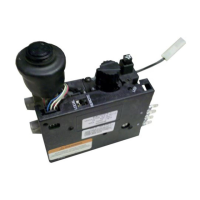
The RV8310D,E Millivolt Receiver/Modulating Gas Valve
is powered by thermopile generators and has a 60,000
Btuh capacity (1 in. pressure drop for straight-through
configuration). The design makes it ideal for vented
fireplace and space heating applications. The RT8220A
Transmitter is used with this product.
SPECIFICATIONS
Main Gas Connection:
Valve: 3/8 in. NPT thread.
Pilot Gas Connection and Flow:
Connection Size: 7/16-24 UNS.
Flow: 1700 Btuh at 4.0 in. wc pressure drop.
Thermopile Generator:
Q313 with 1/4 in. (6 mm)
quick connect or spade terminals.
Ambient Temperature Range:
0°F to 175°F (-18°C to +79°C).
Pressure Settings:
Natural gas: 3.5/1.7 in. wc typical.
Liquid propane (LP): 10.0/6.3 in. typical.
NOTE: Both high and low settings are fixed.
European Pressure Tap:
For both inlet and outlet
pressure a check can be done by turning a captive
screw and using a plastic tube at the test point.
Voltage:
RV8310D,E: The system uses two Q313 thermopile
generators. Each generator must have a minimum of
500 mV in open circuit under all operating conditions.
Contact Honeywell for test procedure.
Fan Connection:
120 Vac, 50/60 Hz, 2A maximum;
1/4 in. spade terminals.
Approvals:
CSA International certificate
158158-250000102.
Accessories:
396206-1 Natural Gas Conversion Kit.
396206-2 LP GAs Conversion Kit.
INSTALLATION
When Installing this Product...
1.
Read these instructions carefully. Failure to
follow them could damage the product or cause
a hazardous condition.
2.
Check the ratings given in the instructions and on
the product to make sure the product is suitable for
your application.
3.
Installer must be a trained, experienced service
technician.
4.
After installation is complete, check out product
operation as provided in these instructions.
WARNING
Oxygen Depletion Hazard.
Can cause injury or death due
to asphyxiation.
Use only vented gas valve models on vented
appliances. Use only unvented gas valve models
on unvented appliances.
WARNING
Fire or Explosion Hazard.
Can cause property damage,
severe injury or death.
Follow these instructions exactly:
1.
Turn off gas supply at the appliance service
valve before starting installation, and perform
a Gas Leak Test after the installation is
complete.
2.
Always install the sediment trap in the gas
supply line to prevent contamination of the
gas valve.
3.
Do not force the gas valve control knob.
Use only your hand to turn the control knob.
If the knob does not operate by hand, the
valve should be replaced by a qualified
service technician.

Question and Answer IconNeed help?

Do you have a question about the Honeywell RV8310D and is the answer not in the manual?

Overview

The Honeywell RV8310D,E is a Millivolt Receiver/Modulating Gas Valve designed for use in vented fireplace and space heating applications. It operates on power supplied by thermopile generators and is compatible with the RT8220A Transmitter.

Function Description

The RV8310D,E gas valve controls the flow of gas to the main burner and pilot. It features a modulating function, allowing for variable flame output, and includes a receiver for remote control via a compatible transmitter. The valve is designed to work in a self-generating power system, utilizing the millivolt output from two Q313 thermopile generators.

Important Technical Specifications

  • Capacity: 60,000 Btuh (at 1 in. pressure drop for straight-through configuration).
  • Main Gas Connection: 3/8 in. NPT thread.
  • Pilot Gas Connection: 7/16-24 UNS, with a flow of 1700 Btuh at 4.0 in. wc pressure drop.
  • Thermopile Generator: Uses two Q313 thermopile generators, each requiring a minimum of 500 mV in open circuit under all operating conditions. Connections are 1/4 in. (6 mm) quick connect or spade terminals.
  • Ambient Temperature Range: 0°F to 175°F (-18°C to +79°C).
  • Pressure Settings (fixed):
    • Natural Gas: 3.5/1.7 in. wc typical.
    • Liquid Propane (LP): 10.0/6.3 in. wc typical.
  • Fan Connection: 120 Vac, 50/60 Hz, 2A maximum; 1/4 in. spade terminals.
  • Approvals: CSA International certificate 158158-250000102.
  • Conversion Kits:
    • 396206-1 Natural Gas Conversion Kit (for RV8310E).
    • 396206-2 LP GAS Conversion Kit (for RV8310E).
    • Note: The RV8310D is not convertible between natural gas and LP. The RV8310E is convertible.

Usage Features

  • Installation:
    • Requires careful reading of instructions to prevent damage or hazardous conditions.
    • Installation must be performed by a trained, experienced service technician.
    • A sediment trap must always be installed in the gas supply line to prevent contamination.
    • The valve can be mounted 0 to 90 degrees in any direction, including vertically, from the upright position of the gas control knob.
    • Gas flow direction must align with the arrow on the side of the valve.
    • Pipe compound (not Teflon tape) should be applied to pipe only, leaving two end threads bare. For LP installations, use LP-resistant compound.
    • Protective seals over inlet and outlet tappings should not be removed until ready to connect piping.
  • Wiring:
    • All wiring must comply with applicable electrical codes and ordinances.
    • Power supply must be disconnected before making wiring connections.
    • White leads of the thermopile connect to terminals with white dots.
    • This valve is exclusively for self-generating power systems.
  • Fuel Conversion (RV8310E only):
    • Involves removing the motor cover, pushing down and rotating the gas selector to align arrows with the appropriate colored screw (red for LP, blue for natural gas), inserting the corresponding fuel conversion plug (red for LP, blue for natural gas), attaching the conversion label, and replacing the motor cover.
    • The high and low outlet pressure settings are fixed and cannot be changed during conversion.
  • Operation:
    • Lighting the Pilot: Turn the gas control knob counterclockwise to PILOT, push down and hold, then push the piezo plunger until the pilot burner lights. The LED on the control will blink continuously after approximately 60 seconds. Release the knob.
    • Turning on Main Burner: Turn the gas control knob counterclockwise to ON. If the manual switch is in LOCAL position, the main burner turns on immediately.
    • Remote Control (with RT8220A Transmitter): For initial use, a recognition operation is required: Turn the gas control knob to PILOT, move the LOCAL/REMOTE switch to LOCAL for at least two seconds, then to REMOTE. Press the FAN or FLAME button on the transmitter within 30 seconds. The LED will blink, indicating transmitter functionality.
    • Modulation: When in REMOTE position, the RT8220A Transmitter controls the main valve, flame modulation level, and fan. In LOCAL position, the receiver/valve operates at the highest fixed pressure setting.
    • Shut-Off: Turn the gas control knob clockwise to OFF. This closes the main gas and safety valves, preventing the transmitter from turning on the main burner or fan.
  • Pilot Flame Adjustment: The pilot flame should envelop 3/8 to 1/2 in. (10 to 13 mm) of the thermocouple or igniter-sensor tip. Adjustment is made by removing the pilot adjustment cap screw and turning the inner adjustment screw. The cap screw must be replaced and tightened firmly after adjustment.

Maintenance Features

  • General: Regular preventive maintenance is crucial, especially in applications with heavy loads or exposure to water, dirt, chemicals, and heat.
  • Inspection Frequency:
    • Cycling frequency: Appliances cycling 20,000 times annually should be checked monthly.
    • Intermittent use: Appliances used seasonally should be checked before shutdown and again before the next use.
    • Consequence of unexpected shutdown: Systems where a shutdown would be costly should be checked more often.
    • Environment: In dusty, wet, or corrosive environments, the system should be checked more often due to accelerated deterioration of the gas valve.
  • Gas Leak Test:
    • Performed by painting pipe connections with a rich soap and water solution; bubbles indicate a leak.
    • Must be done upstream of the gas valve, and also on pipe joints (including adapters) and valve inlet/outlet with the main burner operating.
    • Tighten connections if leaks are found; replace parts if leaks cannot be stopped.
  • Checking Gas Input:
    • Can be done by clocking the gas meter (ensuring no other gas flow) and converting the flow rate to Btuh, then comparing to the appliance's input rating.
    • Can also be checked with a manometer at the inlet and outlet pressure taps (which have captive screws).
  • Safety Shutdown Performance Test:
    • Place the gas control knob in PILOT position (main burner off, pilot lit).
    • Extinguish the pilot flame. The pilot gas flow should stop within thirty seconds, proving complete shutdown.
    • Relight the pilot burner and operate the system through one complete cycle to ensure all controls function properly.
  • Prohibitions:
    • Do not attempt to disassemble or repair the gas valve; it contains no replaceable components. Improper assembly can cause unreliable operation.
    • Do not force the gas control knob. If it doesn't operate by hand, the valve must be replaced by a qualified service technician.

    • The gas valve must be replaced if it was flooded with water or shows any physical damage (bent terminals, missing/broken parts, stripped threads, or heat exposure).
    • Do not clean the gas valve.
    • Any valve not performing properly on checkout or service should be replaced.
    • Any module that is wet or appears to have been wet should be replaced.

Honeywell RV8310D Specifications

General IconGeneral
BrandHoneywell
ModelRV8310D
CategoryReceiver
LanguageEnglish

Related product manuals