EasyManua.ls Logo

Horton S200 - User Manual

Horton S200
4 pages
Print Icon
To Next Page IconTo Next Page
Loading...
Door panels and
header not shown
for clarity
Re-position the close monitor switch. Re-tighten the belt.
Slide 2 square head bolts into the "T"
slot in the top of the header.
Place the bolts in the center of the header.
Access is gained through relief holes
cut in the "T" slot.
(additional relief holes may be cut if required)
•Place the Autolock at the centerline of the header and mount
with 5/16" nuts and washers (do not tighten).
•Place the door in the fully closed position - the lock should
contact the keepers with out binding.Tighten the 5/16"(2003) or 3/8"(2001) nuts.
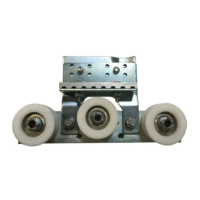
Install the brackets to the wheel
carriages as shown
7th Step
Fail secure
top view locked
SOLENOIDSOLENOID
5th Step
Fail
safe
2003
Fail
secure
2003
See page 4 for
Autolock setup
9th Step
Re-connect the belt through
the existing holes.
6th Step
2003 lock is shown
2001 lock is similar
8th Step
2003
Keepers
top view locked
SOLENOID
Fail safe
Lock hooks
L
C
2.205d
2001
First slot
Autolock Installation for 2001 & 2003 Bipart units
BELT DRIVE SUPPLEMENTAL INSTRUCTIONS
2nd Step
Loosen the belt.
Remove the belt connections
3rd Step
NOTE: If necessary the existing bracket
may be drilled and countersunk for #10
screws as shown.
CAUTION:
Disconnect power before
starting this procedure.
•Remove the old belt brackets
•Install the keepers on the new belt brackets
with countersunk holes using 4 #10 FHMS
4th Step
If the wheel carriages are located at the 9 1/2" position
they must be moved to the 4 7/16" position
1st Step
1-800-531-3111
1/2"
13/64"
1"
1/2"
2003
2001
3/16"
1"
3/8"
1/2"
2001
Loosen bolts (on the pully bracket)
and remove belt tension by backing
off the idler pully lock.
Loosen bolts and
slide idler
2003
S200
10/99
Question and Answer IconNeed help?

Do you have a question about the Horton S200 and is the answer not in the manual?

Summary

Autolock Installation for 2001 & 2003 Bipart Units

1 st Step: Position Wheel Carriages

Adjust wheel carriages to the 4 7/16" position if currently at 9 1/2".

2 nd Step: Loosen Belt and Idler

Loosen the belt and slide the idler to remove belt tension.

3 rd Step: Remove Belt Connections

Disconnect the belt from its current connections.

4 th Step: Install New Belt Brackets

Remove old brackets and install new ones with keepers using FHMS screws.

5 th Step: Mount Brackets to Carriages

Attach the newly installed brackets to the wheel carriages.

6 th Step: Reconnect Belt

Thread the belt through the existing holes to reconnect it.

7 th Step: Insert Header Mounting Bolts

Slide two square head bolts into the 'T' slot in the top of the header.

8 th Step: Mount Autolock Unit

Position Autolock at header centerline and mount with nuts/washers.

9 th Step: Adjust Monitor Switch & Belt

Reposition the close monitor switch and re-tighten the belt.

Autolock Installation for 2001 & 2003 O-SX Units

1 st Step: Mark Door Position

Open door fully, mark position, and note idler movement beyond this point.

2 nd Step: Position Belt Idler

Move the idler to the end of the header, allowing space for tightening.

3 rd Step: Adjust Drive Assembly & Mount Keeper

Dismount carriages, move drive assembly back, idler front, mount keeper.

4 th Step: Install and Tension New Belt

Install a new continuous belt, make splice, and tension it.

5 th Step: Mount Autolock and Switch

Mount the autolock and relocate the closed monitor switch.

Autolock Installation for 2001 & SX-O Units

1 st Step: Remove Existing Belt

Disconnect and remove the current belt; a new belt will be installed later.

2 nd Step: Adjust Drive Assembly & Keeper

Dismount carriages, move drive assembly back, idler front, and mount keeper.

3 rd Step: Reposition Power Supply

Dismount the power supply and reposition it to the left of the control.

4 th Step: Relocate Components to Header End

Move power supply, control, and motor to the right end of the header.

5 th Step: Install and Tension New Belt

Install new continuous belt, make splice connection, and tension.

6 th Step: Mount Autolock and Switch

Mount the autolock and relocate the closed monitor switch.

Autolock Setup & Initialization

Initialization Procedure

Press SET and RESET simultaneously, release RESET, wait 5s, release SET.

Fail Secure Configuration

Checks contact at lock port CN4 and yellow lock monitor LED being off.

Fail Safe Configuration

Checks contact at lock port CN4 and yellow lock monitor LED being on.

Solenoid Response Check

Control sends pulse to retract solenoid; response indicates lock status.

Overview

This document provides supplemental instructions for installing an Autolock system on Horton automatic belt drive doors, specifically for 2001 and 2003 Bipart, O-SX, and SX-O units. It covers the mechanical installation of the Autolock hardware and the electrical setup and initialization of the control unit.

Function Description:

The Autolock system is designed to provide enhanced security for automatic sliding doors by mechanically locking the door in the closed position. It integrates with the door's control system to ensure proper operation and includes features for both "fail secure" and "fail safe" configurations, determining the lock's state during power failure. The system involves modifying existing belt drive components, installing new brackets and keepers, and connecting a solenoid-driven locking mechanism to the door's control unit.

Important Technical Specifications:

  • Compatibility: Designed for Horton 2001 and 2003 Bipart, O-SX, and SX-O belt drive units.
  • Mounting Hardware: Utilizes #10 FHMS screws for keepers, 5/16" nuts and washers for 2003 units, and 3/8" nuts and washers for 2001 units.
  • Electrical Connections: Connects to CN4 on the control board. Incoming 120VAC may require additional length, and a 5-conductor lace may also need additional length for certain configurations (SX-O units).
  • Lock Monitoring: Features "LOCK (Orange)" and "LOCK MON (Yellow)" LEDs on the control board for status indication.
  • Solenoid Operation: The system uses a solenoid to retract the lock. The control sends a pulse to activate the solenoid.
  • Fail Secure/Fail Safe Jumpers: Jumpers on the control board determine the lock's behavior during power failure:
    • Fail Secure: The lock remains locked when power fails.
    • Fail Safe: The lock unlocks when power fails.

Usage Features:

  • Installation Steps: The instructions are broken down into sequential steps, starting with initial door preparation and progressing through mechanical installation, belt adjustments, and electrical setup.
  • Clear Diagrams: Detailed diagrams illustrate each step, showing component placement, bolt locations, and electrical connections.
  • Safety Precautions: A prominent "CAUTION: Disconnect power before starting this procedure" warning is included at the beginning of each section to ensure installer safety.
  • Autolock Setup & Initialization: A dedicated section explains how to set up and initialize the Autolock control unit, including pressing SET and RESET buttons, releasing them in sequence, and observing the version number display. This process clears all ports and deactivates the solenoid.
  • Lock Status Monitoring: The control unit provides visual feedback through LEDs (Orange for LOCK, Yellow for LOCK MON) to indicate the lock's status.
  • Troubleshooting Information: The document references H202 Rev. 9/99 for further information and troubleshooting Autolocks, suggesting additional resources for installers.
  • Configuration Flexibility: The ability to select "fail secure" or "fail safe" operation via jumpers allows the system to be adapted to different security requirements.
  • Mechanical Adjustments: Instructions include precise measurements for repositioning wheel carriages (e.g., from 9 1/2" to 4 7/16") and guidance on loosening/tightening belts and idlers.
  • Component Relocation: For O-SX and SX-O units, the instructions detail the relocation of the drive assembly, idler, power supply, control, and motor to accommodate the Autolock system.

Maintenance Features:

  • Belt Tensioning: Instructions emphasize proper belt tensioning after installation, which is crucial for the door's smooth operation and the longevity of the belt.
  • Close Monitor Switch Repositioning: The close monitor switch needs to be repositioned and re-tightened as part of the installation, ensuring accurate door position sensing.
  • Component Inspection: While not explicitly detailed as maintenance, the installation process involves inspecting existing components (e.g., drilling and countersinking existing brackets if necessary), which can highlight potential wear or issues.
  • Troubleshooting Guide Reference: The reference to H202 Rev. 9/99 implies that a separate troubleshooting guide is available, which would be essential for diagnosing and resolving any issues that arise during or after installation.
  • Solenoid Response Check: The initialization process includes checks for solenoid response, which can help verify the proper functioning of the locking mechanism. If there's no response, the system indicates that no lock is detected.
  • LED Indicators: The LOCK and LOCK MON LEDs serve as diagnostic tools, providing immediate visual feedback on the lock's operational status, which can aid in troubleshooting.

Horton S200 Specifications

General IconGeneral
BrandHorton
ModelS200
CategoryIndustrial Equipment
LanguageEnglish