EasyManua.ls Logo

HP 203A - Adjustments; Frequency Dial Adjustment; Modulator (A3) Adjustment; Frequency Response

HP 203A
68 pages
Print Icon
To Next Page IconTo Next Page
To Previous Page IconTo Previous Page
Loading...
Section
У
Paragraphs
5-19
to
5-23
and
Table
5-4
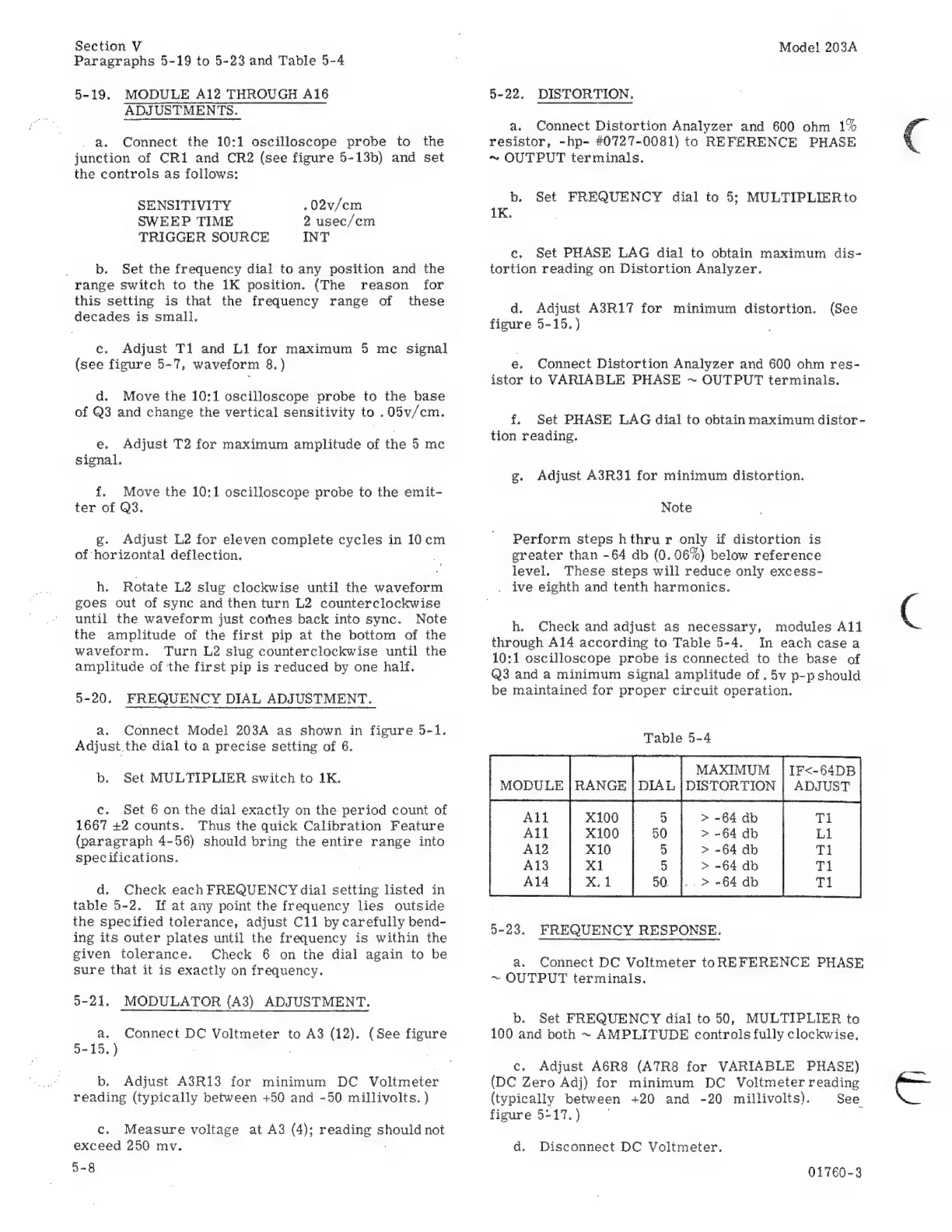
5-19.
MODULE
А12
THROUGH
А16
ADJUSTMENTS.
==
Connect
the
10:1
oscilloscope
probe
to
the
баси
of
СВІ
and
CR2
(see
figure
5-13b)
and
set
the
controls
as
follows:
SENSITIVITY
.02v/em
SWEEP
TIME
2
usec/em
TRIGGER
SOURCE
INT
b.
Set
the
frequency
dial
to
any
position
and
the
range
switch
to
the
1K
position.
(The
reason
for
this
setting
is
that
the
frequency
range
of
these
decades
is
small.
с.
Adjust
ТІ
and
L1
for
maximum
5
me
signal
(see
figure
5-7,
waveform
8.)
d.
Move
the
10:1
oscilloscope
probe
to
the
base
of
Q3
and
change
the
vertical
sensitivity
to
.
Обу/ст.
e,
Adjust
T2
for
maximum
amplitude
of
the
5
mc
signal.
f.
Move
the
10:1
oscilloscope
probe
to
the
emit-
ter
of
Q3.
є.
Adjust
L2
for
eleven
complete
cycles
in
10
ст
of
horizontal
deflection.
h.
Rotate
L2
slug
clockwise
until
the
waveform
goes
out
of
sync
and
then
turn
L2
counterclockwise
until
the
waveform
just
comes
back
into
sync.
Note
the
amplitude
of
the
first
pip
at
the
bottom
of
the
waveform.
Turn
L2
slug
counterclockwise
until
the
amplitude
of
the
first
pip
is
reduced
by
one
half.
9-20.
FREQUENCY
DIAL
ADJUSTMENT.
a.
Connect
Model
203A
as
shown
in
figure
5-1.
Adjust
the
dial
to
a
precise
setting
of
6.
b.
Set
MULTIPLIER
switch
to
1K.
c.
Set
6
on
the
dial
exactly
on
the
period
count
of
1667
+2
counts.
Thus
the
quick
Calibration
Feature
(paragraph
4-56)
should
bring
the
entire
range
into
specifications.
d.
Check
each
FREQUENCY
dial
setting
listed
in
table
5-2.
If
at
any
point
the
frequency
lies
outside
the
specified
tolerance,
adjust
С11
by
carefully
bend-
ing
its
outer
plates
until
the
frequency
is
within
the
given
tolerance.
Check
6
on
the
dial
again
to
be
sure
that
it
is
exactly
on
frequency.
9-21.
MODULATOR
(A3)
ADJUSTMENT.
a.
Connect
DC
Voltmeter
to
A3
(12).
(See
figure
5-15.)
|
|
|
b.
Adjust
A3R13
for
minimum
DC
Voltmeter
reading
(typically
between
+50
and
-50
millivolts.
)
c.
Measure
voltage
at
АЗ
(4);
reading
should
not
exceed
250
mv.
5-8
Model
203A
5-22.
DISTORTION.
a.
Connect
Distortion
Analyzer
and
600
ohm
1%
resistor,
-hp-
40727-0081)
to
REFERENCE
PHASE
^
OUTPUT
terminals.
b.
Set
FREQUENCY
dial
to
5;
MULTIPLIER
to
1K.
c.
Set
PHASE
LAG
dial
to
obtain
maximum
dis-
tortion
reading
on
Distortion
Analyzer.
d.
Adjust
A3R17
for
minimum
distortion.
(See
figure
5-15.)
e.
Connect
Distortion
Analyzer
and
600
ohm
res-
istor
to
VARIABLE
PHASE
~
OUTPUT
terminals.
f.
Set
PHASE
LAG
dial
to
obtain
maximum
distor-
tion
reading.
g.
Adjust
A3R31
for
minimum
distortion.
Note
Perform
steps
hthru
r
only
if
distortion
is
greater
than
-64
db
(0.06%)
below
reference
level.
These
steps
will
reduce
only
excess-
.
ive
eighth
and
tenth
harmonics.
h.
Check
and
adjust
as
necessary,
modules
A11
through
А14
according
to
Table
5-4.
In
each
case
a
10:1
oscilloscope
probe
is
connected
to
the
base
of
Q3
and
a
minimum
signal
amplitude
of.
5v
р-р
should
be
maintained
for
proper
circuit
operation.
Table
5-4
MAXIMUM
i|IF«-64DB
MODULE
|
RANGE
|
DIAL
|DISTORTION
|
ADJUST
»
-64
db
»
-64
db
>
-64
db
>
-64
аъ
.
»
-64
db
5-23.
FREQUENCY
RESPONSE.
a.
Connect
DC
Voltmeter
toREFERENCE
PHASE
^
OUTPUT
terminals.
b.
Set
FREQUENCY
dial
to
50,
MULTIPLIER
to
100
and
both
~
AMPLITUDE
controls
fully
clockwise,
с.
Adjust
А6В8
(A7R8
for
VARIABLE
PHASE)
(DC
Zero
Adj)
for
minimum
DC
Voltmeter
reading
(typically
between
+20
and
-20
millivolts).
See
figure
5217.)
|
д.
Disconnect
DC
Voltmeter.
01760-3

Related product manuals