EasyManua.ls Logo

HP 5326A - Period Measurements

HP 5326A
30 pages
Print Icon
To Next Page IconTo Next Page
To Previous Page IconTo Previous Page
Loading...
display’s
least
significant
digit,
which
is
present
in
all
electronic
counters.
This
error
is
due
to
phasing
be¬
tween
the
timing
pulse
that
operates
the
electronic
gate
and
the
pulses
that
pass
through
the
gate
to
the
counting
assembly.
The
chart
in
Figure
3-3
shows
the
error
possible
for
frequency
and
period
measurements.
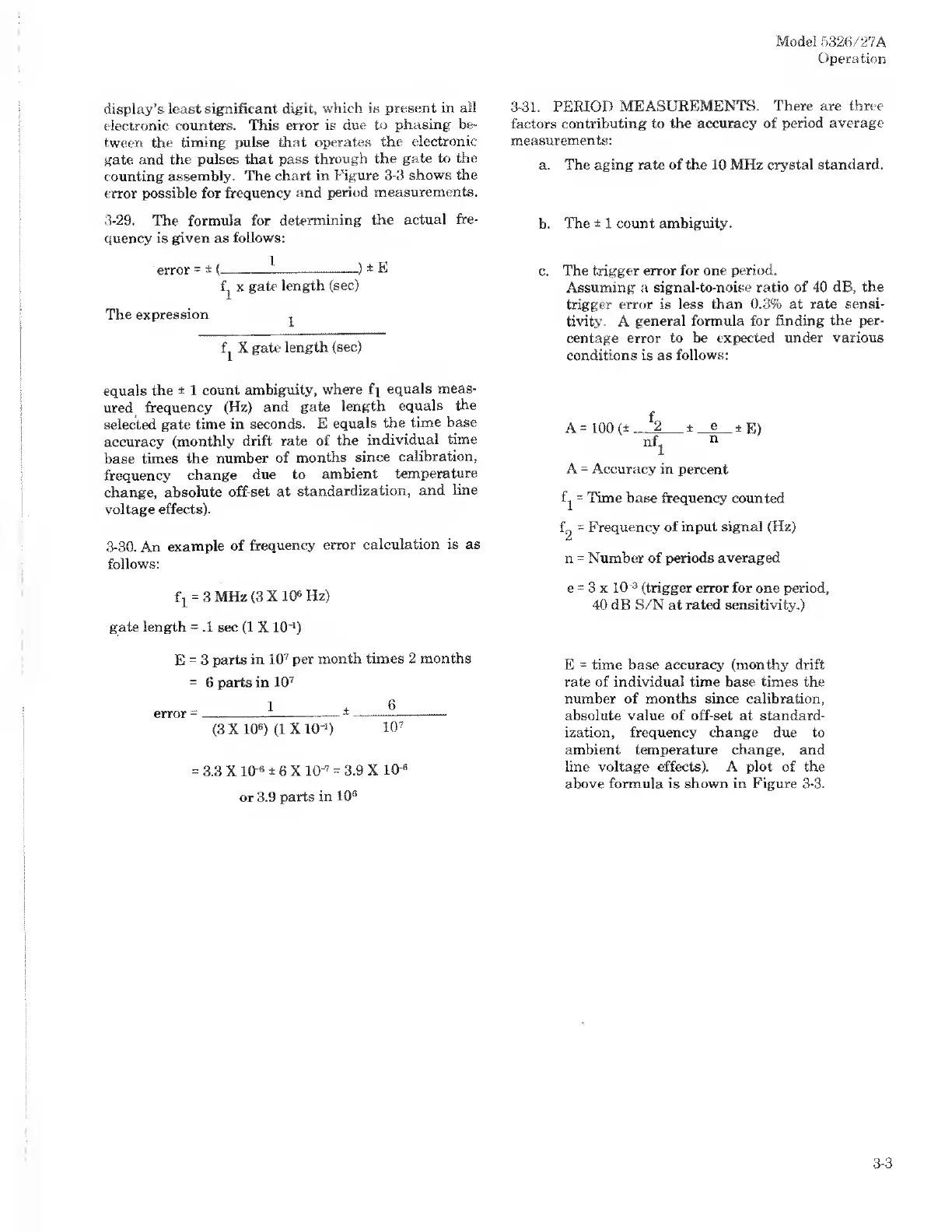
3-29.
The
formula
for
determining
the
actual
fre¬
quency
is
given
as
follows:
error
=
±
(-i-)
±
E
fj
x
gate
length
(sec)
The
expression
j
^
X
gate
length
(sec)
equals
the
±
1
count
ambiguity,
where
f|
equals
meas¬
ured
frequency
(Hz)
and
gate
length
equals
the
selected
gate
time
in
seconds.
E
equals
the
time
base
accuracy
(monthly
drift
rate
of
the
individual
time
base
times
the
number
of
months
since
calibration,
frequency
change
due
to
ambient
temperature
change,
absolute
off-set
at
standardization,
and
line
voltage
effects).
3-30.
An
example
of
frequency
error
calculation
is
as
follows:
f
x
=
3
MHz
(3
X
10
6
Hz)
gate
length
=
.1
sec
(1
X
10'
1
)
E
=
3
parts
in
10
7
per
month
times
2
months
=
6
parts
in
10
7
error
=-*-
(3
X
10
6
)
(1
X
10-
1
)
10
7
=
3.3
X
10-
6
±
6
X
lO"
7
=
3.9
X
10~
6
or
3.9
parts
in
10
c
Model
5326/27A
Operation
3-31.
PERIOD
MEASUREMENTS.
There
are
three
factors
contributing
to
the
accuracy
of
period
average
measurements:
a.
T
he
aging
rate
of
the
10
MHz
crystal
standard.
b.
The
±
1
count
ambiguity.
c.
The
trigger
error
for
one
period.
Assuming
a
signal-to-noise
ratio
of
40
dR,
the
trigger
error
is
less
than
0.3%
at
rate
sensi¬
tivity.
A
general
formula
for
finding
the
per¬
centage
error
to
be
expected
under
various
conditions
is
as
follows:
f
A
=100
2_±
—§—±
E)
nf
n
A
=
Accuracy
in
percent
f^
=
Time
base
frequency
counted
fg
=
Frequency
of
input
signal
(Hz)
n
=
Number
of
periods
averaged
e
=
3
x
10
3
(trigger
error
for
one
period,
40
dB
S/N
at
rated
sensitivity.)
E
=
time
base
accuracy
(monthy
drift
rate
of
individual
time
base
times
the
number
of
months
since
calibration,
absolute
value
of
off-set
at
standard¬
ization,
frequency
change
due
to
ambient
temperature
change,
and
line
voltage
effects).
A
plot
of
the
above
formula
is
shown
in
Figure
3-3.
3-3

Related product manuals