EasyManua.ls Logo

HP 54522A - Page 258

HP 54522A
292 pages
Print Icon
To Next Page IconTo Next Page
To Previous Page IconTo Previous Page
Loading...
Specifications
and
Characteristics
Operating
Characteristics
Effective
Resolution
The
maximum
sample
rate
and
the
number
of
bits
in
an
oscilloscope’s
digitizer
are
too
often
used
for
comparing
oscilloscopes.
These
specifications,
however,
do
not
describe
performance
under
dynamic
signal
conditions.
Effective
Resolution
is
a
figure
of
merit
that
describes
the
digitizing
oscilloscope’s
performance
under
dynamic
conditions,
and
is
measured
using
the
sinewave
curve
fit
test.
This
method
considers:
e
Quantization
error
e
Non-linearities
(including
preamp
and
ADC)
e
System
noise
e
Frequency
of
input
signal
All
of
these
affect
the
effective
resolution
of
the
instrument.
Some
manufacturers
specify
effective
bits
using
half-scale
sinewaves.
While
the
effective
bits
performance
using
half-scale
testing
is
overstated
when
compared
to
full-scale
testing,
Hewlett-Packard
publishes
both
sets
of
numbers
for
the
oscilloscope
so
that,
when
comparing
effective
bits
performance
between
digitizing
oscilloscopes,
a
fair
comparison
can
be
made.
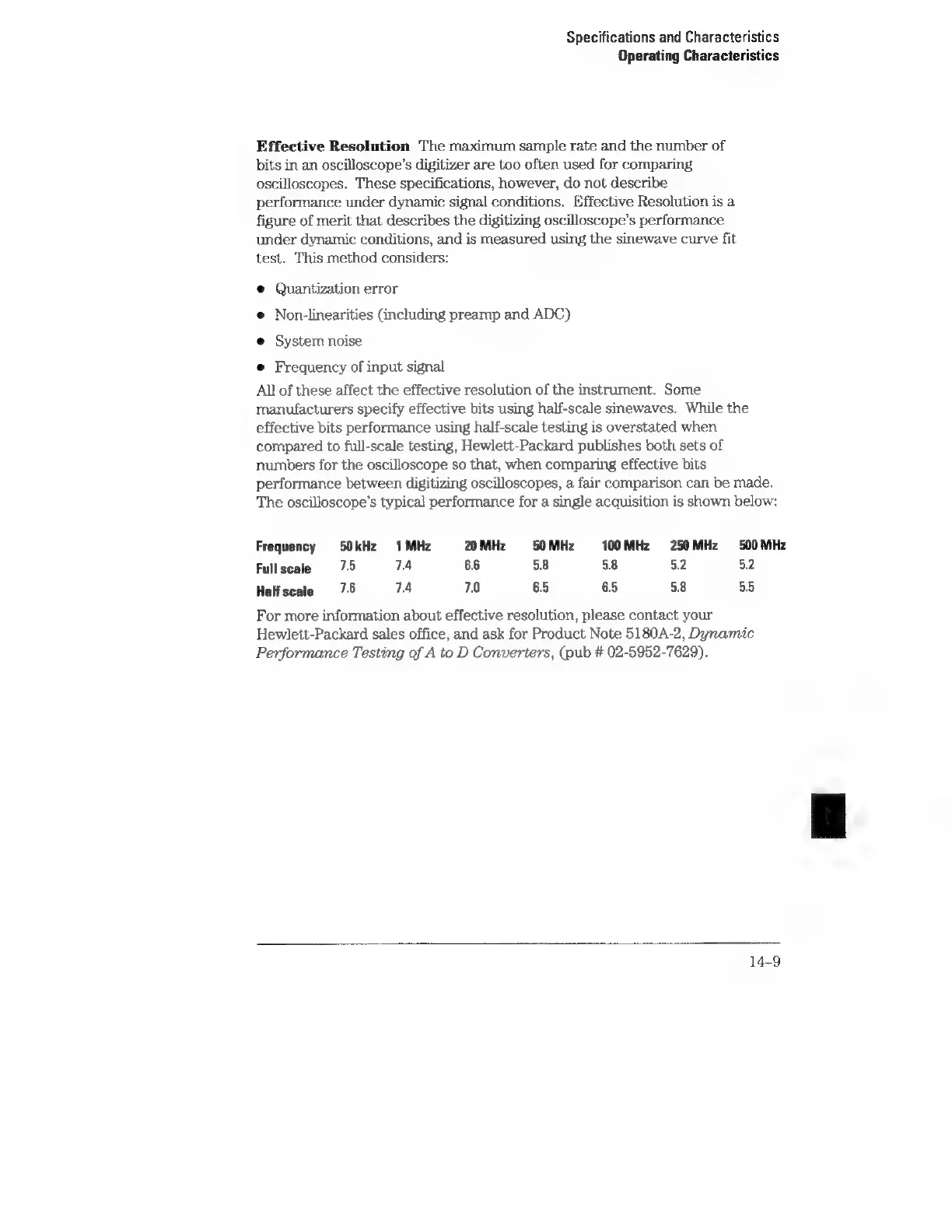
The
oscilloscope’s
typical
performance
for
a
single
acquisition
is
shown
below:
Frequency
50kHz
1MHz
20MHz
50MHz
100MHz
250MHz
500MHz
Full
scale
75
74
6.6 5.8
5.8
5.2
5.2
Halfscale
7.6
74
7.0
6.5
65
5.8
55
For
more
information
about
effective
resolution,
please
contact
your
Hewlett-Packard
sales
office,
and
ask
for
Product
Note
5180A-2,
Dynamic
Performance
Testing
of
A
to
D
Converters,
(pub
#
02-5952-7629).
14-9