Reducing Recall
Time
T
o
reduce
time
during recall
and frequency
changes,
the raw
oset function
and the
spur
avoidance
function
can
be
turned
o.
To
turn these
functions o,
press:
4
SYSTEM
5
N
NN
N
N
N
N
N
N
N
N
N
N
N
N
N
NN
NN
NN
NN
NN
NN
N
N
N
N
N
N
N
N
N
N
N
N
N
NN
N
CONFIGURE
MENU
N
N
N
N
N
N
N
NN
NN
NN
NN
NN
NN
NN
N
N
N
N
N
N
N
N
N
N
N
NN
NN
NN
NN
NN
NN
RAW
OFFSET
OFF
N
N
N
N
N
N
N
NN
NN
NN
NN
NN
NN
NN
N
N
N
N
N
N
N
N
N
N
N
NN
NN
NN
NN
NN
NN
SPUR
AVOID
OFF
The
raw
oset
function
is
normally
on
and
controls
the
sampler
and
attenuator
osets
.
The
spur
avoidance
function
is
normally
on
and
generates
values
as
part
of
the
sampler
oset
table
.
The
creation
of
this
table
takes
considerable
time
during
a
recall
of
an
instrument
state
.
T
o
save
time
at
recalls
and
during
frequency
changes
,
both
functions
should be
turned o.
This
will
avoid
generating
the
sampler
oset
table
.
Raw
osets
may
be
turned
on
or
o
individually
for
each
channel.
They
follow the
channel
coupling.
F
or
dual
channel
operation,
raw
osets
should
be
turned
o
for
each channel
if the
channels
are
uncoupled.
Spur
avoidance
is
always
coupled
between
channels,
therefore both
channels
are
turned
on
or
o
at
the
same
time
.
Note
Both
functions
must
be
turned
o
to
realize
the
recall
time
savings
.
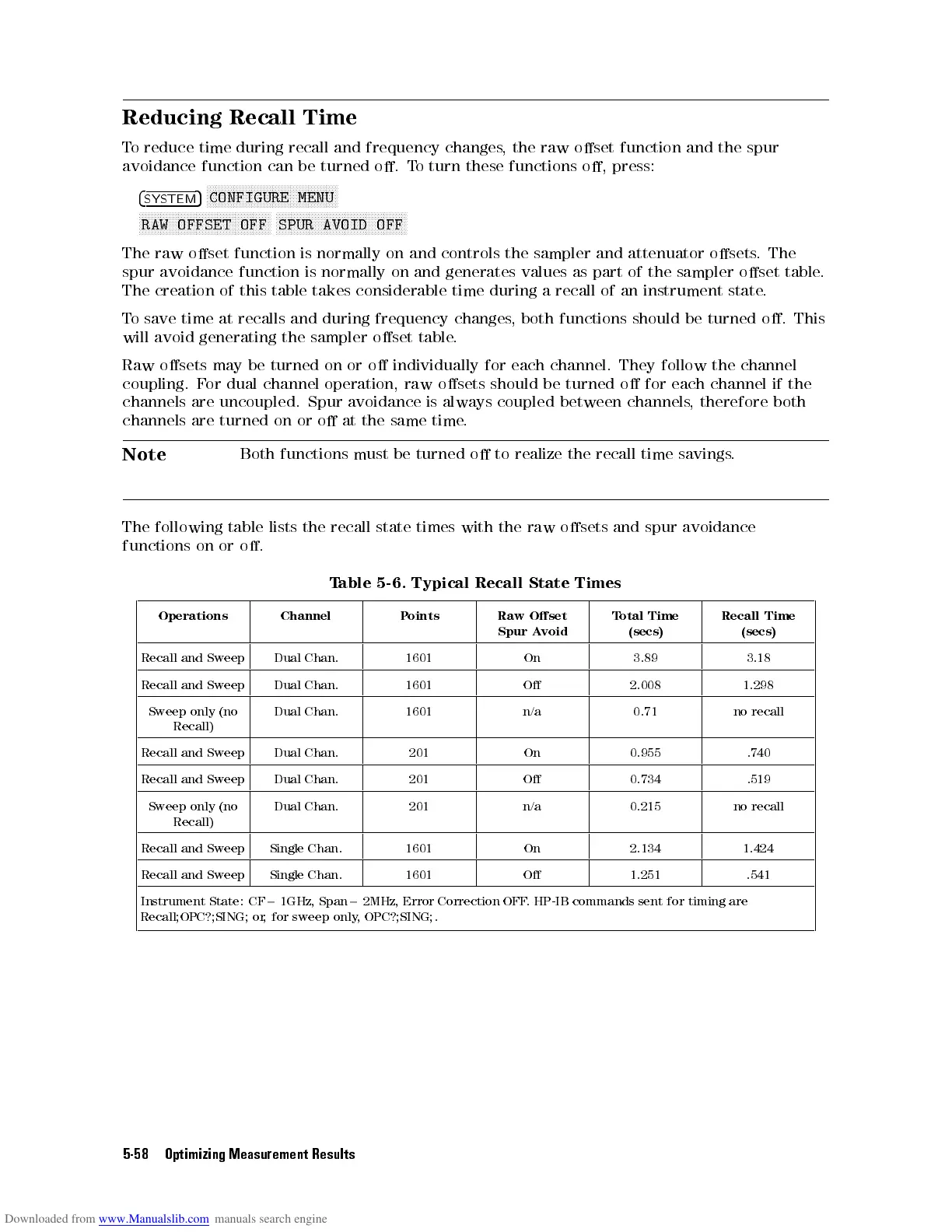
The
following
table
lists
the
recall
state
times
with
the
raw
osets
and
spur
avoidance
functions
on
or
o.
T
able
5-6.
Typical
Recall
State
Times
Operations Channel P
oints
Raw
Oset
Spur
A
void
T
otal
Time
(secs)
Recall
Time
(secs)
Recall
and
Sweep
Dual
Chan.
1601 On 3.89 3.18
Recall
and
Sweep
Dual
Chan.
1601 O 2.008 1.298
Sweep only
(no
Recall)
Dual Chan. 1601 n/a 0.71 no recall
Recall and
Sweep
Dual Chan. 201 On 0.955 .740
Recall
and
Sweep
Dual
Chan.
201 O 0.734 .519
Sweep
only
(no
Recall)
Dual
Chan.
201 n/a 0.215 no
recall
Recall and Sweep Single Chan. 1601 On 2.134 1.424
Recall and Sweep Single Chan. 1601 O 1.251 .541
Instrument State: CF= 1GHz, Span= 2MHz, Error Correction OFF
. HP-IB commands sent for timing
are
Recall;OPC?;SING; or
, for sweep only
, OPC?;SING;.
5-58 Optimizing Measurement Results


 To Next Page