Stimulus Functions
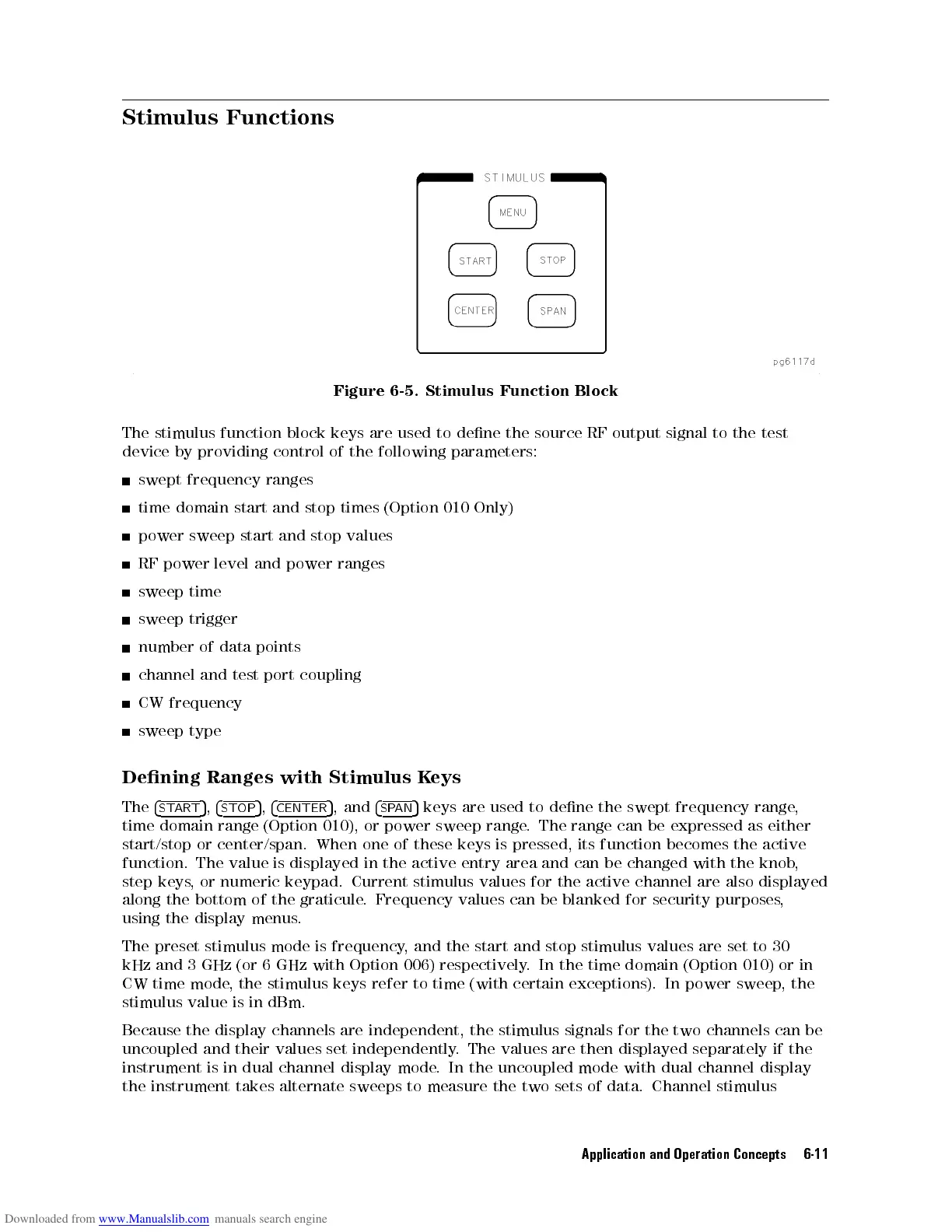
Figure
6-5.
Stimulus
Function
Block
The
stimulus
function
block
keys
are
used
to
dene
the
source
RF
output
signal
to
the
test
device
by
providing
control
of
the
following
parameters:
swept
frequency
ranges
time domain
start
and
stop
times
(Option
010
Only)
power
sweep
start
and
stop
values
RF
power
level
and
power
ranges
sweep
time
sweep
trigger
number
of
data
points
channel
and
test
port
coupling
CW
frequency
sweep
type
Dening
Ranges
with
Stimulus
K
eys
The
4
ST
ART
5
,
4
STOP
5
,
4
CENTER
5
,and
4
SP
AN
5
keys are
used to
dene the
swept
frequency
range
,
time
domain range
(Option 010),
or power
sweep range
. The
range
can
be
expressed
as
either
start/stop or center/span. When one of these keys is pressed, its function becomes
the active
function. The value is displayed in the active entry area and can be changed
with the knob
,
step keys
, or numeric keypad. Current stimulus values for the active channel are also
displayed
along the bottom of the graticule
. Frequency values can be blanked for security purposes
,
using the display menus
.
The
preset stimulus mode is frequency
, and the start and stop stimulus values are set to 30
kHz and
3 GHz (or 6 GHz with Option 006) respectively
. In the time domain (Option 010) or in
CW time mode
, the stimulus keys refer to time (with certain exceptions). In power sweep
,the
stimulus value is in dBm.
Because the display channels are independent, the stimulus signals for the two channels can be
uncoupled and their values set independently. The values are then displayed separately if the
instrument is in dual channel display mode. In the uncoupled mode with dual channel display
the instrument takes alternate sweeps to measure the two sets of data. Channel stimulus
Application and Operation Concepts 6-11


 To Next Page