Smoothing
Smoothing
(similar
to
video
ltering)
averages
the
formatted
active
channel
data over
a portion
of
the
displayed
trace
.
Smoothing
computes
each
displayed data
point based
on one
sweep
only
,
using
a
moving
average
of
several
adjacent data
points for
the current
sweep.
The
smoothing
aperture
is
a
percent
of
the
swept
stimulus span,
up to
a maximum
of 20%.
Rather
than
lowering
the
noise
oor
,
smoothing
nds
the
mid-value of
the data.
Use it
to
reduce
relatively
small
peak-to-peak
noise
values
on
broadband measured
data. Use
a
suciently
high
number
of
display
points
to
avoid
misleading results
.Do
not use
smoothing
for
measurements
of
high
resonance
devices
or
other
devices
with wide
trace variations
,as
it
will
introduce
errors
into
the
measurement.
Smoothing
is
used
with
Cartesian
and
polar
display
formats.
It is
also the
primary way
to
control
the
group
delay
aperture,
given a
xed frequency
span. (Refer
to
\Group
Delay
Principles"
earlier
in
this
section.) In
polar display
format, large
phase shifts
over
the
smoothing
aperture
will
cause
shifts in
amplitude,
since a
vector average
is
being
computed.
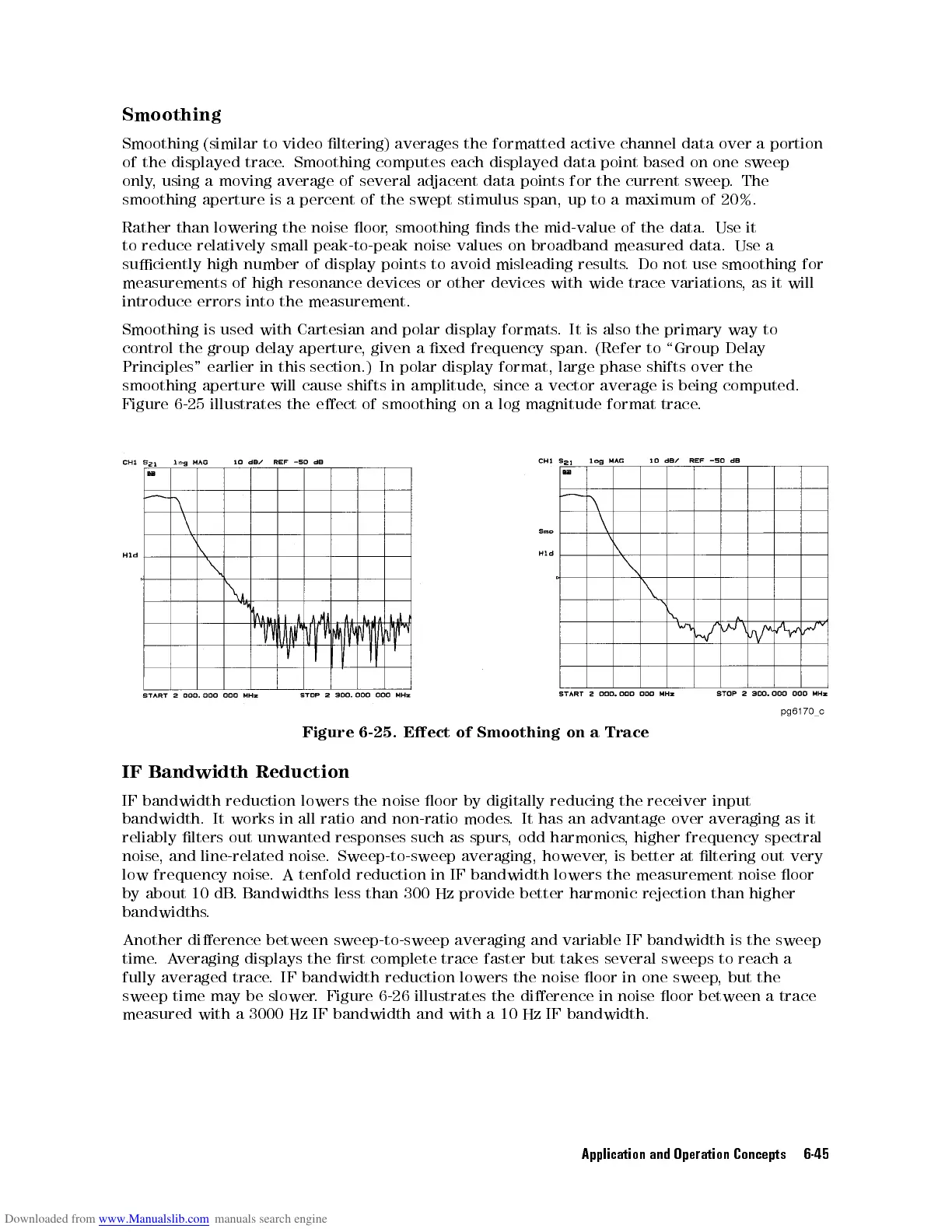
Figure
6-25
illustrates
the
eect of
smoothing on
alog
magnitude format
trace
.
Figure
6-25.
Eect
of
Smoothing
on a
Trace
IF
Bandwidth
Reduction
IF
bandwidth
reduction
lowers
the
noise
oor
by
digitally
reducing
the
receiver
input
bandwidth.
It
works
in all
ratio and
non-ratio modes
.It
has an
advantage over
averaging as
it
reliably
lters
out
unwanted responses
such
as
spurs
,
odd
harmonics
,
higher
frequency
spectral
noise
, and line-related noise
. Sweep-to-sweep averaging, however
, is better at ltering out very
low
frequency noise
. A tenfold reduction in IF bandwidth lowers the measurement noise oor
by about
10 dB
. Bandwidths less than 300 Hz provide better harmonic rejection than higher
bandwidths.
Another dierence between sweep-to-sweep averaging and variable IF bandwidth is the sweep
time.A
veraging displays the rst complete trace faster but takes several sweeps
to reach a
fully averaged trace
. IF bandwidth reduction lowers the noise oor in one sweep
,butthe
sweep time may be slower. Figure 6-26 illustrates the dierence in noise oor between a trace
measured with a 3000 Hz IF bandwidth and with a 10 Hz IF bandwidth.
Application and Operation Concepts 6-45


 To Next Page
 Loading...