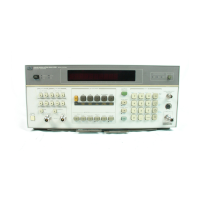
Model
8901B
Service
Audio Distortion Analyzer
The input to the Distortion Analyzer is selected by the Output Switch. The input can be either
the internal demodulated RF signal or
an
audio signal input
to
the front-panel MODULATION
OUTPUT/AUDIO INPUT connector. The distortion measurement
is
limited to audio signals with
a frequency of
400
Hz
or
1
kHz.
The distortion measurement consists of measuring the
rms
level of the
total
audio signal then
remeasuring the signal after
it
passes through a notch filter that removes the fundamental of the
signal-leaving the distortion components, hum,
and
noise. Both measurements use the RMS-to-DC
Converter to obtain true
rms
measurements. The dc level from the RMS-to-DC Converter
is
measured
by the Voltmeter. The Post-Notch Amplifier and the Audio Amplifier optimize the signal level
into
the
RMS-to-DC Converter. The Controller computes the distortion
as
the ratio
of
the output
of
the Notch
Filter to
its
input (with corrections made
to
account for amplifier gain). (In the SINAD measurement
mode, the reciprocal of distortion is computed.)
Audio Counter
The input to the Audio Counter
is
selected by the Output Switch. As with the Audio Distortion
Analyzer, the input can
be
either the internally demodulated RF signal
or
an
audio
signal input
to
the
front-panel MODULATION OUTPUT/AUDIO INPUT connector.
The audio signal is first conditioned by the Schmitt Trigger
to
make
it
compatible with the digital
circuits it drives. When a frequency count is to be made, the Controller, after clearing both the Counter
and Audio Counter and after opening the Audio Switch,
arms
the Counter Control Logic. The
first
signal pulse from the Schmitt Trigger causes the Counter Control Logic to close the Audio Switch and
the Counter Gate switch (in the main Counter). The number of cycles
of
the audio signal are counted
by the Audio Counter. The number
of
time-base reference pulses
are
counted by the main Counter.
After a fixed period
of
time, the Controller readies the count
to
to stop. The next signal pulse from the
Schmitt Trigger causes the
two
switches to open. The counts in the
two
counters are then
read
back,
and the audio frequency is computed and displayed.
Local Oscillator
The heart
of
the
LO
is
a 320 to
650
MHz High-Frequency, Voltage-Controlled Oscillator (HF VCO).
After passing through the programmable
LO
Divider, the HF
VCO
signal
becomes the
LO
drive
to
the
Input Mixer. The
LO
Divider
is
programmed
to
divide the HF VCO by powers
of
two
from
2-I
to
2*,
(that
is,
from a times
2
divide by
256).
Thus the
LO
can tune from 1300 MHz
to
1.25
MHz in ten
octave ranges. A fixed divide-by-eight output from the
LO
Dividers
is
the
LO
(HF
VC0+8) input to
the Counter.
There are four tuning modes:
0
manual tuning and low noise,
0
automatic tuning and low noise,
0
automatic tuning and signal tracking,
0
manual tuning and signal tracking.
Manual Tuning and
Low
Noise.
Consider the sequence followed
for
manual tuning.
When
a frequency
is
entered from the Keyboard, the LO is configured as in Figure 8D-1. The Digital-to-Analog Converter
(DAC)
is
connected to the
HF
VCO tune input as shown. Knowing the desired frequency, the Controller
computes the octave number (n) for
the
LO
Divider and sets the DAC to its midrange. Then, an iterative
sequence
of
counting the
LO
and adjusting the DAC is carried out until the LO
is
near the correct
frequency.
Service Sheet BD1 8D-5


 To Next Page
 Loading...