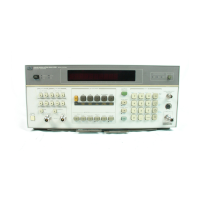
Model
8901B
Service
1600. The output from the dividers becomes the Counter gate.
A
2
MHz output (from a divide-by-five)
is used as the Controller clock.
The Input Selector selects one of several possible inputs to the Counter. When the Voltmeter function
is
selected, the 10 MHz reference, gated by the Stop Count switch, is counted. The Stop Count switch
closes when the Controller initiates a Ramp Gate pulse;
it
remains closed until opened by the Voltage-
to-Time Converter. When the audio frequency function
is
selected, the 10 MHz reference
is
counted as
for the Voltmeter function. The Stop Count switch, however, is now controlled by the Counter Control
Logic of the Audio Counter.
and
FM
Calibrators
The FM Calibrator consists of a
10.1
MHz VCO which toggles between
two
frequencies at a 10
kHz rate. Selecting the FM Calibration mode initiates
a
sequence
of
measurement cycles. During
a
measurement cycle, the VCO is measured by the Counter at the upper frequency and then measured
at the lower frequency. The Controller then computes the deviation (one-half the difference between
the
two
frequencies). The Controller then allows the FM Source to toggle at its
10
kHz rate. When the
signal from the CALIBRATION AMFM OUTPUT is connected
to
the INPUT of the Modulation
Analyzer (either directly, or through a Sensor Module), the FM on the calibrator signal is measured,
and the FM calibration factor (the ratio of the measured FM to the computed FM)
is
displayed.
The AM Calibrator receives its input from the output of the 10.1 MHz VCO
of
the FM Calibrator, which
is
not toggled during AM calibration. This signal
is
limited and applied
to
the Amplitude Modulator.
The AM Source toggles the modulator at a 10 kHz rate between a nominal level and twice that level
to produce
33%
AM.
To enhance the accuracy of the calibrator, measurements are made at the output of the modulator with
the Amplifier/Detector while the AM Source is off. From these measurements the actual AM depth
is
computed. As with the FM Calibrator, the AM Calibrator output, when measured by the instrument,
displays the AM calibration factor.
Power
Supplies
The instrument
is
run from five regulated supplies: +40V, +15V, -15V, +5V, and -5V. The
+15V
supply continues
to
power the high-stability, time base reference (Option
002)
when POWER is switched
to STBY.
Controller and Remote Interface
The Controller plays a key role in governing the instrument operation. The Microprocessor in the
Controller outputs information to configure the instrument, reads back and processes measurement
results, reads back vital status information to prevent invalid measurements, and services interrupts
from the Keyboard or Remote Interface. Information from the Input/Output (I/O) port of the
Microprocessor
is
carried to the rest of the instrument by the Instrument Bus. Typically, the data
on the Instrument Bus is decoded and latched at the various assemblies, then the decoded information
is
distributed
to
the appropriate circuit.
Information within the Controller itself is handled by three main buses: the ROM Control (ROMC)
Bus (which coordinates the various devices which make up the Controller), the Address Bus (which
addresses ROM and RAM), and the Data Bus (which carries information to
or
from ROM and RAM).
Since the Remote Interface also contains Controller devices, these buses are also distributed to
it.
A
battery backup to the RAM devices makes the memory non-volatile; that is, the instrument remembers
key values even with the power switched
off.
The Remote Interface receives
inputs from the external interface bus (HP-IB), processes the
information, and interrupts the Controller in a manner similar to the Keyboard. The Remote Interface
also processes the measurement information and outputs
it
on the HP-IB
if
requested and is designed
to make operation from an external computing controller as similar as possible to operation from the
front panel.
Service Sheet BD1 8D-9


 To Next Page
 Loading...