Need help?
Do you have a question about the Huawei AMN-LX3 and is the answer not in the manual?
Identifies key physical components like buttons, ports, and card slots.
Learn about pre-installed Tips app for device features.
Provides essential precautions for SIM card insertion and eject pin usage.
Illustrates the process for setting up single and dual SIM card configurations.
Explains the single pass mode for dual SIM devices, limiting simultaneous use.
Details how to enable call forwarding between SIM cards to avoid missed calls.
Lists website resources for device information, FAQs, and support.
Guides on accessing legal, safety, and regulatory information within device settings.
Details safe usage practices, temperature limits, and potential hazards.
Advises against using the device in hazardous environments or during flights.
Explains body-worn RF compliance and Specific Absorption Rate (SAR) values.
Provides the FCC statement regarding Class B digital device compliance and potential interference.
Lists trademarks, registered trademarks, and licensing information.
Directs users to the online privacy policy for information protection details.
States copyright information and disclaims warranty for the document's content.
This document serves as a Quick Start Guide for the AMN-LX3 device, providing essential information for its operation, maintenance, and regulatory compliance. It is designed to familiarize users with the device's basic functions and ensure safe usage.
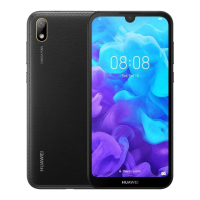
The AMN-LX3 is a mobile device designed for communication and data services. It supports dual card dual standby single pass, meaning it can accommodate two SIM cards, but only one can be actively used for calls or data services at any given time. This single pass feature is implemented to optimize power consumption and extend standby time. The device includes a Micro-USB port for charging and data transfer, a card slot for SIM and microSD cards, and standard volume and power buttons for control. It is equipped with a pre-installed "Tips" app to help users discover and master its various features. The device is designed to operate within specific temperature ranges, with ideal operating temperatures between 0 °C and 35 °C, and storage temperatures between -20 °C and +45 °C.
To power on the device, the user needs to press and hold the power button until the screen illuminates. Powering off involves pressing and holding the power button and then selecting the appropriate option on the screen. A restart function is also available through a similar process. In cases where the device becomes unresponsive, a forced restart can be initiated by pressing and holding the power button for 10 or more seconds.
The device supports both single-SIM and dual-SIM configurations, with clear instructions and illustrations provided for inserting SIM and microSD cards. Users are advised to ensure correct card alignment and a level card tray during insertion to prevent damage. The eject pin, included with the device, is crucial for safely inserting and removing the card tray.
For dual-SIM devices, the "Dual Card Dual Standby Single Pass" feature means that if SIM card 1 is in use for a call, SIM card 2 cannot receive or make calls. Callers attempting to reach SIM card 2 will receive a message indicating unavailability. Similarly, if SIM card 1 is actively using data services, SIM card 2's data services will be disabled. To mitigate missed calls, the device offers a call forwarding option between SIMs.
The device's interface allows users to access various settings and information. Through the "Settings" menu, users can navigate to "System," then "About phone," to find legal information, safety information, authentication details, and certification logos. This provides transparency regarding the device's compliance with various standards and regulations.
Proper maintenance and safe handling are emphasized throughout the guide. Users are cautioned against inserting or removing SIM cards while the device is powered on, as this could lead to damage. The use of cut or modified SIM or microSD cards is also discouraged, as they may not be recognized and could damage the card tray. If a SIM card is incompatible, users are advised to contact their carrier.
Safety information highlights the importance of protecting hearing by avoiding high volume levels for extended periods. The use of only approved and compatible power adapters, chargers, and batteries is critical to prevent damage, shorten lifespan, or cause hazards like fire or explosion. The device and its battery should be kept away from excessive heat, direct sunlight, and heating devices such as microwave ovens or radiators.
Users are reminded to observe local laws and regulations, particularly regarding wireless device usage while driving, to reduce the risk of accidents. During air travel, the device should only be used according to provided instructions, as wireless device operation can disrupt aircraft systems or be illegal. To protect internal components, the device should not be used in dusty, smoky, damp, or dirty environments, or near strong magnetic fields.
When charging, the power adapter should be plugged into an easily accessible socket near the device. The charger should be unplugged from both the electrical outlet and the device when not in use. The device should not be stored or transported in areas where flammables or explosives are present, such as gas stations or chemical plants, due to the increased risk of explosion or fire.
Disposal of the device, battery, and accessories must comply with local regulations, and they should not be treated as normal household waste. The device contains a built-in battery that should not be replaced by the user; instead, an authorized Huawei service center should be contacted for battery replacement to ensure proper function and personal safety.
The guide also includes information on FCC regulatory compliance, detailing body-worn operation guidelines and Specific Absorption Rate (SAR) values. The device complies with RF specifications when used near the ear or at a distance of 1.50 cm from the body, provided accessories do not contain metal components. The SAR values for ear, body, and Wi-Fi hotspot usage are provided, all falling within the FCC limits. The FCC statement confirms the device's compliance with Part 15 of the FCC Rules, outlining conditions for operation and advising on measures to correct potential interference with radio or television reception. Users are warned that unauthorized modifications could void their authority to operate the equipment.
 General
| Model | Huawei AMN-LX3 |
|---|---|
| Network | GSM / HSPA / LTE |
| Display | IPS LCD |
| OS | Android 8.1 (Oreo), EMUI 8.2 |
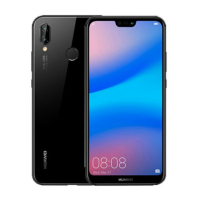
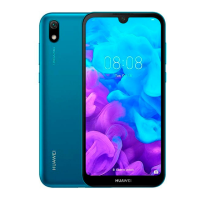
| Colors | Black, Blue, Gold |
| Internal Storage | 16GB |
| Rear Camera | 13 MP + 2 MP |

 To Next Page