6
AEROSOLS
Do not use an aerosol spray on or near the stove
when it is alight.
FIREGUARDS
Always use a fireguard in the presence of children, the
elderly or the infirm. The fireguard should be
manufactured in accordance with BS8423 – Fireguards
for use with solid fuel appliances.
DO NOT OVER-FIRE
It is possible to fire the stove beyond its design
capacity. This could damage the stove so watch for
signs of over-firing. If any part of the stove starts to
glow red, the stove is in an over-fire situation and the
controls should be adjusted accordingly.
Never leave the stove unattended for long periods
without first adjusting the controls to a safe setting.
Careful air supply control should be exercised at all
times.
FUME EMISSION
Properly installed, operated, this appliance will not
emit fumes. Occasional fumes from de-ashing and
refuelling may occur. Persistent fume emission must
not be tolerated.
This appliance should not be operated with the door
open.
If fume emission persists, then the following
immediate action should be taken: -
➢ Open doors and windows to ventilate the room.
➢ Let the fire go out, or eject and safely dispose of
fuel from the appliance.
➢ Check for flue/chimney blockage and clean if
required.
➢ Do not attempt to re-light the fire until the cause
of the fume emission has been identified and
corrected.
If necessary, seek expert advice.
ADVERSE WEATHER
In a small number of installations, occasional local
weather conditions (e.g. wind from a particular
direction) may cause downdraught in the flue and
cause the stove to emit fumes. In these
circumstances, the stove should not be used. A
professional flue installer will be able to advice on
solutions to this problem (e.g. anti-downdraught
cowl).
CARBON MONOXIDE DETECTOR
Hunter Stoves recommend a Carbon Monoxide
Detector that conforms to the latest issue of BS EN
50292 is placed in the same room as the appliance.
The installation of such an alarm is not considered as
a substitute for regular maintenance or servicing or
the appliance and Flue system.
IN THE EVENT OF A CHIMNEY FIRE:
➢ Raise the alarm
➢ Call the Fire Brigade
➢ Close appliance air controls
➢ Move furniture, ornaments etc. away
➢ Place a fireguard in front of stove
➢ Check the chimney breast for signs of
excessive heat.
If the wall is becoming excessively hot, move furniture
away. Ensure the Fire Brigade can gain access to your
roof space in order to check for fire spread.
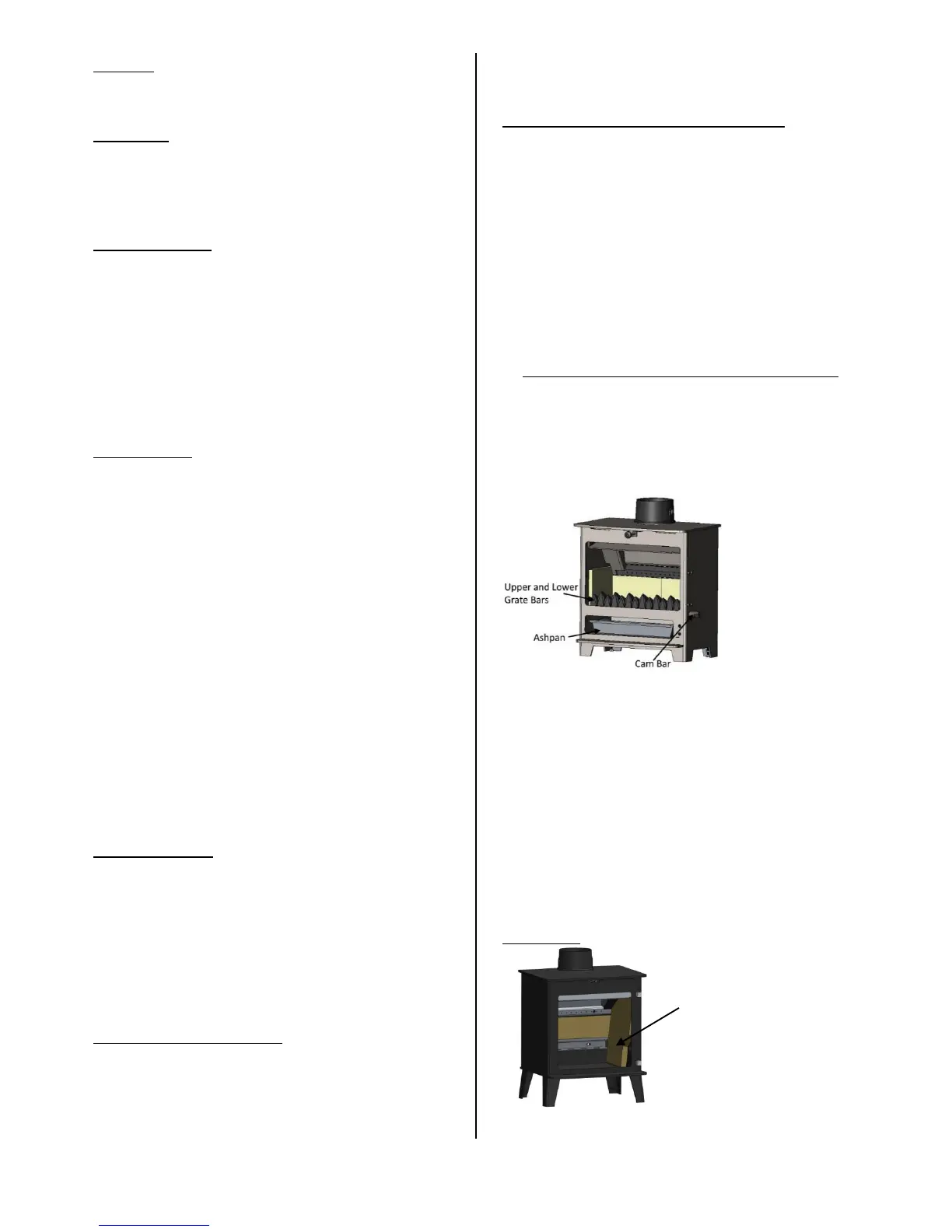
REMOVING INTERNAL COMPONENTS
All internal components must be removed prior to
fitting the stove. This will make handling the stove
easier; allow access to fixings and the flue outlet; as
well as protect the internal components from damage
during the installation process.
1. Open the door and remove the ashpan.
2. Remove the grate bars by lifting the front up
off the cam bar and sliding forward off the
rear grate support and lift out of the firebox.
3. Remove the cam bar by lifting the left-hand
end of it upwards until it clears the side
casting. Pull the left-hand end towards the
front of the stove and then slide all the way
out. Take care not to lose the cam hole plate.
4. Remove the catch bar by lifting upwards and
pulling forwards out of the stove body.
5. Remove both Side Plates by sliding out.
Side Bricks


 To Next Page