
 Need help?
Do you have a question about the Huntleigh D900 and is the answer not in the manual?
General safety warnings and essential precautions for equipment operation.
Procedure for inspecting and preparing the unit upon receipt.
Instructions for installing and replacing the device battery.
Details on selecting and using vascular mode with connected probes.
Guidelines for general maintenance and handling of the product.
Details the equipment's classification regarding electric shock and operation modes.
Lists the various IEC and EN standards the device complies with.
Instructions for returning the Dopplex unit for service or repair.
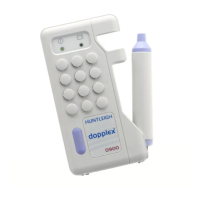
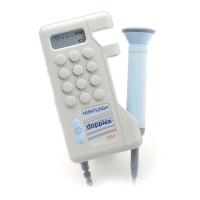
The Huntleigh D900 is a high-sensitivity pocket Doppler designed for use by qualified healthcare practitioners in primary, acute, and community healthcare settings. Its primary function is the assessment of vascular blood flow to assist diagnosis. The device is compatible with both HS and XS Doppler probes, offering versatility for various examinations.
The D900 operates by emitting ultrasound waves and detecting the Doppler shift caused by blood flow. This information is then converted into an audible signal, allowing practitioners to assess vascular health. The device is specifically designed for vascular mode, which is automatically selected when a vascular probe is connected.
Five types of vascular probes are available, each optimized for different applications:
The device features an automatic noise reduction feature that operates on low-level signals to improve sound quality during use. It also includes LED indicators: a green LED signifies power ON, and a yellow LED flashes when the battery is low.
For documentation purposes, the D900 can be connected to a chart recorder via its waveform output socket. This allows for the recording of blood flow waveforms. The device also includes a "Cal Function" to set the baseline and sensitivity of the chart recorder. When activated, this function generates a zero-velocity baseline and a sequence of pulses, accompanied by calibration tones superimposed on the audio signal. Holding the Cal button repeats the calibration sequence.
The D900 is designed for ease of use in a clinical environment. To connect a probe, the arrow on the connector should be aligned with the slot on the probe and pushed firmly. Disconnecting the probe involves pulling the connector sharply, avoiding pulling the cable itself.
When performing an examination, a liberal amount of water-based ultrasound gel (and only water-based gel) should be applied to the skin over the vessel. The probe is then placed at a 45° angle to the skin surface. The practitioner adjusts the probe's position to obtain the loudest audio signal. Arteries typically produce high-pitched pulsatile sounds, while veins emit a non-pulsatile sound resembling a rushing wind. For optimal results, the probe should be kept as still as possible once the best position is found, and the audio volume can be adjusted as needed.
The device is powered by a battery (IEC 6LR61 or IEC 6LP3146) and has an auto shut-off feature that activates after 5 minutes of continuous operation if the unit is not manually switched off. This helps conserve battery life.
General care for the D900 involves keeping its external surfaces clean and free of dirt and fluids using a clean, dry cloth. Any fluids on the surface should be wiped off with a clean, dry cloth, followed by wiping with a cloth dampened in 70% Isopropyl Alcohol, and then completely drying with a clean, dry lint-free cloth.
For patient-applied parts (the ultrasound probes), specific cleaning and disinfecting procedures are outlined based on the level of cross-contamination risk:
Important Cleaning Warnings:
Regular inspection of the product is recommended before each use, paying close attention to the probe tip for cracks, and to the cable and connector. Any crackling or intermittent behavior should be investigated. The D900 does not require periodic maintenance.
For storage, if the unit is not to be used for some time, the battery should be removed. The unit, along with its probe and accessories, should be stored in the provided soft carry case. If not for immediate use, it should be re-sealed in its original packing after initial inspection.
 General
| Frequency | 2 MHz |
|---|---|
| Display | LCD screen |
| Power Source | Rechargeable battery or mains power |
| Type | Handheld Doppler |
| Weight | 295 g |
| Category | Doppler |
| Technology | Doppler Ultrasound |
| Applications | Vascular |




 To Next Page