This document is an operator's manual for Husqvarna 130BT, 170BT, and 170BF blower models. It provides essential information for safe operation, maintenance, and technical specifications of these units.
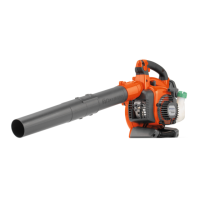
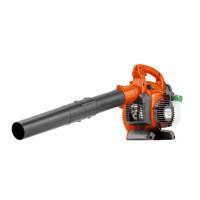
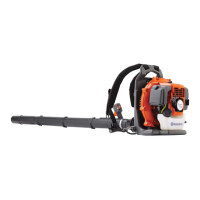
The primary function of these devices is to blow lawns, pathways, asphalt roads, and similar surfaces. They are designed for outdoor use and are powered by air-cooled 2-cycle gasoline engines.
Important Technical Specifications:
The manual provides detailed specifications for each model:
130BT:
- Dimensions (L x W x H): 295x387x432 mm (11.6x15.2x17 in)
- Dry Weight (including pipe): 6.75 kg (14.9 lbs)
- Fuel Tank Capacity: 0.9 liter (30.4 fl. oz)
- Piston Displacement: 29.5 cu. cm (1.8 cu. in)
- Air Filter: Single stage filter
- Carburetor: Diaphragm valve type, Rotary
- Ignition System: CDI
- Spark Plug: NGK CMR7H
- Muffler: Spark arrester equipped
- Idle Speed: 3000 rpm
- Operating Engine Speed: 3000 to 6700 rpm
- Fuel Consumption: 0.58 liter/h (19.6 fl. oz/h)
- Average Air Volume (w/std Pipe): 10.2 cu. m/min (360 cf/m)
- Max. Air Velocity (Average): 50.2 m/sec (184 mph)
- Max. Air Static Pressure at Pipe End: 1.2 kPa
- Noise Level (50 Feet ANSI B175. 2002): 69 dB(A)
- Sound Power Level (EC directive 2000/14/EC, measured/guaranteed): 102 dB(A)
- Noise Pressure Level at Operator's Ear (ISO22868): 89.9 dB(A)
- Vibration Level at Idle (right handle ISO22867): 1.9 m/s²
- Vibration Level at Max. Speed (right handle ISO22867): 2.6 m/s²
170BT:
- Dimensions (L x W x H): 365x464x485 mm (14x18x19 in)
- Dry Weight (including pipe): 12 kg (26.5 lbs)
- Fuel Tank Capacity: 1.75 liter (60.0 fl. oz)
- Piston Displacement: 64.9 cu. cm (4.0 cu. in)
- Air Filter: 2-stage fresh flow filter system
- Carburetor: Diaphragm valve type, Rotary
- Ignition System: Digital Ignition
- Spark Plug: NGK CMR7H
- Muffler: Spark arrester equipped
- Idle Speed: 2000 rpm
- Operating Engine Speed: 2000 to 6900 rpm
- Fuel Consumption: 1.6 liter/h (54.1 fl. oz/h)
- Average Air Volume (w/std Pipe): 16 cu. m/min (565 cf/m)
- Max. Air Velocity (Average): 78 m/sec (175 mph)
- Max. Air Static Pressure at Pipe End: 3.5 kPa
- Noise Level (50 Feet ANSI B175. 2002): 76 dB(A)
- Sound Power Level (EC directive 2000/14/EC, measured/guaranteed): 110 dB(A)
- Noise Pressure Level at Operator's Ear (ISO22868): 95 dB(A)
- Vibration Level at Idle (right handle ISO22867): 0.8 m/s²
- Vibration Level at Max. Speed (right handle ISO22867): 3.9 m/s²
170BF:
- Dimensions (L x W x H): 365x496x485 mm (14x20x19 in)
- Dry Weight (including pipe): 12.2 kg (26.9 lbs)
- Fuel Tank Capacity: 1.75 liter (60.0 fl. oz)
- Piston Displacement: 64.9 cu. cm (4.0 cu. in)
- Air Filter: 2-stage fresh flow filter system
- Carburetor: Diaphragm valve type, Rotary
- Ignition System: Digital Ignition
- Spark Plug: NGK CMR7H
- Muffler: Spark arrester equipped
- Idle Speed: 2000 rpm
- Operating Engine Speed: 2000 to 6900 rpm
- Fuel Consumption: 1.6 liter/h (54.1 fl. oz/h)
- Average Air Volume (w/std Pipe): 16 cu. m/min (565 cf/m)
- Max. Air Velocity (Average): 78 m/sec (175 mph)
- Max. Air Static Pressure at Pipe End: 3.5 kPa
- Noise Level (50 Feet ANSI B175. 2002): 76 dB(A)
- Sound Power Level (EC directive 2000/14/EC, measured/guaranteed): 110 dB(A)
- Noise Pressure Level at Operator's Ear (ISO22868): 95 dB(A)
- Vibration Level at Idle (right handle ISO22867): 1.4 m/s²
- Vibration Level at Max. Speed (right handle ISO22867): 4.3 m/s²
Usage Features:
The manual emphasizes several key usage features and safety precautions:
- Assembly: Instructions are provided for assembling the swivel joint, throttle lever, throttle cable, right handle (170BF), handlebar (option for 130BT/170BT), blower tubes, harness, and waist belt (170BT/170BF). The harness and waist belt are crucial for comfortable and safe operation, distributing the blower's weight.
- Fueling: The blowers use a mixed gasoline (50:1 gasoline to oil ratio) with anti-oxidant added quality oil for air-cooled 2-cycle engines (JASO FC GRADE OIL or ISO EGC GRADE). Users are warned against using raw gasoline, gasohol, or 4-cycle engine oil. Fueling should be done in a well-ventilated area, away from flames, and with a cool engine.
- Starting Engine: The starting procedure involves pushing the primer bulb until fuel flows, closing the choke (for a cool engine), setting the throttle lever to about 1/3 open, and pulling the starter knob vigorously. Gradual choke opening and a minute of idle speed warm-up are recommended after starting.
- Adjusting Idle Speed: The factory-set idle speed is 3000 rpm for 130BT and 2000 rpm for 170BT/170BF. Adjustment can be made using the idle adjustment screw on the carburetor.
- Stopping Engine: For 130BT/170BT, move the throttle lever to the STOP position. For 170BF, move the throttle lever to the idling position and press the stop switch. If the engine fails to stop, the choke lever should be closed.
- Safety Precautions: Extensive safety guidelines cover working conditions (avoiding operation when tired, ill, or under influence; wearing hearing and eye protection, face filter mask in dusty conditions, rubber-soled shoes; avoiding loose clothing), working circumstances (operating in well-ventilated areas, stable footing, avoiding high wind/bad weather), and avoiding noise problems (operating at reasonable hours, limiting equipment, using lowest throttle speed, checking equipment).
Maintenance Features:
Regular maintenance is crucial for the longevity and safe operation of the blowers:
- Maintenance Schedule: A detailed table outlines daily/before use, every 25 hours, every 50 hours, and every 100 hours maintenance tasks.
- Air Filter: Inspect and clean the prefilter daily/before use. For 170BT/170BF, the paper filter should be inspected/replaced every 25 hours. Cleaning involves washing with a non-flammable cleaning solution and drying. Tapping the paper filter is discouraged as it can damage the element.
- Fuel Leaks/Filter/Line: Inspect for fuel leaks daily/before use. The fuel filter should be inspected/replaced every 25 hours, and the fuel line inspected/cleaned every 25 hours.
- Spark Plug: Inspect/clean the spark plug every 25 hours. The spark gap should be adjusted to 0.025 in (0.6 to 0.7 mm). Replacement with NGK CMR7H is recommended twice a year.
- Muffler/Spark Arrester: Inspect/clean the muffler and spark arrester every 50 hours. The spark arrester prevents hot carbon from flying out of the exhaust. Bolts on the muffler should be tightened every 25 hours.
- Cooling System: Inspect/clean the cooling system every 50 hours.
- Screws/Nuts/Bolts: Tighten all screws, nuts, and bolts every 25 hours.
- Cylinder Exhaust Port: Inspect/clean the cylinder exhaust port every 100 hours.
- Air Inlet Net: Inspect daily/before use for blockages. The blower should never be used without the net.
- Ignition Coil Air Gap: Inspect and adjust the air gap between the ignition coil and the iron core of the rotor. The gap should be 0.35 mm (0.014 in) for 130BT and 0.40 mm (0.016 in) for 170BT/170BF.
- Shoulder Strap: Instructions are provided for replacing a damaged shoulder strap.
- Storage: Before storing, drain the fuel tank, push the primer bulb until it's empty, remove the spark plug, add 2-cycle oil to the cylinder, crank the engine several times, and then reinstall the spark plug. Store the unit in a dry, dust-free place, out of reach of children.
The manual also includes a warning about engine exhaust containing chemicals known to cause cancer, birth defects, or other reproductive harm, as per California Proposition 65. It emphasizes the importance of reading the manual carefully before use and contacting the dealer for assistance with any questions or repairs not covered in the manual. The manufacturer reserves the right to modify the design and appearance of products without prior notice due to continuous product development.

 Need help?




 To Next Page
 General