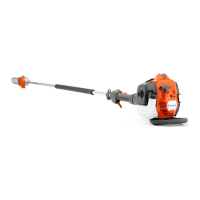
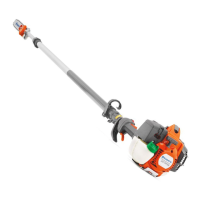
This document is an operator's manual for the Husqvarna 525PT5S pole saw, a tool designed specifically for cutting branches and twigs. The manual emphasizes safety, proper usage, and maintenance to ensure the longevity and safe operation of the machine.
Function Description:
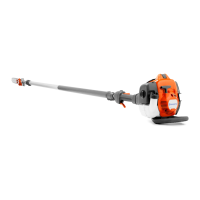
The Husqvarna 525PT5S is a motor-driven pole saw equipped with a two-stroke engine. Its primary function is to cut branches and twigs, particularly those that are out of reach, thanks to its telescopic shaft. The machine's cutting attachment consists of a saw chain, guide bar, and drive sprocket, all designed to work in conjunction for efficient cutting. The engine powers the saw chain, which rotates around the guide bar to perform the cutting action. The machine is designed with a vibration damping system to minimize vibration transfer between the engine unit/cutting equipment and the handle unit, making operation easier and reducing operator fatigue. It also features a muffler to keep noise levels to a minimum and direct exhaust fumes away from the user, with some models including a catalytic converter to reduce harmful exhaust gases. The cooling system, comprising an air intake on the starter, fins on the flywheel, cooling fins on the cylinder, and a cylinder cover, is crucial for maintaining optimal working temperature and preventing engine damage.
Usage Features:
The pole saw is designed for ease of use and operator safety. It features a throttle trigger lockout mechanism to prevent accidental operation of the throttle control. When the lockout is pressed (by grasping the handle), it releases the throttle control. Upon releasing the handle, both the throttle control and lockout return to their original positions, ensuring the throttle is automatically locked at the idle setting. The stop switch is used to turn off the engine, and it automatically returns to the start position. For starting, the primer bulb is pressed repeatedly until fuel fills it, and the choke control is set to the choke position. The starter handle is then pulled to start the engine. The telescopic function allows the operator to adjust the length of the shaft by undoing a knob, pulling the shaft to the desired length, and then tightening the knob. This feature enhances reach and adaptability for various cutting tasks. The machine is intended to be used with a harness, which supports its weight, provides maximum control, and reduces fatigue in the operator's arms and back. The harness support hook should be roughly level with the operator's right hip. When working, it is crucial to maintain a safe and stable position, holding the machine with both hands at the side of the body. An initial cut on the underside of a branch is recommended before cutting through to prevent bark tearing and jamming. The chain should be kept running while withdrawing the cutting attachment from the branch to prevent jamming. The machine is not electrically insulated, so extreme caution is advised when working near high-voltage power lines, maintaining a minimum distance of 10 meters.
Maintenance Features:
Regular maintenance is vital for the safe and efficient operation of the 525PT5S pole saw. The operator's manual outlines a comprehensive maintenance schedule, including daily, weekly, and monthly checks.
Key maintenance tasks include:
- Cutting Equipment: The saw chain's cutting teeth must be kept properly sharpened using a recommended file gauge. The correct raker clearance must be maintained to reduce kickback risk. The chain tension needs regular adjustment; a slack chain can jump off and cause increased wear. The cutting equipment must be well lubricated, and the chain lubrication system should be checked each time the machine is refueled. The guide bar and drive sprocket should be regularly inspected for wear and replaced if excessive.
- Engine and Fuel System: The carburettor's idle speed should be adjusted to ensure the cutting attachment stops at idle. The air filter needs regular cleaning to prevent malfunctions, starting problems, loss of engine power, unnecessary wear, and excessive fuel consumption. The spark plug condition should be checked, cleaned, and the electrode gap adjusted to 0.65 mm, or replaced if necessary. The fuel tank should be cleaned, and the fuel filter and hose checked for contamination or defects.
- Muffler and Cooling System: The muffler, especially if fitted with a spark arrestor mesh, requires regular cleaning (weekly for non-catalytic, monthly for catalytic converters) to prevent overheating and damage. The cooling system, including the air intake, flywheel fins, cylinder fins, and cylinder cover, must be cleaned weekly to prevent overheating.
- General Checks: All nuts and screws should be checked for tightness. The throttle trigger lock and throttle function must be verified for correct operation. The stop switch must work correctly. The vibration damping elements should be inspected for damage. The machine's exterior and the area under the protective cover should be kept clean. All cables and connections need to be checked. The clutch, clutch springs, and clutch drum should be inspected for wear, with replacement by an authorized service workshop if necessary.
- Fuel Handling: Fuel should always be mixed outdoors in approved containers, away from sparks or flames. The engine must be shut off and allowed to cool before refueling. The fuel cap should be tightened carefully after refueling, and the machine moved away from the refueling area before starting. Only quality petrol/oil mixture (at least 90 octane RON) and Husqvarna two-stroke engine oil should be used, with specific mixing ratios provided. Waste oil should never be used.


 To Next Page

 General