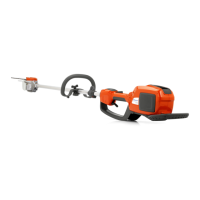
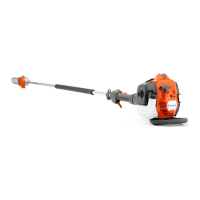
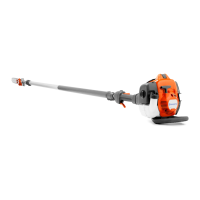
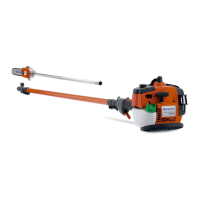
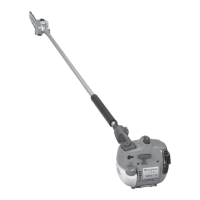
This document provides an operator's manual for the Husqvarna 530iP4 and 530iPT5 battery pole saws, which are electrically powered tools designed for cutting branches and twigs. The manual emphasizes safety, proper usage, and maintenance to ensure the longevity and safe operation of the product.
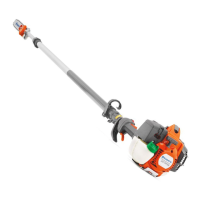
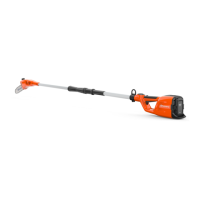
The pole saw is equipped with a saw head, a chain oil tank, and a guide bar. It features a keypad for control, a power trigger lockout, and a power trigger for operation. The rear and front handles provide grip, and a flexible cord connects to a battery (accessory) which is charged by a battery charger (accessory). Indicators for power, battery status, and warnings are present. The product also includes a start and stop button, a SavE button for power saving, a harness for support, a 4 mm hex key and combination key for adjustments, an operator's manual, a telescopic function, a branch hook, a transport guard, and an impact guard.
Function Description
The Husqvarna 530iP4 and 530iPT5 are battery-powered pole saws primarily used for cutting branches and twigs. The electrical motor drives a saw chain and guide bar to perform cutting tasks. The telescopic function allows for extended reach, making it suitable for pruning high branches. The SavE function is a power-saving mode that reduces chain speed to extend battery operation time without significantly decreasing cutting power. The product is designed to be used with a harness to support its weight and improve handling.
Usage Features
Before operation, users must read and understand all safety warnings. The product is started by pushing and holding the start/stop button until the green LED illuminates, and speed is controlled via the power trigger. The battery must be fully charged and correctly installed, locking into position with an audible click. The harness should be adjusted so the support hook is level with the operator's right hip. The chain oil tank must be filled with Husqvarna chain oil, especially after one hour of operation or when the battery is empty.
For cutting, it is recommended to use the stop at the base of the cutting head for support to prevent the cutting attachment from "jumping" on the branch. An initial cut on the underside of the branch is advised before cutting through to prevent bark tearing and promote healing. The cut should not exceed 1/3 of the branch thickness to avoid jamming. The chain should remain running while withdrawing the cutting attachment from the branch to prevent jamming. Large branches should be cut in sections. Operators should avoid standing directly underneath the branch being cut and maintain a firm footing. The power trigger should only be activated when the cutting attachment is in full view.
The product is not electrically insulated, so extreme caution is necessary near overhead power lines, maintaining a minimum distance of 10 meters (33 ft). If working within this distance, the power company must be contacted to switch off the power. The product should not be used for felling trees or cutting metal, plastic, masonry, or non-wood building materials.
Maintenance Features
Regular maintenance is crucial for safe and effective operation. Before any maintenance, the battery must be removed. The operator should only perform maintenance tasks outlined in the manual; more extensive servicing should be done by an approved Husqvarna dealer.
Daily checks include cleaning external parts with a dry cloth, ensuring the start/stop button and power trigger lockout function correctly, and verifying all controls are undamaged. Handles should be kept dry and clean, free from oil and grease. The saw chain cover must be undamaged, and all screws and nuts tight. The oil tank cap should be cleaned. Battery release buttons must function correctly, and the battery should lock securely. The battery and charger should be inspected for damage and proper function, and all cables and connections checked for damage or dirt.
Weekly maintenance involves cleaning the saw chain cover. Monthly checks include verifying connections between the battery, product, and charger. The saw head should be inspected for damage and replaced if necessary. The chain drive sprocket's wear should be examined, and it should be replaced after approximately 100 hours of operation or more frequently if needed.
The saw chain should be checked daily for cracks in rivets and links, rigidity, and wear compared to a new chain. It should be replaced if worn or if cutting teeth are reduced to 4 mm (0.16 in.). The guide bar's oil channel must be clear, and burrs on its edges should be removed with a file. The guide bar groove should be cleaned, and the guide bar itself should be examined for wear and replaced if necessary. The bar tip sprocket should turn freely, and its lubricating hole should be clear. Turning the guide bar daily extends its life.
Saw chain sharpening is critical. A blunt chain requires more pressure and produces sawdust instead of chips. The cutting teeth should be sharpened using a round file and file gauge, following recommended angles and diameters. The depth gauge setting also needs regular adjustment, typically after every third sharpening, using a flat file and depth gauge tool. Correct chain tension is vital to prevent derailment and should be adjusted regularly. The chain lubrication system should be checked each time the chain oil tank is refilled by aiming the bar tip at a light-colored surface and observing a distinct line of oil after one minute of running at 75% throttle. If lubrication is insufficient, the oil channel in the bar and gear housing should be cleaned, and the bar tip sprocket checked for free movement. If issues persist, a service workshop should be consulted.



 To Next Page

 General