EasyManua.ls Logo

Husqvarna 327 PT5S - User Manual

Husqvarna 327 PT5S
12 pages
Print Icon
To Next Page IconTo Next Page
Loading...
Workshop manual
327 PT5S
English
Question and Answer IconNeed help?

Do you have a question about the Husqvarna 327 PT5S and is the answer not in the manual?

Summary

General Recommendations

Saw Head Dismantling

Saw Head Assembly

Output Shaft Assembly

Details the process of assembling the output shaft, bearing, and related components.

Input Shaft Assembly

Details the process of assembling the input shaft, bearing, and pump drive.

Oil Pump Assembly

Details the process of fitting the oil pump, screw, and oil pipe.

Telescopic Tube Dismantling

Telescopic Tube Assembly

Overview

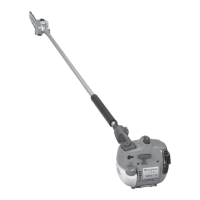
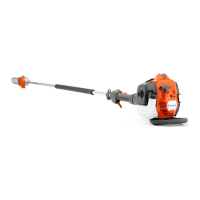
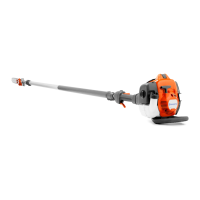
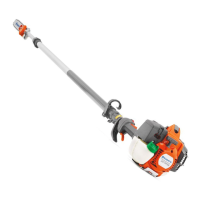
The provided document is a workshop manual for a Husqvarna 327 PT5S pole saw. This manual details the procedures for dismantling and assembling the saw head and the telescopic tube, offering guidance for maintenance and repair.

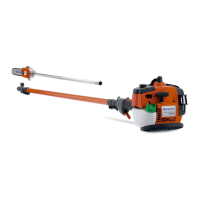
The Husqvarna 327 PT5S pole saw is a specialized tool designed for pruning and cutting branches at height, eliminating the need for ladders. Its primary function is to provide a safe and efficient way to maintain trees and shrubs from the ground. The "PT5S" designation likely indicates specific features related to its power, telescopic capability, and saw type.

Function Description:

The pole saw operates by means of a saw head, which houses the cutting mechanism (bar and chain), and a telescopic tube that extends to reach elevated branches. The saw head is driven by an engine (not detailed in this manual, but implied by components like the flywheel and drive wheel), transmitting power through a drive shaft that runs inside the telescopic tube. The oil pump, also located within the saw head, ensures proper lubrication of the bar and chain during operation, which is crucial for smooth cutting and preventing wear. The telescopic tube allows the operator to adjust the length of the pole saw, providing versatility for various cutting heights. The throttle control, integrated into the telescopic tube, enables the operator to manage the engine speed and, consequently, the cutting action.

Usage Features:

The design of the 327 PT5S emphasizes reach and maneuverability. The telescopic tube is a key feature, allowing the user to extend or retract the pole to suit the task at hand. This adjustability makes it suitable for a range of pruning jobs, from low-hanging branches to those high up in trees. The saw head is designed to be robust, capable of handling the demands of cutting wood. The oil tank and pump system are integrated to provide automatic chain lubrication, reducing the need for manual intervention during operation and ensuring consistent performance. The overall structure is built for outdoor use, with components designed to withstand the rigors of forestry and gardening tasks. The manual highlights the importance of proper assembly and maintenance to ensure safe and effective operation, implying that the tool is intended for users who are familiar with power equipment and safety protocols.

Maintenance Features:

The workshop manual provides detailed instructions for the maintenance and repair of the saw head and telescopic tube.

Saw Head Maintenance:

  • Dismantling and Assembly: The manual outlines a step-by-step process for disassembling the saw head, starting with the removal of the bar and chain, followed by detaching the saw head from the telescopic tube. This involves removing nuts, screws, and the drive wheel. The plastic cover and oil tank are also removed, with specific instructions to prevent the oil screen from detaching from the hose. Further dismantling involves prying off the oil pipe connection, removing the pump unit, and pressing out the pump axle. The input and output shafts are then dismantled, which requires removing circlips, heating the saw housing to 110°C, and using a wooden block or mandrel to extract components.
  • Cleaning and Inspection: During assembly, it is recommended to clean and inspect all components, replacing any worn or defective parts. The tank venting filter and oil screen should be cleaned, with the oil tank rinsed if necessary.
  • Lubrication: Specific instructions are given for lubricating the sprocket with gear housing grease (part number 579 06 49-01) during the assembly of the output and input shafts.
  • Sealing and Gaskets: The manual emphasizes checking the O-ring of the oil pump for damage and replacing it if needed, ensuring proper sealing. It also generally advises replacing dismantled sealing rings, lubricating sealing lips with grease, and ensuring correct orientation to maintain airtightness.
  • Special Tools: The manual mentions the need for special tools for certain tasks, such as mandrels for fitting ball bearings and removing plugs, and screwdrivers for prying and unscrewing.

Telescopic Tube Maintenance:

  • Dismantling and Assembly: The telescopic tube dismantling process begins with removing the saw head and detaching the tube from the clutch cover. Screws holding the tube and throttle control are loosened. The drive shaft, plastic pipe, and long drive shaft are then pulled out. Further disassembly involves loosening circlips and screws to remove the clamping sleeve and telescopic pipe. The throttle control cover and clamping sleeve are also removed, followed by the extraction of the pipe and rubber sleeve. Finally, circlips, ball bearings, and axle controls are removed from the bearing cage, and springs are pulled out.
  • Cleaning and Lubrication: During assembly, all components should be lubricated with a thin layer of grease.
  • Component Orientation: Critical instructions are provided regarding the correct direction for fitting the axle control in the ball bearings and telescopic tube, and ensuring the spring tongues on the bearing cage snap into place on the tube.
  • Securing Components: The manual stresses the importance of tightening screws that fit into holes and locking pipes in relation to each other.
  • Reassembly Sequence: The assembly process for both the saw head and telescopic tube is described as the reverse order of dismantling, with specific steps for fitting ball bearings, circlips, and other components, often requiring heating of parts for easier fitting.

Overall, the manual provides comprehensive guidance for maintaining the Husqvarna 327 PT5S pole saw, ensuring its longevity and safe operation through detailed repair procedures and best practices for handling components.

Husqvarna 327 PT5S Specifications

General IconGeneral
Engine Type2-stroke
Displacement25.4 cm³
Bar Length25 cm
Engine displacement25.4 cm³
Tube diameter28 mm
Fuel Tank Volume0.5 L
Maximum cutting length25 cm

Related product manuals