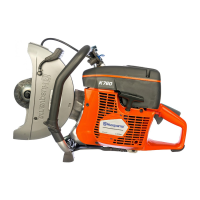
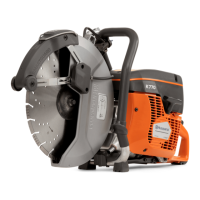
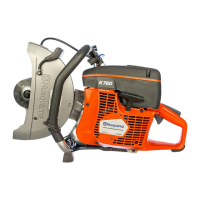
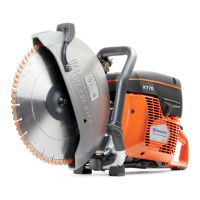
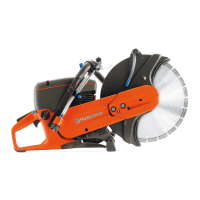
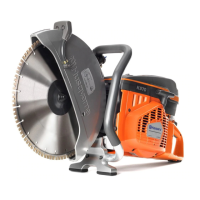
The Husqvarna K760 Cut-n-Break is a high-speed, hand-held power cutter designed for cutting hard materials such as masonry or reinforced concrete. It is not intended for any other purpose than those described in its operator's manual. Safe operation requires the operator to read and understand the manual thoroughly.
Function Description:
The K760 Cut-n-Break is equipped with a two-stroke engine that requires a mixture of gasoline and two-stroke engine oil for operation. It features a dual-blade system with specially developed patented diamond blades, which are designed for Cut-n-Break applications and approved for freehand cutting. The machine utilizes a centrifugal air cleaning system called Active Air Filtration™ for extended service life and longer service intervals. Its SmartCarb™ system provides automatic filter compensation to maintain high power and reduce fuel consumption. The Dura Starter™ is a dust-sealed starter unit with a sealed return spring and pulley bearing, making it virtually maintenance-free and more reliable. The X-Torq® engine technology offers increased torque across a wider range of speeds, maximizing cutting capacity while reducing fuel consumption by up to 20% and emissions by up to 60%. EasyStart technology ensures quick and easy starting by reducing pull resistance in the starter cord by up to 40% (by reducing compression during starting). An air purge diaphragm facilitates starting by pumping fuel to the carburetor, requiring fewer pulls. The DEX (Dust Extinguisher) system is a low-flushing wet cutting kit designed for effective dust handling. The machine also incorporates an efficient vibration damping system to reduce vibration transfer to the user's arms and hands.
Important Technical Specifications:
- Engine: Two-stroke, air-cooled.
- Cylinder displacement: 4.5 cu.in / 74 cm³
- Cylinder bore: 2 in / 51 mm
- Stroke: 1.4 in / 36 mm
- Idle speed: 2700 rpm
- Wide open throttle - no load: 9300 (+/- 100) rpm
- Power: 5.0 hp / 9000 rpm (3.7 kW / 9000 rpm)
- Ignition System:
- Manufacturer: SEM
- Type: CD
- Spark plug: Champion RCJ 6Y / NGK BPMR 7A
- Electrode gap: 0.020 in / 0.5 mm
- Fuel and Lubrication System:
- Carburetor manufacturer: Zama
- Carburetor type: C3
- Fuel tank capacity: 30 fl.oz / 0.9 litre
- Fuel mixture ratio: 1:50 (2%) with Husqvarna two-stroke oil or equivalent.
- Recommended octane grade: 87 ((RON+MON)/2) or higher.
- Ethanol blended fuel: E10 (max 10% ethanol blend) may be used.
- Water Cooling:
- Recommended water pressure: 7-150 PSI / 0.5-10 bar
- Weight:
- Power cutter without fuel (exclusive cutting blade): 21.2 lb / 9.6 kg
- Power cutter without fuel (inclusive cutting blade): 24.5 lb / 11.1 kg
- Cutting Equipment:
- Cutting blade: 9" (230 mm) diamond blades
- Max cutting depth: 16 in / 400 mm
- Max. peripheral speed: 16000 ft/min / 80 m/s
- Max. speed of output shaft: 5900 rpm
Usage Features:
- Safety: The machine is equipped with blade guards/spray guards to prevent material from being thrown towards the user and minimize contact with the cutting blade. A throttle lockout prevents accidental throttle operation. A stop switch is used to turn off the engine.
- Starting: For a cold engine, the decompression valve should be pressed, the air purge diaphragm pressed repeatedly (about 6 times) until fuel fills, the stop switch set to the left position, and the choke control pulled out completely. For a warm engine, the stop switch is set to the left, the choke control in the choke position (automatic start throttle), and the decompression valve pressed. The starter handle is pulled firmly and rapidly.
- Cutting Technique: Always hold the saw with both hands, maintaining a firm grip. Cut from top to bottom. Avoid standing directly behind the cutting blade to prevent injury from kickback. The machine should work without forcing or pressing the blade. When cutting into an existing cut, ensure the cut is wide enough and blades are not angled to prevent kickback. The breaking tool is used to remove material between cuts. The "Cut-n-Break" method involves making parallel cuts and then breaking out the remaining material.
- Dust Management: The DEX system provides low-flushing wet cutting to suppress dust. Water flow can be adjusted via a tap.
- Kickback Avoidance: Understand the kickback zone and avoid using it for cutting. Support the workpiece to keep the cut open and prevent the blade from pinching. Be alert to workpiece movement.
- Pipe Cutting: Special care is required when cutting pipes to ensure they are properly supported and the cut remains open to prevent pinching and kickback.
Maintenance Features:
- Daily Maintenance: External cleaning, cleaning of cooling air intake, checking the spark plug (electrode gap 0.5 mm), general inspection (tightness of nuts and screws), throttle lockout, stop switch, blade guards, and blades.
- Weekly Maintenance: Cleaning, functional inspection of vibration damping system, muffler, drive belt, carburetor, and starter.
- Monthly Maintenance: Cleaning of spark plug and fuel tank, functional inspection of fuel system, air filter, drive gear, clutch, and water tap.
- Blade Replacement: Blades are changed in pairs and include integrated belt pulley halves. The screw kit must be replaced when changing blades. The drive belt tensioner is adjusted during blade replacement.
- Drive Belt: The drive belt is enclosed. Check and adjust its tension (should have about 5 mm of movement). Replacement involves removing the cutting arm, loosening belt cover screws, removing the old belt, and fitting a new one.
- Carburetor: Fixed needles ensure correct fuel/air mixture. If power is low or acceleration poor, check the air filter. Idle speed can be adjusted with the T screw; the cutting blade should be stationary when idling.
- Starter: The recoil spring is under tension and requires caution during maintenance. Changing a broken or worn starter cord involves removing the starter, guiding the cord through the pulley, and tensioning the recoil spring (3 turns clockwise, then 4 more turns).
- Fuel System: Check fuel cap, seal, and hose for damage. The fuel filter inside the tank should be replaced at least once a year.
- Air Filter: Check and replace if necessary when engine power drops. Do not clean with compressed air.
- Drive Gear/Clutch: Check clutch center, drive gear, and clutch spring for wear.
- Water Tap: Check and clean the restrictor.

 Need help?




 To Next Page
 General