4000 SRM 660 Safety Procedures When Working Near Mast
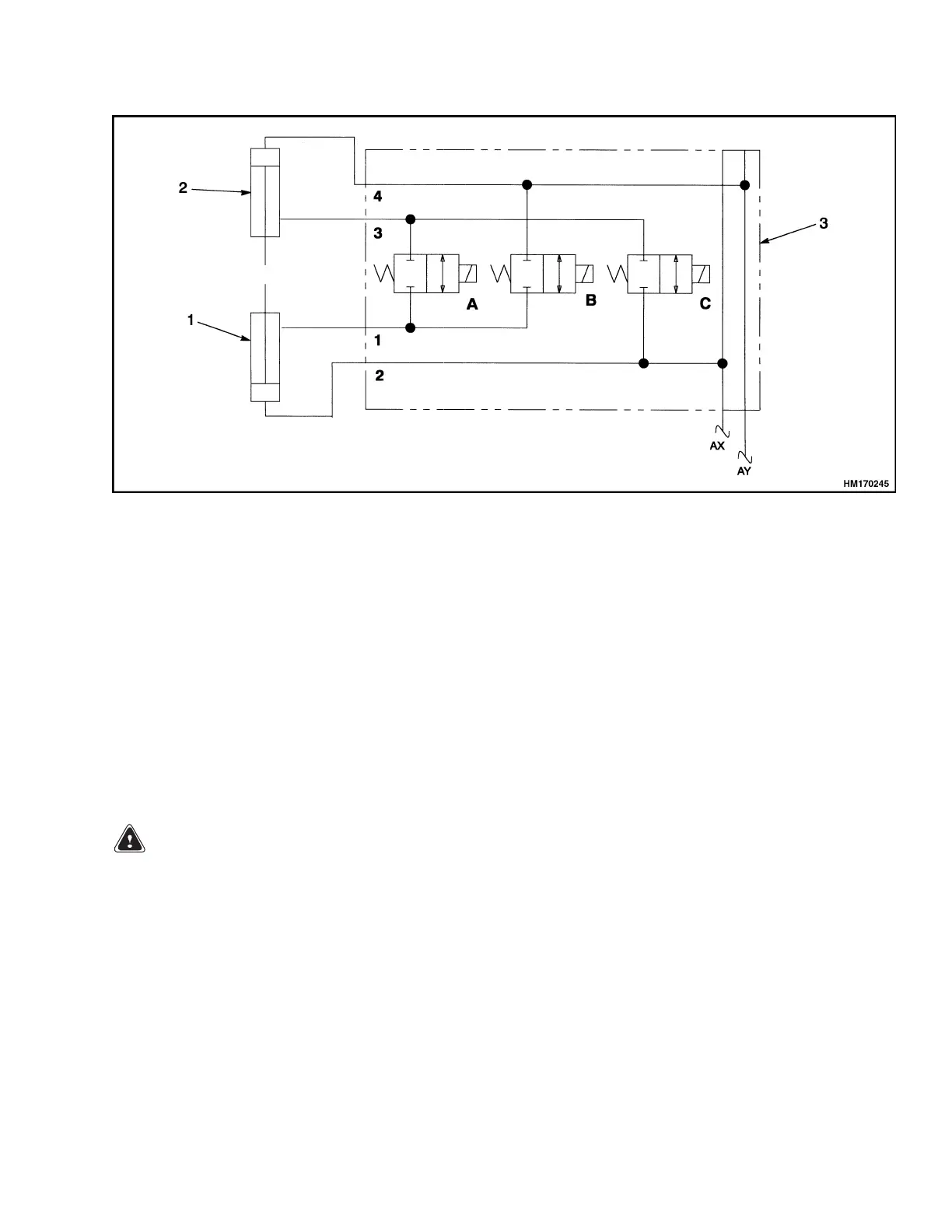
NOTE: PORTS: 1 = LEFT-HAND CYLINDER (ROD END), 2 = LEFT-HAND CYLINDER (PISTON END), 3 =
RIGHT-HAND CYLINDER (ROD END), 4 = RIGHT-HAND CYLINDER (PISTON END). SOLENOIDS: SOLENOID
A (SIDESHIFT), SOLENOID B (RIGHT FORK), SOLENOID C (LEFT FORK).
1. LEFT-HAND CYLINDER (MOVES RIGHT-HAND FORK)
2. RIGHT-HAND CYLINDER (MOVES LEFT-HAND FORK)
3. SELECTOR VALVE
Figure 2. Hydraulic Schematic (Selector Valve)
Safety Procedures When Working Near Mast
The following procedures must be used when inspect-
ing or working near the mast. Additional precautions
and procedures can be required when repairing or re-
moving the mast.
WARNING
Mast parts are heavy and can move. Distances
between parts are small. Serious injury or
death can result if part of the body is hit by
parts of the mast or the carriage.
• Never put any part of the body into or under
the mast or carriage unless all parts are com-
pletely lowered or a safety chain is installed.
Also make sure that the power is off and the
key is removed. Put a DO NOT OPERATE tag
in the operator’s compartment.
• Be careful of the forks. When the mast is
raised, the forks can be at a height to cause
an injury.
• Do NOT climb on the mast or lift truck at any
time. Use a ladder or personnel lift to work
on the mast.
• Do NOT use blocks to support the mast weld-
ments nor to restrain their movement.
• Mast repairs require disassembly and re-
moval of parts and can require removal of
the mast or carriage. Follow the repair pro-
cedures in the correct Service Manual for
the mast.
WHEN WORKING NEAR THE MAST ALWAYS:
1. Lower the mast and carriage completely. Push
the lift/lower control lever forward and make
sure there is no movement in the mast. Make
sure that all parts of the mast that move are
fully lowered.
OR
3


 To Next Page