Need help?
Do you have a question about the Hyster S30XM and is the answer not in the manual?
Overview of the frame, hydraulic and fuel tanks, and operator module.
Safety precautions and steps to remove the operator module from the frame.
Procedure for installing the operator module onto the frame, including mount alignment.
Steps and safety notes for removing the hood and seat assembly.
Procedure for installing the hood and seat assembly onto the lift truck.
Procedure for removing and installing the overhead guard, including safety warnings.
Steps for removing the counterweight, including safety warnings for LPG and heavy lifting.
Procedure for installing the counterweight, including mount spacers and torque specifications.
Procedure for replacing the muffler, noting counterweight removal is required.
Steps for draining coolant and removing the radiator, including a hot coolant warning.
Procedure for installing the radiator, fan, and fan shroud, and connecting hoses.
Checking seat belt, hip restraint, hood, and latch for proper function and adjustment.
This document is a service and repair manual for Hyster C010 (S25XM, S30XM, S35XM, S40X MS) forklifts, specifically focusing on the frame and related components. It covers models H1.50-1.75XM (S/H25-35XM) and H2.00XMS (S/H40XMS) with serial codes [C010, D001, D010, E001]. The manual provides detailed instructions for maintenance and repair procedures, emphasizing safety precautions throughout.
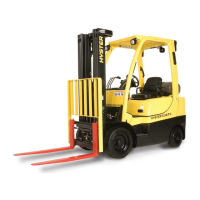
The Hyster C010 series forklifts are designed for material handling, utilizing a robust frame as their core structural component. This frame integrates the hydraulic tank and the fuel tank, which can be configured for gasoline, Liquid Petroleum Gas (LPG), Compressed Natural Gas (CNG), or Diesel fuel, although Diesel fuel is not used on S25-35XM or S40XMS models. An operator module, including the overhead guard, steering controls, hydraulic control valve, instrument panel, hood, and seat, is mounted on the frame using rubber mounts to reduce vibration and enhance operator comfort. Counterweights are attached to the frame to provide stability, with different weights available depending on the lift truck's capacity. The exhaust system, including the muffler, is typically housed within the counterweight cavity, with options for standard or overhead exhaust configurations.
The manual details various weights for the counterweights, which are crucial for maintaining the lift truck's stability and operational safety. These weights vary by model:
The operator module, including the overhead guard, weighs approximately 385 kg (850 lb), requiring a lifting device for removal and installation. Specific torque values are provided for fasteners, such as the lock nuts for the operator module mounts (36 N•m or 27 lbf ft), overhead guard bolts (65 N•m or 48 lbf ft), counterweight capscrews (555 N•m or 409 lbf ft), and exhaust pipe nuts (16 to 23 N•m or 12 to 17 lbf ft for gasoline/LPG; 32 to 47 N•m or 24 to 35 lbf ft for diesel). Overhead exhaust vertical pipe capscrews are tightened to 15 to 18 N•m (11 to 13 lbf ft).
The design of these forklifts incorporates several features to facilitate operation and maintenance. The hood is hinged and assisted by two torsion springs, allowing it to be raised for access to internal components. A support rod holds the hood in the open position. Removable floor plates and side covers further enhance access to the engine, transmission, and other components. The operator restraint system, comprising the seat belt, hip restraint, seat, hood, and latch, is designed for operator safety and requires regular checks for proper function and condition. The hood latch has two positions, indicating full closure after two clicks, and must be correctly adjusted for the restraint system to function effectively.
The manual outlines comprehensive maintenance and repair procedures, emphasizing safety as a primary concern.


 To Next Page
 General