This document is a service manual for the Robex 290LC-9MH Crawler Excavator, manufactured by Hyundai Construction Equipment. It provides comprehensive information on the structure, function, specifications, operation, and maintenance of the machine.
Function Description
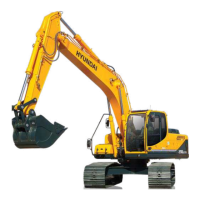
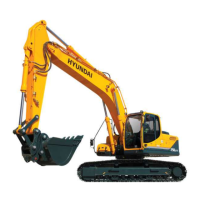
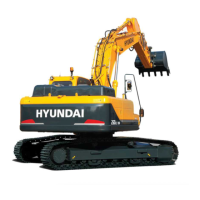
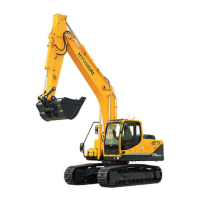
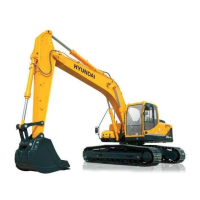
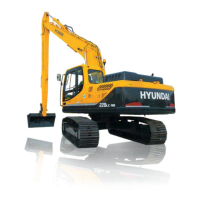
The Robex 290LC-9MH is a crawler excavator designed for heavy-duty construction and excavation tasks. It is equipped with a grapple attachment, making it suitable for material handling, demolition, and other applications requiring precise gripping and lifting capabilities. The excavator's robust design and powerful hydraulic system enable efficient operation in various working conditions.
Important Technical Specifications
The manual details two main configurations for the Robex 290LC-9MH: one with a 7.8 m (25' 7") boom, 5.4 m (17' 9") arm, and 1.2 m (3' 11") tilt cab, and another with a 7.8 m (25' 7") boom, 5.4 m (17' 9") arm, and 2.0 m (6' 7") elevating cab.
General Specifications (Tilt Cab / Elevating Cab):
- Operating weight: 32,710 kg (72,110 lb) / 33,660 kg (74,210 lb)
- Grapple capacity, standard: 0.90 m³ (1.18 yd³)
- Overall length: 11,085 mm (36' 4")
- Overall width, with 800mm shoe: 3,520 mm (11' 7")
- Attachment height: 4,170 mm (13' 8")
- Superstructure width: 2,980 mm (9' 9")
- Overall height of cab: 4,445 mm (14' 7") (Tilt Cab) / 3251/5042 mm (10' 8" / 16' 7") (Elevating Cab)
- Ground clearance of counterweight: 1,185 mm (3' 11")
- Engine cover height: 3,190 mm (10' 6")
- Minimum ground clearance: 500 mm (1' 8")
- Rear-end distance: 3,120 mm (10' 3")
- Rear-end swing radius: 3,200 mm (10' 6")
- Distance between tumblers: 4,030 mm (13' 3")
- Undercarriage length: 4,883 mm (16' 0")
- Undercarriage width: 3,400 mm (11' 2")
- Track gauge: 2,600 mm (8' 6")
- Track shoe width, standard: 800 mm (32")
- Travel speed (low/high): 3.5 / 5.5 km/hr (2.2 / 3.1 mph)
- Swing speed: 10.5 rpm
- Gradeability: 35 (70) Degree (%)
- Ground pressure (800 mm shoe): 0.47 kgf/cm² (6.68 psi) (Tilt Cab) / 0.48 kgf/cm² (6.83 psi) (Elevating Cab)
- Max traction force: 27,300 kg (60,200 lb)
Working Range (7.8 m Boom, 5.4 m Arm):
- Max working reach (A): 13,090 mm (42' 11")
- Max working height (B): 14,590 mm (47' 10")
- Max working depth (C): 6,190 mm (20' 4")
Weight Breakdown:
Key components and their weights are listed, including the upperstructure, engine, main pump, swing motor, hydraulic oil tank, fuel tank, counterweight, cab, and various boom and arm assemblies. For example, the engine assembly weighs 556 kg (1230 lb), and the main pump assembly weighs 140 kg (310 lb).
Lifting Capacities:
Detailed load radius charts are provided for both "rating over-front" and "rating over-side or 360 degree" scenarios, with various boom and arm configurations (3.0 m, 4.5 m, 6.0 m, 7.5 m, 9.0 m, 10.5 m, 12.0 m). These charts specify the maximum load that can be lifted at different reaches and heights, with critical notes on hydraulic capacity and stability. For instance, with a 7.8 m boom and 5.4 m arm, at a 3.0 m load radius and 12.0 m load point height, the capacity is 7367 kg (16241 lb) over-front and 7367 kg (16241 lb) over-side or 360 degrees.
Grapple Specifications:
- Orange grapple: 0.90 m³ (1.18 yd³) lifting capacity, 2000 mm (6' 7") max opening width, 1400 kg (3090 lb) weight.
- Wood grapple: 1.90 m³ (2.49 yd³) lifting capacity, 3500 mm (11' 6") max opening width, 2100 kg (4630 lb) weight.
Undercarriage:
- Tracks: X-leg type center frame, reinforced box-section track frames, dry tracks, lubricated rollers, idlers, sprockets, hydraulic track adjusters with shock absorbing springs, and assembled track-type tractor shoes with triple grousers.
- Number of rollers and shoes on each side: 2 carrier rollers, 9 track rollers, 48 track shoes.
Engine (HYUNDAI HE6.7):
- Type: 4-cycle turbocharged diesel engine
- Cooling method: Water cooling
- Number of cylinders and arrangement: 6 cylinders, in-line
- Firing order: 1-5-3-6-2-4
- Combustion chamber type: Direct injection type
- Cylinder bore × stroke: 107 × 124 mm (4.21" × 4.88")
- Piston displacement: 6700 cc (409cu in)
- Compression ratio: 17.2 : 1
- Rated gross horse power (SAE J1995): 227 Hp at 1900 rpm (169 kW at 1900 rpm)
- Maximum torque: 97.0 kgf·m (701 lbf·ft) at 1400 rpm
- Engine oil quantity: 24 l (6.3 U.S. gal)
- Dry weight: 556 kg (1226 lb)
- High idling speed: 1850 ± 50 rpm
- Low idling speed: 800 ± 100 rpm
- Rated fuel consumption: 166.3 g/Hp·hr at 1900 rpm
- Starting motor: 24 V-4.5 kW
- Alternator: 24 V-90 A
- Battery: 2 × 12 V × 160 Ah
Main Pump:
- Type: Variable displacement tandem axis piston pumps
- Capacity: 2 × 140 cc/rev
- Maximum pressure: 350 kgf/cm² (4980 psi) [380 kgf/cm² (5400 psi)]
- Rated oil flow: 2 × 252 l/min (66.6 U.S. gpm / 55.4 U.K. gpm)
Gear Pump:
- Type: Fixed displacement gear pump single stage
- Capacity: 15 cc/rev
- Maximum pressure: 40 kgf/cm² (570 psi)
- Rated oil flow: 27 l/min (7.1 U.S. gpm / 5.9 U.K. gpm)
Main Control Valve:
- Type: 10 spools
- Operating method: Hydraulic pilot system
- Main relief valve pressure: 350 kgf/cm² (4980 psi) [380 kgf/cm² (5400 psi)]
- Port relief valve pressure (Boom/Arm/Bucket): 400 kgf/cm² (5690 psi)
Swing Motor:
- Type: Axial piston motor
- Capacity: 169.4 cc/rev
- Relief pressure: 300 kgf/cm² (4270 psi)
- Braking system: Automatic, spring applied hydraulic released
- Braking torque: 70 kgf·m (506 lbf·ft)
- Brake release pressure: 26 kgf/cm² (370 psi)
- Reduction gear type: 2 - stage planetary
Travel Motor:
- Type: Variable displacement axial piston motor
- Relief pressure: 350 kgf/cm² (4980 psi)
- Capacity (max / min): 154.8/88.5 cc/rev
- Reduction gear type: 3-stage planetary
- Braking system: Automatic, spring applied hydraulic released
- Brake release pressure: 9 kgf/cm² (128 psi)
- Braking torque: 40 kgf·m (290 lbf·ft)
Remote Control Valve:
- Operating pressure (Minimum/Maximum): 6.5 kgf/cm² (92 psi) / 26 kgf/cm² (370 psi)
- Single operation stroke (Lever/Pedal): 61 mm (2.4 in) / 123 mm (4.84 in)
Cylinder:
- Boom cylinder: Bore dia × Rod dia × Stroke: ø140 × ø100 × 1465 mm, Cushion: Extend only
- Arm cylinder: Bore dia × Rod dia × Stroke: ø150 × ø110 × 1765 mm, Cushion: Extend and retract
Recommended Oils:
The manual provides a detailed chart for recommended oils and fluids based on ambient temperature, including engine oil (SAE 10W to SAE 15W-40), swing drive oil (SAE 75W-90, SAE 80W-90), final drive oil (SAE 80W-90), hydraulic oil (ISO VG 32 to ISO VG 68), diesel fuel (ASTM D975 NO.1, NO.2), grease (NLGI NO.1, NO.2), and radiator coolant (Ethylene glycol base permanent type 50:50, 60:40).
Usage Features
The Robex 290LC-9MH is designed for versatility and operational efficiency.
- Grapple Attachment: The inclusion of a grapple (orange or wood) as a standard or optional attachment highlights its suitability for tasks beyond traditional digging, such as handling logs, scrap metal, or demolition debris.
- Cab Configurations: The availability of both tilt and elevating cabs allows operators to choose the configuration best suited for their specific work environment, optimizing visibility and comfort. The elevating cab, in particular, would be beneficial for tasks requiring a higher vantage point.
- Working Modes: The machine likely features various working modes (e.g., power mode, work mode, user mode) to optimize performance and fuel efficiency for different tasks, though specific details are in a later section.
- Travel Speed: With a travel speed of up to 5.5 km/hr, the excavator can be moved efficiently around job sites.
- Gradeability: A gradeability of 35 degrees (70%) indicates its capability to operate on sloped terrain.
Maintenance Features
The service manual emphasizes the importance of proper maintenance for the longevity and safe operation of the excavator.
- Service Manual Purpose: The manual serves as an aid to improve the quality of repairs and provides technical information for operations performed in a service workshop.
- Structure and Function Sections: These sections provide a detailed understanding of the machine's components, which is crucial for effective troubleshooting and maintenance.
- Hydraulic and Electrical System Sections: These sections offer in-depth information on the hydraulic circuit, single and combined operation, and electrical circuit, monitoring system, and each component, aiding in diagnosing and repairing these complex systems.
- Mechatronics System Section: This section explains the computer-aided power optimization system and each component, indicating advanced diagnostic capabilities.
- Troubleshooting Section: This section highlights common problems and their causes, providing a structured approach to identifying and resolving issues.
- Maintenance Standard Section: This section gives judgment standards when inspecting disassembled parts, ensuring that components are within acceptable wear limits.
- Disassembly and Assembly Section: This section provides detailed procedures for removing, installing, disassembling, or assembling each component, along with precautions to be taken.
- Component Mounting Torque Section: This section shows bolt specifications and standard torque values needed when mounting components, ensuring correct assembly and preventing damage.
- Recommended Oils: The detailed oil chart, specifying types and capacities based on ambient temperature, is critical for proper lubrication and fluid management, which directly impacts component lifespan and performance.
- Safety Precautions: The manual includes extensive safety hints covering various aspects of service work, such as wearing protective clothing, warning others, using handholds, preparing for emergencies, protecting against flying debris and noise, avoiding power lines, keeping riders off, operating safely, supporting the machine, handling fluids, preventing exhaust fumes, illuminating work areas, servicing machine safely, staying clear of moving parts, avoiding high-pressure fluids, avoiding heating near pressurized fluid lines, preventing battery explosions, preventing acid burns, using tools properly, disposing of fluids properly, replacing safety signs, and living with safety. These precautions are fundamental for preventing accidents and ensuring a safe working environment.
- Conversion Table: The inclusion of conversion tables for millimeters to inches, kilogram to pound, liter to U.S. gallon, liter to U.K. gallon, kgf·m to lbf·ft, kgf/cm² to lbf/in², and temperature (Fahrenheit-Centigrade) simplifies working with different units of measurement, which is helpful for international maintenance teams.

 Need help?
 General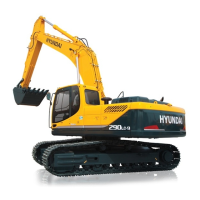


 To Next Page