IBM
1005A Input
Communication
Adapter
IBM
1005B
Output Communication
Adapter
The
18M 1005A Input
Communication
Adapter (1cA)
and
1005B Output Communication
Adapter (oca)
transfer
data between two
data-handling systems havy-
ing
different codes, speeds,
and control systems. These
two
systems are: (1) a telegraph system, and (2) an
1BM
9000 series Airlines Reservation System. The 1ca
and
the oca are completely
independent units. The 1ca
transfers
information from
a telegraph network to an
18M
1006 Terminal Interchange; the oca does the re-
verse.
The principal advantages
of using the 1ca and
the
oca to transfer data between the two systems are:
Their translation of telegraph code into true scp code
that needs no further programmed translation in
the data processing center, and vice versa.
The
1ca’s automatic editing of the incoming tele-
graph message and the oca’s automatic insertion
of special telegraph control characters in outgoing
messages.
The compatibility of their scp control signals with all
types of data processing center equipment.
The automatic retransmission by the 1ca of any
input message that is in error when received at
the data processing center.
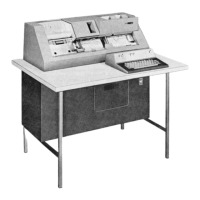
The 1ca and the oca (Figure 26) are identical in
external
appearance except for differing operator’s
panels. Each can have a maximum cable length to the
Figure 26. 13m 1005 Input
Communication Adapter or
Output Communication Adapter
26
terminal
interchange
of 1,500 feet
and a maximum
cable
length
to the telegraph
equipment
of 50 feet.
Both
units are
normally
unattended.
Input
Communication
Adapter
Functions
To
transfer telegraphic
data into the
Airlines Reserva-
tion
System, the ca
translates codes,
edits the incoming
telegraph
code, recognizes
a telegraph end-of-message
sequence,
and retransmits
a message
if necessary.
Associated
functions are: controlling
input from tele-
graph
equipment, using messages of preset formats,
and
alerting an operator to
any alarm condition that
may arise.
Translating
The
1ca accepts from the telegraph equipment a five-
level
code and translates this code into binary-coded-
decimal
(scp) characters (Figure 27). The five-level
code
has two “shift” characters, letters shift and figures
shift, enabling the 1ca to distinguish between alpha-
betic
and numeric (including punctuation) characters.
As
soon as they have served this purpose, the shift
characters
are edited out of the message that is relayed
into
the 9000 series system. Blank characters are also
edited.
The
telegraph-code input to the ica is parallel by bit
and
serial by character (Figure 27A); the scp char-
acters
are transmitted to the terminal interchange
serially
by bit and serially by character. The 1ca can
receive
input speeds up to 200 words per minute
(20 characters per second); it transmits each character
as
it is received from the telegraph equipment. During
retransmission, it transmits 23 characters per second.
The
bit rate of transmission and retransmission is
approximately
207 bits per second.
Characters sent from the ica to the terminal inter-
change
consist of:
Start bit, check bit, six data bits, stop bit
Several
different sequences of as many as four char-
acters are used in telegraph code to signify the end
of
a message. The 1ca can be programmed to recognize
any
one of these; the programming can be easily modi-
fied whenever necessary.
))
BCD Code Telegraph Code
(A
1 bit indicates a hole
in punched paper tape)
BABY ace al le 28 Aro Shift Key
Teele 50 OC Or 10720; 0 L A
Te 0) 20.320 AO Oe | is B
Ole OO) Aa Oe ono) i (|
ee tg. 1 0.0 1070.10 iE D
Oe a Oe) 10:00 0 a E
Oy 10, 11 20 0 bE 0 5 E
ele) 01] 0 1°61] L G
Voll 10;.0..0 O70 Ors L H
On aleo. 0:4 (oF es th 6] E |
Osi 70 30 40.0} We eg) L E
Ot -0.0- 0 1-0 Troe to E K
40) 10700 sieti Of 00a is Lb
OE 0- 0-1 070 Vago Alle LE M
121,070 f.0. 1 0. 0.1.1°0 L N
MeO Ole 0 OF 02051 41 Ee (@)
Onl Osa 12) Oodle 0. lh P
O10: 160, OF0 ele 0 LE Q
Lea? Ve0e0 2 ORF F080) LE R
OenO sl s0n07 1.0) 1102 1.0 a0 L Ss
sO se) 20) O21 0707070) L a
OPO) 18100: eet 0 0 E U
W010) 0] OTE Bee Sb | L: Vv
0 a OFF 0. Ea 0.0 4 L Ww
O20 10 1 t £2611 LE X
0-0. 020. 102 1.20 #1 L ry,
EO. 11. O70 4 12020 70 1 L zi
Oc O10. 1 0 00 8 agli 9 F 0
1430; 302:02:0. 044 ET 20-1 FE ]
120)
0.-0:.0 12,0 12120: 0. | F 2
O07 00 0.1) 132070070 E 3
1508-020) 4070 O21 011-0 F 4
0F07.0-0-4..0, 1 020: 0:01 F 5
(3 osha 9 0 oes Kaa 6) ha 0es a0je E 6
080 20 71s1:-1 118582040 3 4
10.0.1. 02.020 O71 1,.0..0 E 8
ou
UTU yt 07020 ri EF 7,
O70" 1 0r0 70! HO EF vA
130 071-0 171 le 16027 20 E 4s
O50 10a 1 0-001 10 3
O31 Del On tcd Jz
0.40.41 0 F $
Lia L120 44 0 0.41244 5 P
he Orly Ora -O (Oe lasts ks Pos| li ;
bee te ae eS 151202050 FE -
OA} si40 0.0.0, Dp 120. As | EF &
1:02 10.070 0 0.0:1°071 F #
0-0:
0 -Foi 141
ele ORNS Lore 0,312.0: 0: «] F )
On el A
1 tora 8 11.0 P (
OF als Ot 0. Te 000 S131 E td
1
onions 0 Tel Onl ears FiguresShift (4)
Oe OF al 0 1707020 4 E i
O00" Al 0-0 OO" O20 Lr Carriage Return (<)
07 fies 13.020 020.1070 LYE Space (=)
1120-11080 Tt | LettersShift (+)
(=ae BS ise HENGE Leeroy a} O71 0i.0 E bell
T7205 sOesl al erg 0F.4550:.0 0 LE Line Feed )
OreOh aa eG O10 E :
hy Oa sla leeks <a T0elk0
F !
Figure
27. Telegraph-scp Equivalents
Letters
9g
8
01
Azo 7226
ABCDE FGHI JKL MNOPQRSTUVWXYZ
V
ees
3—|@
4__ |@e0@
5—|ee
ee ece
2_|e@ © @ @
Figure 27A. Paper Tape Characters
Transmitting
After accepting, translating,
and transmitting as many
as
95 data characters (excluding edited characters),
the 1ca stops further data transmission
to the terminal
interchange until it receives
an “answer-back” from the
data processing center. The
answer-back is a one-char-
acter message (address characters
are dropped in the
interchange) signifying that
the data processing center
has received the input message, checked it for char-
acter errors, and found it correct. If the 1ca fails to
receive the answer-back within a predetermined inter-
val of time, it retransmits the input message. If it again
fails to receive an answer-back within the time limit,
it sounds an alarm to summon an operator.
Alarm Conditions
Four alarm conditions cause the 1cA to summon the
services of an operator. They
are: input check, output
check, time-out, and reader check. The first three con-
ditions cause the re-enter light to come on; the fourth
causes the reader check light to come on. Any of these
conditions causes the audible alarm to be sounded.
The input check alarm results when the terminal
interchange senses an invalid character in an input
message from the Ica.
The output check alarm is produced when the 1ca
receives an output message (answer-back) that is an
invalid character instead of an end-of-message char-
acter.
The
time-out alarm occurs when the following se-
quence of events has taken place: the 1ca has trans-
mitted a message to the terminal interchange; it has
not received an answer-back within the preassigned
time;
it has retransmitted the message once; it has not
received
an answer-back from the retransmitted mes-
sage.
The
reader check alarm signifies to the operator that
some
error condition exists in the telegraph equipment
to
which it is connected.
Input Communication Adapter Operations
Operations performed by the input communication
adapter in carrying out its various functions can be
divided into four phases or modes:
Input Mode: In this mode, data are received from
the
telegraphic equipment, translated, and edited. As
each
character is stored in 1ca storage, it is transmitted
over the data input line to the terminal interchange.
Wait Mode: Upon filling its storage or recognizing a
telegraph end-of-message sequence, the Ica goes into
Communication
Adapters 27


 To Next Page
 Loading...