Agents’ Sets
Most transactions in airlines
reservation systems are
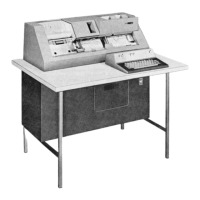
initiated either by agents’ entries into the agents’ sets
(Figure 1) or by external telegraph
inquiries. All entries
pass through a transmission network into the data proc-
essing center, where the computer acts upon them,
prepares a response, transmits it to the appropriate
remote equipment, and causes it to be displayed—
either
at the agent’s set (in printed form or by lighted
indicators)
or as punched paper tape at other remote
low-speed
equipment.
By
far the largest amount of input and output data
for
an airline’s reservation
system passes through the
agents’
sets. See Figure
2. Designed
for manual input,
the
set contains:
(1) a card reader
with pushbutton
controls
—the 13m 1003 Air Information Device —
in
which the proper air information
sheet is inserted
manually
by the agent;
(2) an 18M 1003
Routine Action
Pushbutton
Module on which
the agent enters and re-
quests
flight reservation information;
(3) an 1mm 1003
92300900000
ono
AID
(IBM
1003A)
|-O
Device
(1BM
1003)
AIS
Card
Well
mae
a
Terminal
Control
(IBM
1004)
Figure 2. 1M
1003A Terminal
and 1004 Terminal
Control
6
Figure
1. Airline Reservation Agent’s Set
Input-Output
Device used by the agent for manual
entries
of passenger data and also by the computer for
automatic
printing of output messages; and (4) an IBM
1004
Terminal Control containing the circuitry re-
quired
for agent’s set operation. 18M installs these
pieces of equipment in the customer’s desk or counter.
Component Description
IBM 1003A Air Information
Device
As the first step in inquiring
for information about any
flight, the agent picks from
a file of air information
sheets one containing the desired
cities of departure
and arrival. The operator
places this
air information
sheet (ats) in the ars holder
of the air information de-
vice (am). The am
(Figure 3) establishes
the identity
of the particular air
information sheet
by sensing holes
punched at the bottom
of the sheet. Twenty-three
pos-
sible
punched-hole positions
are provided, consisting
of
three data fields of seven positions each and two
additional
positions to ascertain that the card is prop-
erly
positioned (Figure 4).
The 21 positions of the
three
data fields constitute three characters and allow
68,921
possible combinations.
When the ais is correctly
positioned,
the card check light comes on.
The
air information sheets are printed and punched
by
a printing service according
to: (1) the quantity
specifications
(provided by
the airline) for cards of
each
desired punched-hole combination, and (2) the
reader-punch
equipment and
master cards designed
by
1pm.
LINE
SELECTOR (FLIGHT) BUTTONS
At the left margin of the card holder are two vertical
columns of eight buttons each, staggered so that suc-
cessive horizontal rows on the air information sheet
are indicated by alternate columns. If one of these but-
tons is pressed, all others are released. These are called
00
@00000080
FROM
DETROIT TO SAN FRANCISCO:
Flight
| Leave Arrive Flight
Frequency
Meal Fore
* 1 leave Arrive
iu
TBM 22-Procosany
remo
ce
A CST |
Figure 3. Air Information
Device
with Air Information
Sheet
Agents’ Sets 7


 To Next Page
 Loading...