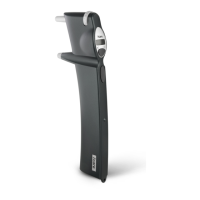
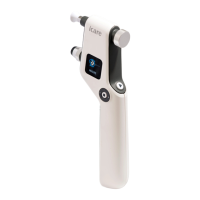
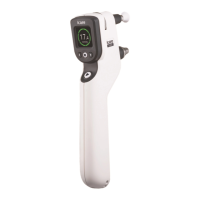
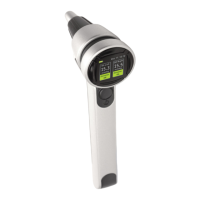
Icare HOME tonometer Instruction manual for health care professionals
English
• High corneal astigmatism >3D in the study eye(s) based on their current refractive
prescription if available. Those without a prescription will undergo auto-refraction to
obtain Keratometry readings.
• Disabling arthritis or limited motor coordination limiting self-handling of the Icare
Home tonometer
• Lack of comprehension or willingness to use the tonometer as instructed
• Corneal scarring
• History of prior incisional glaucoma surgery or corneal surgery, including corneal laser
surgery in the study eye
• Microphthalmos
• Buphthalmos
• Contact Lens Use
• Symptoms of Dry Eye Syndrome and signs of dry eye on examination of cornea
• Known history of difficulty in obtaining Goldmann IOP measurements or any factors
that might contribute to inaccurate Goldmann IOP measurements (e.g. lid squeezing or
tremor)
• Nystagmus
• Keratoconus
• Any other corneal or conjunctival pathology or infection
• Central corneal thickness greater than 0.60 mm or less than 0.50 mm in the study eye
• Inability to demonstrate proficiency with Icare Home tonometer after training and
failure to complete certification procedures described in the attachment to this
protocol
• Cataract Extraction within last 2 months in study eye
Table 1 provides demographics of the completed eligible subjects and distribution of
intraocular pressures.
Table 1. Demographics of the completed eligible subjects and distribution of IOP.
Demographics
Age N
Mean (SD)
Min, Max
Gender Male
Female
Race Asian Indian
Black/African
American
Black/African
American,
American Indian
or Alaska Native
Black/African
American, White
Chinese
Chinese, Korean
Filipino
Filipino, Japanese
Japanese
Korean
Native Hawaiian
Other Asian
Vietnamese
White
Refused
Overall
383
66.1 (12.6)
35, 95
171 (44.6%)
212 (55.4%)
2 (0.5%)
70 (18.3%)
1 (0.3%)
1 (0.3%)
15 (3.9%)
1 (0.3%)
8 (2.1%)
1 (0.3%)
157 (41.0%)
9 (2.3%)
1 (0.3%)
5 (1.3%)
1 (0.3%)
108 (28.2%)
3 (0.8%)
www.icaretonometer.com
25
Icare HOME
Icare HOME tonometer Instruction manual for health care professionals
English
Table 2 provides descriptive statistics for the IOP measurements from the Icare Home,
GAT, and TA01i.
Table 2. Descriptive Statistics of IOP Measurements (Effectiveness Analysis Cohort)
Not
Spanish/
Hispanic/Latin o
Mexican,
Mexican Am.,
Chicano
Puerto Rican
Other
Spanish/
Hispanic/Latino
Handedness Right
Left
Ambidextrous
Study Eye OD (Right)
OS (Left)
IOP Group
16 mmHg
> 16 to <23
mmHg
23 mmHg
% =
Count
N
100. 9 eyes had IOP ≥ 30 mmHg.
Demographics
355 (92.7%)
16 (4.2%)
2 (0.5%)
10 (2.6%)
355 (92.7%)
23 (6.0%)
5 (1.3%)
206 (53.8%)
177 (46.2%)
146 (38.1%)
169 (44.1%)
68 (17.8%)
Overall


 To Next Page