SERVICE AND TECHNICAL SUPPORT MANUAL Gas Furnace: (F/G)9MVE
Specifications subject to change without notice.
440 04 4801 00 32
The blower motor BLWM will revert to continuous−blower
airflow after the heating cycle is completed. In high−heat,
the furnace control CPU will drop the blower motor
BLWM to low−heat airflow during the selected
blower−OFF delay period before transitioning to
continuous−blower airflow.
When the thermostat “calls for low−cooling”, the blower
motor BLWM will switch to operate at low−cooling airflow.
When the thermostat is satisfied, the blower motor
BLWM will operate an additional 90 seconds at
low−cooling airflow before transitioning back to
continuous−blower airflow.
When the thermostat “calls for high−cooling”, the blower
motor BLWM will operate at high cooling airflow. When
the thermostat is satisfied, the blower motor BLWM will
operate an additional 90 seconds at high−cooling airflow
before transitioning back to continuous−blower airflow.
When the R−to−G circuit is opened, the blower motor
BLWM will continue operating for an additional 5
seconds, if no other function requires blower motor
BLWM operation.
6. Heat pump
See Figure 20 and Figure 21 for thermostat
connections. When installed with a heat pump, the
furnace control automatically changes the timing
sequence to avoid long blower off times during demand
defrost cycles. Whenever W/W1 is energized along with
Y1 or Y/Y2, the furnace control CPU will transition to or
bring on the blower motor BLWM at cooling airflow,
low−heat airflow, or whichever is lowest. The blower
motor BLWM will remain on until the main burners ignite
then shut OFF and remain OFF for 25 seconds before
coming back on at heating airflow. When the W/W1 input
signal disappears, the furnace control begins a normal
inducer post−purge period while changing the blower
airflow. If Y/Y2 input is still energized the furnace control
CPU will transition the blower motor BLWM airflow to
cooling airflow. If Y/Y2 input signal disappears and the
Y1 input is still energized the furnace control CPU will
transition the blower motor BLWM to low−cooling airflow.
If both the Y1 and Y/Y2 signals disappear at the same
time, the blower motor BLWM will remain on at low−heat
airflow for the selected blower−OFF delay period. At the
end of the blower− OFF delay, the blower motor BLWM
will shut OFF unless G is still energized, in which case
the blower motor BLWM will operate at continuous
blower airflow.
Component Self Test
Refer to page 18 for instructions.
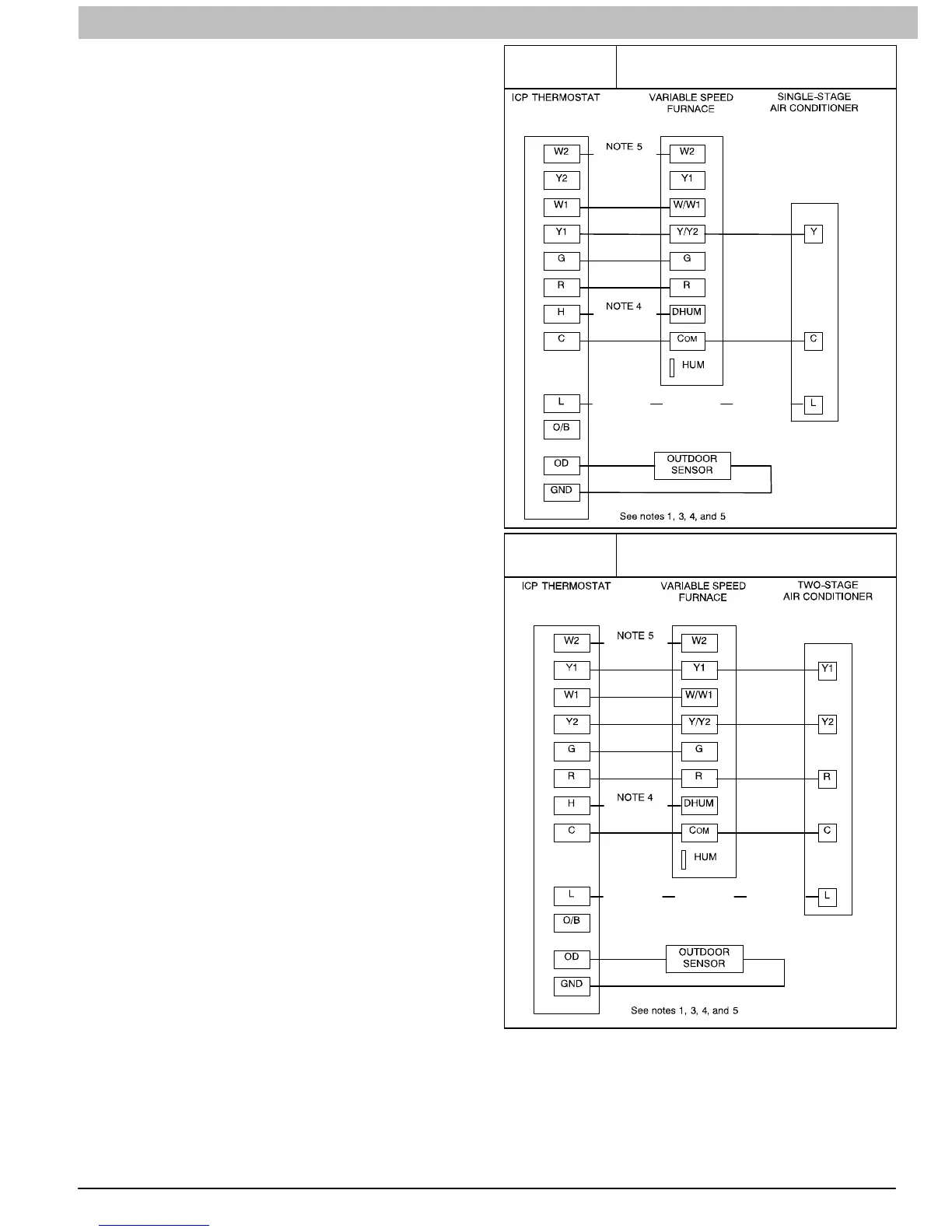
Figure 18
Variable Speed Furnace with Single
Stage Air Conditioner
NOTE 9
Figure 19
Variable Speed Furnace with
Two−Stage Air Conditioner
L09F027
NOTE 9



 To Next Page