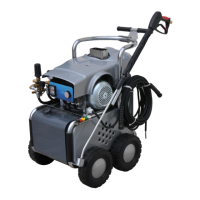
This document is a user and maintenance manual for the Idrobase Stella hot water high-pressure washer. It provides comprehensive information on the device's function, technical specifications, usage, and maintenance.
Function Description
The Idrobase Stella high-pressure washer is designed for efficient and safe hydro-washing in various industrial and commercial settings. It is suitable for continuous use for up to 4 hours a day. Its primary applications include:
- Cleaning industrial vehicles: Such as trucks, buses, trains, and boat hulls.
- General descaling and pipe cleaning: Using appropriate accessories.
- Washing pavements and floors: Removing stubborn dirt, oil, grease, soil, and pollution.
- Removing incrustations: Such as color, paint, or deteriorated plaster.
The machine is constructed with a chromed steel frame, equipped with wheels for mobility. Key components include a motor-pump group, an unloader valve, a control panel, and connection hoses. The heating unit, which produces hot water, consists of an electric motor, a fuel pump, a fuel filter, a transformer, a heating coil, and a combustion chamber. A diesel tank with a level indicator is located at the front, and a cover protects the internal components. Standard equipment includes a high-pressure hose, a spray gun, and a lance.
Important Technical Specifications
The manual provides a table of models and their characteristics. Here's a summary of the common specifications for the Stella series:
| Code |
Model |
Version |
Pressure (bar) |
Flow rate (L/min) |
Temperature (°C) |
Power (Hp) (Volts) |
| ZX.2133 |
1450 150/15 |
BY-PASS |
150 |
15 |
45-80 |
5.5 Hp (3X400v-50Hz) |
| ZX.2133-TS |
1450 150/15 |
TOTAL STOP |
150 |
15 |
45-80 |
5.5 Hp (3X400v-50Hz) |
| ZX.2134 |
1450 200/15 |
BY-PASS |
200 |
15 |
45-80 |
7.5 Hp (3X400v-50Hz) |
| ZX.2134-TS |
1450 200/15 |
TOTAL STOP |
200 |
15 |
45-80 |
7.5 Hp (3X400v-50Hz) |
| ZX.2146 |
1450 150/21 |
BY-PASS |
150 |
15 |
45-65 |
7.5 Hp (3X400v-50Hz) |
| ZX.2146-TS |
1450 150/21 |
TOTAL STOP |
150 |
21 |
45-65 |
7.5 Hp (3X400v-50Hz) |
| ZX.2214 |
1450 200/14 |
BY-PASS |
200 |
14 |
45-90 |
7.5 Hp (3X400v-50Hz) |
| ZX.2214-TS |
1450 200/14 |
TOTAL STOP |
200 |
14 |
45-90 |
7.5 Hp (3X400v-50Hz) |
| ZX.2133-60 |
1750 150/15 |
BY-PASS |
150 |
15 |
45-80 |
5.5 Hp (3X400v-60Hz) |
| ZX.2133-60-TS |
1750 150/15 |
TOTAL STOP |
150 |
15 |
45-80 |
5.5 Hp (3X400v-60Hz) |
| ZX.2134-60 |
1750 200/15 |
BY-PASS |
200 |
15 |
45-80 |
7.5 Hp (3X400v-60Hz) |
| ZX.2134-60-TS |
1750 200/15 |
TOTAL STOP |
200 |
15 |
45-80 |
7.5 Hp (3X400v-60Hz) |
| ZX.2146-60 |
1750 150/21 |
BY-PASS |
150 |
21 |
45-65 |
7.5 Hp (3X400v-60Hz) |
| ZX.2146-60-TS |
1750 150/21 |
TOTAL STOP |
150 |
21 |
45-65 |
7.5 Hp (3X400v-60Hz) |
Overall Dimensions (mm):
- L (Length): 570
- P (Depth): 1130
- H (Height): 890
Heater Technical Data (T 2000/2 model):
- Recommended flow rate: 13-18 L/min
- Fuel nozzle max: 1.50 gl/h
- Fuel consumption: 5.70 kg/h
- Heat capacity: 58,000 Kcal/h
- Max efficiency: 90%
- Max pressure: 220 bar
- Weight: 49 kg
- Dimensions (mm): A=650, B=320, C=560
Guaranteed Sound Power Level: 93 dB (A)
Measured Sound Power Level: 92 dB (A)
Usage Features
The manual emphasizes several critical usage features and safety precautions:
- Pre-installation: Installers and users must read and understand the entire manual.
- Water Supply: Do not run the pump without water or with liquids containing solid particles. Auxiliary filters are recommended. The water supply pressure must be between 1.5 and 2.5 bar, and the water must be free from impurities. Do not use brackish or non-potable water.
- Temperature Limits: Avoid exposing the machine to freezing temperatures (below 0°C) or water temperatures above 40°C (104°F) or below 5°C (41°F). Complete emptying is recommended for prolonged inactivity in cold conditions.
- Electrical Connection: The electrical system must comply with local laws. A differential circuit breaker (30 mA sensitivity) is recommended. Do not use extension cords or loose plugs. Check the integrity of the electrical cable and equipment regularly. Do not touch the plug with wet hands or feet.
- Operator Training: The machine must be used by a properly trained operator. It should never be left unattended, especially with children around.
- Safety Gear: Operators must wear appropriate protective clothing, including goggles (or a protective mask), anti-slip boots, and safety gloves.
- High-Pressure Jet: Do not direct the jet at electrical sockets, the machine itself, people, or animals. The high-pressure jet can be dangerous if used improperly.
- Detergents: Use only liquid detergents recommended by the manufacturer. Other detergents may compromise safety and machine function. Rinse the circuit with clean water after using detergents. Do not use solvents, petrol, thinners, acetone, combustible oils, or toxic/irritant products.
- Total Stop Models: For models with "TOTAL STOP," the machine automatically stops when the gun trigger is released but remains powered. Do not leave it unsupervised without turning off the main switch, disconnecting the plug, and closing the water tap.
- Burner Operation: When using hot water, cool the machine with cold water for a few minutes before turning it off. The burner exhaust fumes are hot and considered a danger area; do not touch or cover the exhaust.
- By-Pass Operation: Do not leave the machine in by-pass mode for more than three continuous minutes.
- Trial Stage: New machines require a brief trial stage of 5 cycles, each consisting of 1 hour of operation followed by 1 hour of cooling.
Maintenance Features
The manual outlines a detailed maintenance plan, categorized into ordinary and scheduled maintenance, to ensure the machine's safety and efficiency. All maintenance and cleaning operations must be performed with the machine turned off and disconnected from the electrical supply. Only authorized spare parts should be used.
Ordinary Maintenance:
- Before each use:
- Verify the power cable and plug are in optimal condition.
- Check the water supply hose, high-pressure hose, spray gun, lance, nozzle, and all connections for optimal condition. If any parts are worn or damaged, do not use the machine and contact a qualified technician.
- Weekly:
- Check and clean or replace the inlet water filter(s). The frequency may vary based on water quality.
Scheduled Maintenance (based on operating hours):
Every 250 hours:
- Replace: Pump oil (first time after 50 hours).
- Clean: In-line fuel filter, fuel pump filter, electrodes, burner combustion, water inlet filter.
- Adjust/Set: Fuel pressure, by-pass valve, safety valve, lance nozzle, quick couplings.
Every 500 hours:
- Replace: Pump valves, pump seals, in-line fuel filter, fuel pump filter, fuel nozzle, electrodes, spark plug.
- Clean: Fuel tank, burner combustion, water inlet filter.
- Adjust/Set: Fuel pressure, by-pass valve, safety valve, lance nozzle, quick couplings.
Every 750 hours:
- Replace: Pump oil, in-line fuel filter, fuel pump filter, electrodes, by-pass valve, safety valve, h.p. nozzle, quick couplings, spray gun, inlet water filter.
- Clean: Burner combustion, descaling.
- Adjust/Set: Fuel pressure.
Every 1000 hours:
- Replace: Pump valves, seal packing, oil seals, in-line fuel filter, fuel pump filter, fuel nozzle, electrodes, spark plug, ignition transformer, by-pass valve, safety valve, h.p. nozzle, quick couplings, inlet water filter.
- Clean: Fuel tank, burner combustion.
- Adjust/Set: Fuel pressure.
Specific Maintenance Procedures:
- High-Pressure Pump: Instructions are provided for removing and replacing valve O-rings, sealing gaskets, and ceramic pistons.
- Fuel Pump: Procedures for removing the fuel pump, checking/replacing the plastic drive, and addressing issues like low fuel level, worn electrodes, clogged filters/nozzles, and faulty ignition transformers.
- Heater: Instructions for cleaning soot from the heater cover and coil.
- Heater Adjustment: Guidance on adjusting the burner based on fuel/air temperature and altitude.
- Electrodes and Fuel Nozzle: Detailed steps for replacing electrodes and cleaning/replacing the fuel nozzle filter.
Troubleshooting:
The manual includes extensive troubleshooting tables for both the high-pressure pump and the heater/fuel pump, listing common problems, their causes, and solutions. This covers issues like irregular pressure, pump noise, water in oil, oil leakage, burner not starting, lack of vacuum, and unstable pressure.
Disposal:
The machine's demolition and disposal must be carried out by qualified personnel according to local laws. This involves emptying fuel and lubricating oil, rendering dangerous parts safe, and removing electrical components for recycling.

 Need help?
 General

 To Next Page