EasyManua.ls Logo

impinj R700 - User Manual

impinj R700
2 pages
Print Icon
To Next Page IconTo Next Page
Loading...
Version 2.0 © 2021, Impinj, Inc. Version 2.0 © 2021, Impinj, Inc.
RESOURCES & NEXT STEPS
Develop business applications using the Impinj IoT device interface, Impinj Octane SDK,
the Impinj Octane LLRP toolkit, or Impinj R700 ETK. For more information, contact Impinj
using the resources listed below.
Sales: www.impinj.com/contact-us
Support: support.impinj.com
Developer site: developer.impinj.com
Postal Address: 400 Fairview Avenue North, Suite 1200, Seattle, WA 98109
NOTICES
Copyright © 2021, Impinj, Inc. All rights reserved.
Impinj gives no representation or warranty, express or implied, for accuracy or reliability of information in this document.
Impinj reserves the right to change its products and services and this information at any time without notice.
EXCEPT AS PROVIDED IN IMPINJ’S TERMS AND CONDITIONS OF SALE (OR AS OTHERWISE AGREED IN A
VALID WRITTEN INDIVIDUAL AGREEMENTWITH IMPINJ), IMPINJ ASSUMES NO LIABILITY
WHATSOEVER AND IMPINJ DISCLAIMS ANY EXPRESS OR IMPLIEDWARRANTY, RELATED TO SALE AND/OR
USE OF IMPINJ PRODUCTS INCLUDING LIABILITY OR WARRANTIES RELATING TO FITNESS FOR A PARTICULAR
PURPOSE,MERCHANTABILITY,OR INFRINGEMENT.
NO LICENSE, EXPRESS OR IMPLIED, BY ESTOPPEL OR OTHERWISE, TO ANY PATENT, COPYRIGHT,
MASKWORK RIGHT, OR OTHER INTELLECTUALPROPERTY RIGHT IS GRANTED BY THIS DOCUMENT.
Impinj assumes no liability for applications assistance or customer product design. Customers should provide adequate
design and operating safeguards to minimize risks.
Impinj products are not designed, warranted or authorized for use in any product or application where a malfunction may
reasonably be expected to cause personal injury or death or property or environmental damage (“hazardous uses”) or for
use in automotive environments. Customers must indemnify Impinj against any damages arising out of the use of Impinj
products in any hazardous or automotive uses.
Impinj, Monza, Speedway, xArray, xSpan are trademarks or registered trademarks of Impinj, Inc. All other product or
service names are trademarks of their respective companies. For a complete list of Impinj Trademarks visit:
www.impinj.com/trademarks
The products referenced in this document may be covered by one or more U.S. patents. See www.impinj.com/patents for
details.
OVERVIEW
This guide provides basic instructions to configure an RFID system using the Impinj R700
Antenna Hub with an Impinj R700 RAIN RFID Reader. Additional details can be found in
the Impinj R700 Installation and Operations guide available at support.impinj.com.
Box Contents
1 x Impinj R700 Antenna Hub
Required Accessories Sold Separately
Impinj R700 RAIN RFID Reader IPJ-R700
SMA to R-TNC cable IPJ-A3002-000
Antennas and additional RF Cable
Connections and Ports
1 SMA port to connect to Impinj R700 Reader port
8 SMA ports to connect to RFID Antennas
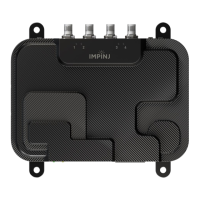
Impinj R700 Antenna Hub
Quick Start Guide
Question and Answer IconNeed help?

Do you have a question about the impinj R700 and is the answer not in the manual?

Summary

Impinj Resources and Contact Information

Sales Inquiry

Contact Impinj for sales inquiries via the official website.

Technical Support

Access support resources and documentation through the support portal.

Developer Resources

Visit the developer site for resources, tools, and community.

Impinj Postal Address

Impinj's physical mailing address for correspondence.

Impinj R700 Antenna Hub Product Overview

Included Box Contents

Lists all items that are included with the Impinj R700 Antenna Hub.

Required Accessories for Setup

Details components that are sold separately but necessary for operation.

Antenna Hub Connections

Describes the SMA ports available for connecting readers and antennas.

R700 Antenna Hub Setup and Configuration

Connect RF Cables

Connect antennas and the R700 Reader to the Antenna Hub using RF cables.

Reader Login and Hub Enablement

Access the reader's web interface to log in and enable the Antenna Hub feature.

Verify Antenna Connectivity

Use the web configuration page to check and troubleshoot antenna connections.

Mounting the Antenna Hub

Physically secure the Antenna Hub to a suitable surface using mounting holes.

Overview

The Impinj R700 Antenna Hub is a crucial component designed to expand the capabilities of an Impinj R700 RAIN RFID Reader, enabling a more extensive and flexible RFID system. Its primary function is to allow a single Impinj R700 Reader to connect to multiple RFID antennas, significantly increasing the reader's coverage area and the number of read points within an environment. This hub acts as an intermediary, managing the RF signals between the reader and up to eight individual antennas.

Function Description

At its core, the Impinj R700 Antenna Hub serves as a signal multiplexer and demultiplexer for RF signals in an RFID system. It takes the RF output from a single port of an Impinj R700 RAIN RFID Reader and intelligently routes it to one of its connected antennas. Conversely, it receives RF signals from the connected antennas and directs them back to the reader. This intelligent switching allows the reader to interrogate tags across a wider physical area or from multiple perspectives without requiring multiple readers.

The hub is designed to work seamlessly with the Impinj R700 Reader, leveraging its advanced capabilities for tag interrogation. By expanding the number of antenna connections, the hub facilitates more comprehensive RFID deployments in various applications such as inventory management, asset tracking, supply chain visibility, and access control. It allows for the creation of dense read zones or the coverage of large areas with a single reader, optimizing hardware costs and simplifying system architecture.

The device's operation is managed through the Impinj R700 Reader's firmware and web configuration interface. This integration ensures that the hub's antenna switching and signal routing are synchronized with the reader's tag interrogation cycles, providing efficient and reliable performance. The hub's ability to connect up to eight antennas means that a single reader can effectively monitor eight distinct locations or orientations, making it highly versatile for complex RFID environments.

Usage Features

The Impinj R700 Antenna Hub is engineered for straightforward integration and flexible deployment. Its usage features are centered around ease of connection, configuration, and operational monitoring.

  • Expanded Antenna Connectivity: The most prominent usage feature is its ability to connect up to eight RFID antennas to a single Impinj R700 Reader port. This significantly enhances the reader's reach and coverage, allowing for more comprehensive RFID solutions.
  • Simple RF Cabling: Connecting the hub involves a single SMA to R-TNC cable to link the hub to the Impinj R700 Reader. The individual RFID antennas then connect to the hub's eight SMA ports. Unused ports can be left empty or terminated, offering flexibility in antenna deployment.
  • Integrated Configuration via Reader Web Interface: The hub's features are enabled and managed directly through the Impinj R700 Reader's web configuration page. This eliminates the need for separate software or interfaces, streamlining the setup process. Users can log into the reader's web interface using a standard browser and enable the "Antenna Hub" feature.
  • Firmware Compatibility: The hub requires the Impinj R700 Reader to be running a specific firmware version (7.3 or later) to ensure full compatibility and functionality. The reader's web interface provides clear instructions for firmware upgrades if needed, guiding users through downloading the firmware file from the Impinj support portal and initiating the upgrade process.
  • Visual Connection Verification: Once enabled and connected, the hub provides visual feedback to confirm antenna connections. The lights on the enabled antenna hubs will cycle sequentially, indicating that they are properly connected and recognized by the reader. This visual cue simplifies troubleshooting during initial setup.
  • Connection Troubleshooting Tool: The reader's web configuration page includes a "Check Connections" tool within the Antenna Hub section. This feature allows users to diagnose and troubleshoot any issues related to antenna connectivity, providing a quick way to identify and resolve problems.
  • Mounting Flexibility: The hub is designed with 1/4" mounting holes, allowing it to be securely affixed to a suitable surface. This physical mounting capability ensures stable placement in various operational environments. It's noted that RF cables may need to be temporarily removed during mounting for easier installation.
  • Scalability: By expanding the number of antennas, the hub enables scalable RFID deployments. Businesses can start with a few antennas and gradually add more as their needs evolve, all while utilizing the same Impinj R700 Reader.
  • Optimized Performance: The hub is engineered to maintain signal integrity and minimize loss, ensuring that the RFID system operates efficiently even with multiple antennas. This contributes to reliable tag reads and overall system performance.

Maintenance Features

The Impinj R700 Antenna Hub is designed for minimal maintenance, focusing on reliability and ease of troubleshooting when issues arise.

  • Firmware-Driven Updates: As the hub's functionality is deeply integrated with the Impinj R700 Reader's firmware, any updates or enhancements to the hub's operation are delivered through reader firmware upgrades. This centralized approach simplifies maintenance, as users only need to manage the reader's firmware. The process involves downloading firmware from the Impinj support portal and applying it via the reader's web interface.
  • Self-Diagnostic Capabilities (via Reader): The "Check Connections" feature in the Impinj R700 Reader's web configuration page acts as a primary diagnostic tool for the antenna hub. This allows users to quickly verify the status of connected antennas and identify any potential cabling or connection issues without requiring specialized equipment.
  • Visual Status Indicators: The sequential cycling of lights on the hub after rebooting provides an immediate visual confirmation of successful connection and operation. This simple indicator helps in quickly assessing the hub's status and identifying if it's properly communicating with the reader and antennas.
  • Robust Construction: While not explicitly detailed, the design of such industrial equipment typically implies a robust build quality intended for continuous operation in various environments, minimizing the need for frequent physical maintenance.
  • Simplified Troubleshooting: In case of operational issues, the troubleshooting process is streamlined. Users are guided to verify firmware versions, check physical cable connections, and utilize the reader's built-in diagnostic tools. This systematic approach helps in quickly pinpointing the source of a problem, whether it's related to cabling, configuration, or firmware.
  • No Dedicated Software Maintenance: Unlike devices that require separate software installations, the hub's reliance on the reader's web interface means there's no additional software to maintain, update, or troubleshoot on a separate system. This reduces the overall maintenance burden.
  • Clear Documentation: The availability of an "Impinj R700 Installation and Operations Guide" on the support portal ensures that users have access to comprehensive documentation for setup, configuration, and troubleshooting, which is a key aspect of effective maintenance.

In summary, the Impinj R700 Antenna Hub is a robust and user-friendly device that significantly enhances the capabilities of the Impinj R700 RAIN RFID Reader. Its design emphasizes ease of integration, flexible deployment, and straightforward maintenance, making it an invaluable component for expanding RFID coverage and optimizing system performance in diverse applications.

impinj R700 Specifications

General IconGeneral
Operating Temperature-20°C to +55°C
Humidity5% to 95% non-condensing
Frequency Range865-868 MHz (EU), 902-928 MHz (US)
Air Interface ProtocolEPCglobal UHF Class 1 Gen 2 (ISO 18000-63)
Communication Interface10/100 Ethernet
Storage Temperature-40°C to +70°C
Power Supply24V DC
CertificationsFCC, ETSI
HousingMetal
Transmit Power+10 dBm to +32.5 dBm (0.5 dB steps)

Related product manuals