23
B. Regarding the InBody Test
Some of the more common clinical questions are answered below. If additional questions or more clarication is
desired, please contact InBody.
Question Answer
•
Must socks or stockings
be removed for the
InBody Test?
•
Bare skin contact is essential in the analysis using the BIA method. Socks
or stockings may cause a varying degree of distortion in the results. Socks
or stockings must be removed to obtain accurate data.
•
Is it okay to wear accessories
(jewelry, watch, rings, etc) or
metal objects while taking
the InBody Test?
•
The ideal condition for the analysis is simply standing with no clothes
and wearing no accessories. However, this may not always be possible.
Therefore, we recommend that the examinee remove as many clothing items
and accessories that may affect the weight as possible.
•
Who cannot take the
InBody Test or will have
difficulties taking the
InBody Test?
•
Individuals with medical implant devices such as pacemakers, or essential
support devices such as patient monitoring systems, must not use this
equipment. The currents will ow through the body during the
test, which may cause malfunctioning of the device or endanger lives.
•
Children, amputees, or the elderly, may have trouble testing if they cannot
hold the hand electrodes or stand still on the foot electrodes.
•
Can a person with metal
implants in the body take
the InBody Test?
•
The ideal test methodology is where the examinee does not wear anything
metallic. Individuals with metallic implants may have skewed test results
due to the conductivity of the metal affecting the results.
•
As the weight of clothes and other wear affects the results of the body
composition analysis, it is strongly recommended to take off any heavy
clothing or metallic wear. Except for the weight, jewelry does not effect
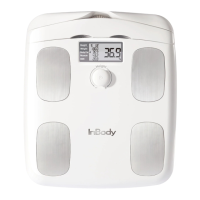
the body composition analysis, as the contact point with the InBody270
are hands and feet.
•
I have limited mobility
and cannot maintain proper
posture for the InBody Test.
How can I still be tested?
•
It is impossible to test if an individual cannot maintain contact with the
hand or foot electrodes. InBody has a line of products that conduct body
composition analysis on bed ridden examinees that allow the patients to
stay in bed. For more information, please contact InBody.
•
Is the electric current
harmful to the body?
•
The physiological electric impedance method uses safe low level currents
that is not harmful to the body. The safety of the InBody has been tested
and proven. The InBody products have been approved for medical use by
the CE and all over the world. Many medical institutions around the world
are actively using the InBody.
•
How often should I take
the InBody Test?
•
Individuals who are undergoing any programs that may affect their body
composition are strongly recommended to have the InBody Test done every two
to four weeks.
•
Consistent testing will allow individuals to track and monitor their progress
over time.
•
What are the precautionary
steps to ensure accuracy of
the InBody Test?
•
Please refer to ‘A. Precautionary Steps’ in section ‘II. InBody Test’ in this
User’s Manual.
270_manual_ENG_B_150608.indd 23 2015. 6. 8. 18:45


 To Next Page