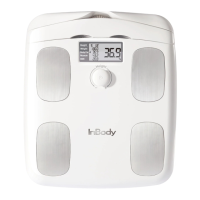
(4) Check Test Result: Turn the dial to enlarge results
Outcomes will be displayed for 100 seconds after an InBody Test has completed. If the device is not
used within that timeframe, it will turn off. To turn off thedevice immediately after use, press and hold the
dial.
If a user’s palms and/or soles are dry or callused, you may have difficulty
testing.
Clean your hands and feet with a wet tissue for more accurate results.
D. Understanding Test Items
Body fat mass and muscle mass change with diet and exercise. • Weight : Total body mass
Weight is the total mass of the human body.
• Percent Body Fat: The total mass of fat divided by total body mass A person’s body fat
percentage is the total weight of the person’s fat divided by the person’s weight and consists of
essential body fat and storage body fat. Although the weight is same, the percentages of fat or
muscle mass can be different. Therefore, the body fat percentage is an essential item for
diagnosing obesity.
The standard range is 10-20% for men and 18-28% for women. The standard body fat
percentage differs for children under 18 depending on their gender and height.
• Muscle Mass: Skeletal Muscle Mass
Skeletal muscle represents the majority of muscle tissue; it is the type of muscle that powers
movement of the skeleton. It is categorized as striated muscle because when viewed under a
light microscope, alternating stripes of light and dark bands can be seen. There are three muscle
types, cardiac, smooth, and skeletal muscle. Skeletal muscle is innervated by the somatic
nervous system and subject to voluntary control. Skeletal muscle is attached to the bone and its
main function if for movement of the body. This is the muscle that is influenced the most by
physical activity.
• Visceral fat : Fat surrounding the major organs
Fat around organs is shown in levels between 1 and 20. People with visceral fat levels above 10
are considered unhealthy and are at higher risk for diseases like heart disease, cancer and sleep
apnea.


 To Next Page