Need help?
Do you have a question about the Indesit DWL 700 and is the answer not in the manual?
On/Off button, cycle selection dial, and Start/Reset button for appliance operation.
Lights indicating power status, salt/rinse aid levels, cycle phase, and delayed start.
Buttons for delayed start selection and half load options.
Component for opening the dishwasher door.
For very dirty dishes and pans, using hot water and multiple rinses.
Standard daily cycle for normally dirty pans and dishes with hot water rinse.
Environmentally-friendly cycle with low energy consumption for normally dirty items.
Economic and fast cycle for slightly dirty dishes, no drying.
Preliminary wash to prevent food drying onto dishes awaiting next meal.
Special cycle for delicate items sensitive to high temperatures.
Economic and fast cycle for small daily loads, typically on the upper rack.
Explains the sequence of 4 indicator lights showing pre-wash, wash, rinses, and drying phases.
Steps for loading dishes, checking arms, adding detergent, and closing the door.
Procedure for powering on, selecting a cycle via dial, and initiating with the Start button.
Warning about hot steam and advice to allow cooling time before unloading.
Recommended order for unloading: lower rack first, then the upper rack.
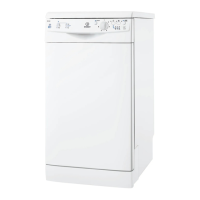
This document outlines the operating instructions for the Indesit DWL 700 dishwasher, a household appliance designed to clean dishes and pans efficiently. The dishwasher offers a range of wash cycles tailored to different levels of soiling and types of items, aiming to provide convenience and effective cleaning for various daily needs.
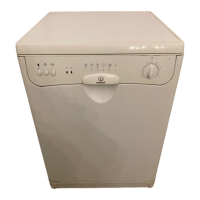
The Indesit DWL 700 dishwasher is equipped with a control panel that allows users to select and manage various wash cycles and settings. Key components of the control panel include an On/Off button (A) with an accompanying indicator light (B), a handle for opening the door (C), and a dial for selecting cycles (D). For user convenience, the dishwasher features indicator lights for low salt (E) and low rinse aid (F), ensuring optimal performance by prompting users to refill these consumables. Cycle phase and delayed start indicator lights (G) provide visual feedback on the progress of the wash cycle and any set delays. Additional controls include a delayed start select button (H), a 1/2 load button (I) with its corresponding indicator light (L), and a Start/Reset button (R).
The dishwasher offers seven distinct wash programmes:
Intensive: This cycle is designed for very dirty dishes and pans, excluding delicate items. It involves a pre-wash with hot water at 40°C, an extended wash at 65°C, two cold rinses, a hot rinse at 65°C, and a drying phase. The total duration is approximately 120 minutes.
Time 4 You: A standard daily cycle for normally dirty pans and dishes. It includes a pre-wash with cold water, an extended wash at 50°C, a cold rinse, a hot rinse at 70°C, and drying. This cycle takes about 72 minutes.
Eco: An environmentally-friendly cycle with low energy consumption, suitable for normally dirty pans and dishes. It features two cold pre-washes, an extended wash at 50°C, a hot rinse at 65°C, and drying. The duration is approximately 130 minutes.
Rapid 25': A quick and economic cycle for slightly dirty dishes, to be run immediately after use. It includes a short wash at 50°C and a rinse with hot water at 50°C, but no drying. This cycle is about 24 minutes long.
Soak: A preliminary wash cycle for dishes and pans awaiting completion of the load with items from the next meal. It consists of a short cold wash to prevent food from drying onto the dishes, lasting approximately 12 minutes.
Crystal: A special cycle for more delicate items sensitive to high temperatures. This cycle includes a wash at 50°C, a rinse at 45°C, a hot rinse at 65°C, and drying. It runs for about 96 minutes.
Just You: A special, economic, and fast cycle for a fairly small daily load of dishes, to be used only on the upper rack. It involves a wash at 50°C and a hot rinse at 70°C, lasting approximately 40 minutes.
The dishwasher also features cycle phase indicator lights (G) that illuminate in sequence to show the current stage of the wash cycle: pre-wash, wash, rinses, and drying.
Operating the Indesit DWL 700 is straightforward. Users begin by loading the dishwasher, ensuring that the upper and lower spray arms can rotate freely to allow for effective water distribution. Detergent should be added to the dispenser, and the door closed securely.
To start the appliance, the On/Off button (A) is pressed, which triggers a short beep and illuminates the On/Off light (B), indicating the dishwasher is ready for programming. The desired wash cycle is then selected by turning the cycle selector dial (D) clockwise until the reference notch aligns with the number or symbol of the chosen programme.
Once the door is shut, pressing the Start/Reset button (R) initiates the cycle, accompanied by another beep. The wash cycle will commence within a few seconds.
For safety, it is crucial not to open the dishwasher door while the appliance is in operation.
While the document does not explicitly detail maintenance features, it implicitly emphasizes the importance of monitoring the low salt (E) and low rinse aid (F) indicator lights. These indicators serve as prompts for users to replenish these consumables, which are essential for optimal cleaning performance and preventing water spots on dishes. Regular refilling of salt helps to soften hard water, improving detergent effectiveness and preventing limescale buildup, while rinse aid ensures streak-free drying.
Regarding unloading, care must be taken when opening the door after a cycle, as hot steam will escape. It is recommended to allow 15-30 minutes for the dishes to cool before unloading. To prevent potential damage or re-soiling, users should unload the lower rack first, followed by the upper rack. This practice helps to avoid water dripping from the upper rack onto already dry items in the lower rack.
The design of the dishwasher, with its various cycle options, suggests that proper cycle selection based on the level of soiling and type of dishes contributes to effective cleaning and potentially reduces the need for extensive manual pre-cleaning or post-cleaning. The inclusion of a "Soak" cycle also serves as a preliminary step to prevent food from drying onto dishes, making subsequent washing more efficient and reducing the effort required for stubborn residues.
 General
| Type | Freestanding |
|---|---|
| Capacity | 12 place settings |
| Energy Efficiency Class | A |
| Washing Performance Class | A |
| Number of Programs | 7 |
| Delay Start | Yes |
| Dimensions (H x W x D) | 85 x 60 x 60 cm |


 To Next Page