EasyManua.ls Logo

Infinity PS410 - Important Safety PRECAUTIONS; General Safety Instructions; Electrical Safety and Usage Precautions; Antenna Grounding Example

Infinity PS410
8 pages
Print Icon
To Next Page IconTo Next Page
To Previous Page IconTo Previous Page
Loading...
IMPORTANT
SAFETY
PRECAUTIONS
Read
First!
CAUTION
RISK
OF
ELECTRIC
SHOCK
DO
NOT
OPEN
CAUTION:
To
reduce
the
risk
of
electric
shock,
do
not
remove
cover
(or
back).
No
user-serviceable
parts
inside
.
Refer
servicing
to
qualified
service
personnel.
CAUTION:
To
prevent
electric
shock,
do
not
use
this
(polarized)
plug
with
an
extension
cord,
receptacle
or
other
outlet
unless
the
blades
can
be
fully
inserted
to
prevent
blade
exposure.
A
The
lightning
flash
with
arrowhead
symbol,
w~hin
an
equ
i
lateral
triangle,
is
intended
to
alert
the
user
to
the
presen
ce
of
uninsulated
'"dangerous
voltage"
within
the
product
's
enclosure
that
may
be
of
sufficient
magnitude
to
const~ute
a
risk
of
electric
shock
to
persons.
A
The
exclamation
point
within
an
equilateral
triangle
is
intended
to
alert
the
user
to
the
presence
of
tmportant
operating
and
maintenance
(
servicing)
instructions
in
the
inorature
accompanying
the
appliance
.
1.
Read
these
instructions.
1.
Keep
these
instructions.
1.
Heed
all
warnings.
1.
Follow
all
instructions.
1.
Do
not
use
this
a
pparatus
near
water
.
1.
Clean
only
with
a
dry
cloth.
1.
Do
not
block
any
ventilation
openings
.
Install
in
accordance
with
the
manufacturer's
instructions.
1.
Do
not
install
near
any
heat
sources
such
as
radi
at
ors,
heat
registers,
stoves
or
other
apparatus
(including
amplifiers)
that
produce
heat.
1.
Do
not
defeat
the
safety
purpose
of
the
polarized
or
grounding-type
plug.
A
polarized
plug
has
two
blades
with
one
wider
than
the
other.
A
grounding-type
plug
has
two
blades
and
a
third
grounding
prong.The
wide
blade
or
th
e
third
prong
is
provided
for
your
safety.
If
the
provided
plug
does
not
fit
into
your
outlet,
consult
an
electrician
for
replacement
of
the
obsolete
outlet
.
1.
Protect
the
power
cord
from
being
walked
on
or
pinched,
particularly
at
plugs,
convenience
receptacles
and
the
point
where
they
exit
from
the
apparatus.
1.
Only
u
se
attachments/accessories
&
specified
by
the
manufacturer.
1.
Use
only
with
the
cart,
stand,
tripod,
~
PS410(120V)
bracket
or
table
specified
by
the
manufacturer
or
sold
with
the
apparatus.
When
a
cart
is
used,
use
caution
when
moving
the
cart
/
apparatus
combinat
i
on
to
avoid
injury
from
tip-over.
1.
Unplug
th
is
apparatus
during
lightn
in
g
storms
or
when
unused
for
long
periods
of
t
ime.
1.
Refer
all
servicing
to
qualified
service
personnel.
Servicing
is
required
when
the
apparatus
has
been
damaged
in
any
way,
such
as
power-supply
cord
or
plug
is
damaged,
liquid
has
been
spilled
or
objects
have
fallen
into
the
apparatus
,
the
apparatus
has
been
exposed
to
rain
or
moisture,
does
not
operate
normally,
or
has
been
dropped.
1.
Do
not
use
attachments
not
recommended
by
the
product
manufacturer,
as
they
may
cause
hazards.
1.
This
product
should
be
operated
on
ly
from
the
type
of
power
source
indicated
on
the
marking
label.
If
you
are
not
sure
of
the
type
of
power
supply
to
your
home,
consult
your
product
dealer
or
local
power
company.
For
products
intended
to
operate
from
battery
power,
or
other
sources,
refer
to
the
operating
instructions.
1.
If
an
outs
i
de
antenna
or
cable
sys
te
m
is
connected
to
the
product,
be
sure
the
antenna
or
cable
system
is
grounded
so
as
to
provide
some
protection
against
voltage
surges
and
built-up
static
charges.
Article
810
of
the
National
Electrical
Code,
ANSI
/
NFPA
70,
provides
information
with
regard
to
proper
grounding
of
the
mast
and
supporting
structure,
grounding
of
the
lead-in
wire
to
an
antenna
discharge
unit,
size
of
grounding
conductors,
location
of
antenna-discharge
unit
,
connection
to
grounding
electrodes,
and
requirements
for
the
grounding
electrode.
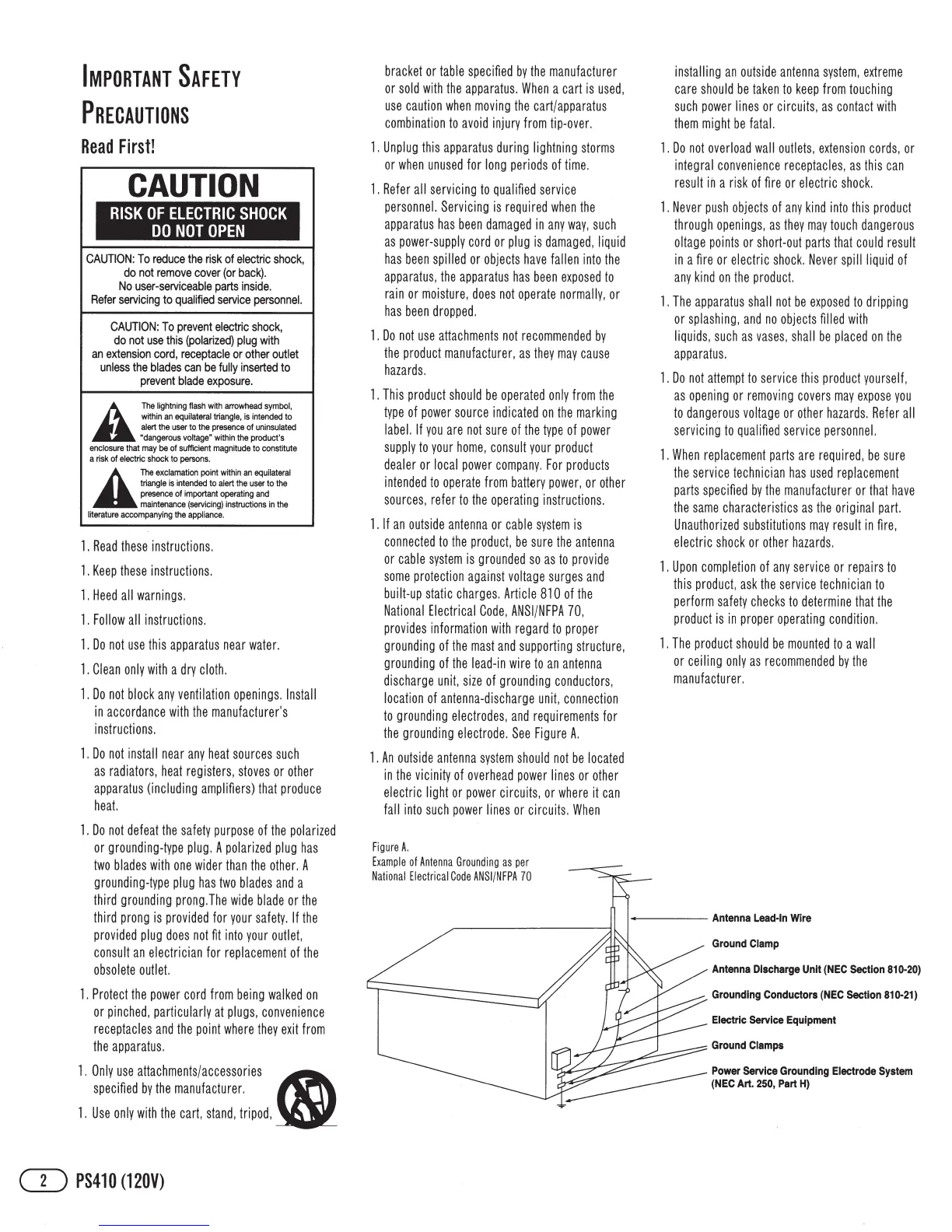
See
Figure
A.
1.
An
outside
antenna
system
should
no
t
be
located
in
the
vicinity
of
overhead
power
lines
or
other
electric
light
or
power
circuits,
or
where
it
can
fall
into
such
power
lines
or
circu
i
ts.
When
Figure
A.
Example
of
Ante
n
na
Grounding
as
per
National
El
ectrica
l
Code
ANSI/NFPA
70
installing
an
outside
antenna
system,
extreme
care
should
be
taken
to
keep
from
touching
such
power
lines
or
circu
it
s,
as
contact
with
them
might
be
fatal.
1.
Do
not
overload
wall
outlets,
extension
cords,
or
integral
convenience
receptacles,
as
this
can
resu
lt
in
a
risk
of
fire
or
electric
shock.
1.
Never
push
objects
of
any
kind
into
this
product
through
openings
,
as
they
may
touch
dangerous
o
lta
ge
points
or
short-out
parts
that
could
result
in
a
fire
or
electric
shock.
Ne
v
er
spill
liquid
of
any
kind
on
the
product.
1.
The
apparatus
shall
not
be
exposed
to
dripping
or
splashing,
and
no
objec
ts
fi
l
led
with
liqu
i
ds,
such
as
vases
,
shall
be
placed
on
the
apparatus.
1.
Do
not
attempt
to
service
this
p
roduct
yourself
,
as
opening
or
removing
covers
may
expose
you
to
dangerous
voltage
or
other
hazards
.
Refer
all
servicing
to
qualified
service
personnel.
1.
When
replacement
parts
are
required,
be
sure
the
service
technician
has
used
replacement
pa
rts
specified
by
the
ma
n
ufacturer
or
that
have
the
same
characteristics
as
t
he
original
part.
Unauthorized
substitutions
may
result
in
fire,
electric
shock
or
other
h
az
ards.
1.
Upon
completion
of
any
ser
v
ice
or
repairs
to
th
is
product,
ask
the
serv
i
ce
technician
to
perform
safety
checks
to
determine
that
the
product
is
in
proper
opera
t
ing
condition.
1.
The
product
should
be
mounted
to
a
wall
or
ceiling
only
as
recommended
by
the
manufacturer.
Ground
Clamp
Antenna
Discharge
Unit
(NEC
Section
81G-20)
Grounding
Conductors
(NEC
Section
81G-21)
Electric
Service
Equipment
Ground
Clamps
~
---------
Power
Service
Grounding
Electrode
System
:::...--------
(NEC
Art.
250,
Part
H)

Related product manuals