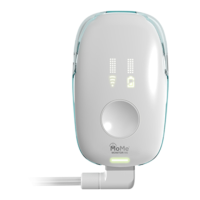
The MoMe® Kardia System is a small, lightweight, battery-operated device designed for physiological data collection, storage, and transmission via a built-in cellular module. It functions as a continuous monitoring system, requiring minimal patient intervention once activated. The system is intended for use in the United States and is not designed for use on infants weighing less than 10kg (22 lb). It is also not defibrillation-proof, and the device and patient leads must be removed before external defibrillation.
Function Description:
The MoMe® Kardia Monitor continuously collects, stores, and transmits physiological data to a remote server. It requires no intervention to capture or analyze data, but patients are responsible for daily battery pack charging and reporting symptomatic events by pressing the event record button as instructed by their physician. The device includes a lead set that attaches to the monitor and electrodes, which are provided by the physician. The system is designed to provide 24 hours of function before requiring a battery recharge.
Important Technical Specifications:
- Battery Life: Provides 24 hours of function before recharging.
- Operating Temperature: 5°C to 40°C.
- Storage Temperature (power off): -25°C to 70°C.
- Operating/Storage Humidity: 15% to 93% non-condensing.
- Operating Pressure: 700 hPa to 1060 hPa.
- ECG Sampling Rate: 200 Hz.
- Digital Resolution: 5uV.
- Input Dynamic Range: +/- 10 mV.
- Input Offset Dynamic Range: +/- 300 mV.
- Input Impedance: > 3 MOhm.
- Peak Current Injection: 24 nA (Lead off circuit) DC.
- RMS Current Injection: 29 microA.
- Data Storage Capacity: Minimum 30 days.
- Dimensions: 108 mm x 67 mm x 17 mm max.
- Weight: 80 +/- 5 g.
- Communication Means: LTE, WCDMA (Bands 2,4,5,12,13).
- Ingress Protection Rating: IPX0.
- Display: Type: LED Matrix, Size: 24 X 7.
- Memory: Internal microSD card up to 32 GB (Not user accessible).
- Battery Type: Li-Ion 1900mAh battery pack.
Usage Features:
The MoMe® Kardia monitor features three buttons: Event Record, Wake, and Volume.
- Wake Button: Press at any time to display the current battery level status.
- Volume Button: Adjusts the volume or silences alerts. Pressing up or down on the button updates the display with the current level and plays a tone. The lowest volume setting mutes the speaker, and pressing it one more time after muting sets the monitor to vibrate mode.
- Event Record Button: Located on the face of the device, press to report a symptomatic event. The screen will display a solid heart when an event has been recorded. Press and hold for 3 seconds to record an event.
- Notifications: The device provides a "BATT LOW" notification on the screen and an audio alert when the battery level is low.
- Belt Clip: The monitor must be used with the included belt clip. It slides into the holster, and the clip goes over the belt or waistband with the lead set attachment facing upwards. This ensures the device is carried safely and maintains a minimum distance of 6mm from the body for SAR compliance.
- Battery Installation/Removal: To install, place the battery pack into the monitor, push down until fully seated, then slide it towards the slide lever lock until a "click" is heard. To remove, push the slide lever lock to the right and hold, push the battery pack away from the lock, release the lock, and then lift the battery pack out.
- Unpacking and Setup: The initial setup involves unpacking components, plugging in the charger dock, placing a battery pack in the charger, inserting the second battery pack into the monitor (which should turn on the device), attaching the lead set, and placing electrodes as instructed.
Maintenance Features:
- Charging Battery Pack: Slide the battery pack into the charger dock until the charging indicator turns red. The battery pack is fully charged when the indicator light turns green. Each battery pack takes approximately 3 hours to fully charge. Patients are instructed to charge the battery pack every day.
- Cleaning: Keep cells and batteries clean and dry. Wipe cell or battery terminals with a clean, dry cloth if dirty.
- Inspection: Before each use, inspect all system components for defects or damage, such as cracks or fraying in lead wires, or cracks/dents/chips on the device. Do not use if any component appears defective, damaged, or worn.
- Storage: Do not store cells or batteries haphazardly in a box or drawer where they may short-circuit. Avoid direct sunlight.
- Disposal: Dispose of batteries properly.
Warnings and Cautions:
- Use only specified MoMe® Kardia cables and accessories to avoid negative effects on EMC performance and non-compliance.
- Route all cables away from the patient's throat to avoid strangulation.
- Do not service or repair any components of the system; contact your physician's office for repair or replacement. Unauthorized repairs can damage the equipment or cause system malfunction.
- The system should not be used in the presence of flammable anesthetics or in an oxygen-rich environment.
- The MoMe® Kardia contains a cellphone; patients with implantable devices should follow their device manufacturer's recommendations for use with a cellphone.
- Electrodes may cause skin irritation or breakdown; use standard FDA-approved Ag/AgCL ambulatory monitoring electrode patches and instruct patients on what to do if irritation occurs.
- Keep the system out of reach of children and pets.
- The system uses cellular phone technology, and operation/data transmission may be affected by poor cellular coverage or electromagnetic interference. Data will be cached and sent once communication is restored.
- The MoMe® Kardia is not waterproof. Protect all parts from water, liquids, or moisture. Do not immerse any part of the system in water or fluids, spray with cleaners, or bathe/shower/swim while wearing the device.
- Do not drop or subject parts to extreme physical shock.
- The system uses and generates radio frequency energy, which may cause harmful interference if not used according to instructions.
- The MoMe® Kardia provided for use in the U.S. will not transmit recorded data if the patient travels outside of the U.S.
- Do not use or store the system in extreme temperatures (below 0°C/32°F or above 40°C/104°F for use; below -25°C or above 70°C for storage/transport) or outside specified humidity ranges (15%-93% non-condensing).

 Need help?
 General

 To Next Page