Need help?
Do you have a question about the Infors HT Multitron Standard and is the answer not in the manual?
Details the purpose and scope of the operating manual.
Explains the meaning of warning and information notices used in the manual.
Describes the information found on the device's identification plate.
States compliance with relevant EU directives.
Provides information on contacting customer service for support and inquiries.
Defines the intended application and warns against misuse.
Specifies approved cultivation vessels and safety considerations.
Defines the roles of provider, user, and operator, emphasizing qualification.
Identifies and prohibits access for unqualified individuals.
Outlines the provider's responsibilities for safe operation and compliance.
Covers general risks present during normal device operation.
Details specific risks associated with special applications.
Describes built-in safety mechanisms like fuses and shut-down.
Explains the meaning of warning labels affixed to the device.
Specifies requirements for decontamination before return or disposal.
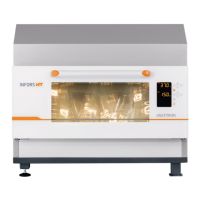
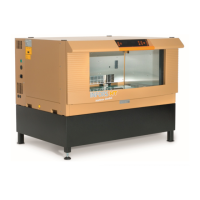
Details the external components and setup of the basic incubation shaker unit.
Presents the different configurations and versions of the Multitron Standard.
Describes the core functions of the device.
Explains the automatic and manual operation of the interior illumination.
Details the mains connection and serial interface for device connectivity.
Describes the discharge outlet and air vents on the device.
Details the different substructure options like rubber feet and bases.
Identifies the power switch and the main operating panel.
Explains the identification plates and throw identification.
Describes the available tray types, including universal and pre-fitted options.
Details various clamps and holders for securing vessels on trays.
Describes the box used for microtitre and deep-well plates.
Information on the bioprocess platform software for planning and control.
Specifies environmental requirements for optimal device setup.
Details necessary specifications for the electrical power supply.
Specifies required clearances for ventilation and access.
Step-by-step guide to powering on the device and its self-test.
Instructions for opening the door, handling trays, and loading vessels.
Provides an overview of the control panel's displays and buttons.
Guides on setting, activating, and deactivating operational parameters.
Details how to program timed sequences for parameters.
Explains how to view the operational hours of device components.
Describes automatic and manual activation of the internal light.
Provides instructions and precautions for powering down the device.
Explains how the device behaves and recovers after power interruptions.
Categorizes and explains alarm and error messages displayed on the device.
Lists common faults, their possible causes, and resolution measures.
Provides procedures for replacing fuses and interior lighting elements.
Details the process and requirements for returning the device for service.
Outlines the minimal maintenance required and intervals for optimal operation.
Provides guidelines for cleaning and disinfecting device surfaces.
Specifies precautions and procedures for safely transporting the device.
Details conditions and procedures for storing the device.
Provides steps and precautions for safely disassembling the device.
Guides on environmentally friendly disposal of device components.
Presents dimensional drawings for different device configurations.
Lists weight, dimensions, electrical, and material specifications.
Details specifications for rotation speed, temperature, and limits.
 General
| Type | Incubator Shaker |
|---|---|
| Shaking Diameter | 25 mm |
| Shaking Speed | 20 to 300 rpm |
| Humidity Control | Optional |
| CO2 Control | Optional |
| Power Supply | 230 V / 50-60 Hz |
| Weight | Approximately 130 kg |

 To Next Page