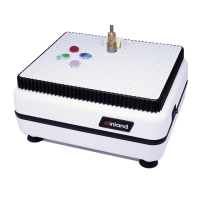
put the glass and your hands onto the work surface to grind and turns off when you
remove your hands. Using the TouchTop™ switch selection will extend motor life. You
can adjust the sensitivity of the work surface to the feel you like best. When you adjust
the sensitivity of the TouchTop, put a weight of about 1 lb. on top of the work surface. The weight will compensate for
the load of the coolant that will be in the reservoir when it is being used. Under the reservoir is a sensitivity set screw:
turning the screw tighter, or clockwise, decreases the sensitivity. By loosening the screw, or turning it counter-clock
wise, you increase the sensitivity. Adjust the sensitivity of the work surface to your preference now.
Grinding:
It is advisable first to test grind a scrap of glass to get a feel for grinding. Make sure the sponge is touching the
grinding head. Turn the machine to either TouchTop™ or 'On'. Begin by pushing the glass into the diamond bit using
light pressure at first. As you grind, move the glass back and forth across the head. Slowly increase the pressure until
you feel comfortable with the grinding speed and your control. If you need to grind out a deep cut, use intermittent
pressure. This allows coolant to clean the head making it more effective.
If you notice a white powder or paste while grinding, immediately stop and check the position of the sponge and the
coolant level. Grinding without coolant on the head greatly reduces its life. When you notice that the head doesn't
seem to grind as well and more pressure is needed to grind, the diamond is wearing and you need to expose a new
section of diamond. Loosen the set screw and move the grinding head up on the shaft until you have exposed a new
1/8" section of diamond. Secure in place and reposition the sponge if needed. You have up to five 1/8" sections of
diamond on a standard grinding bit to use before you need to consider replacing the entire bit
Page 5
BitSerts™ and the InvisibleSponge™
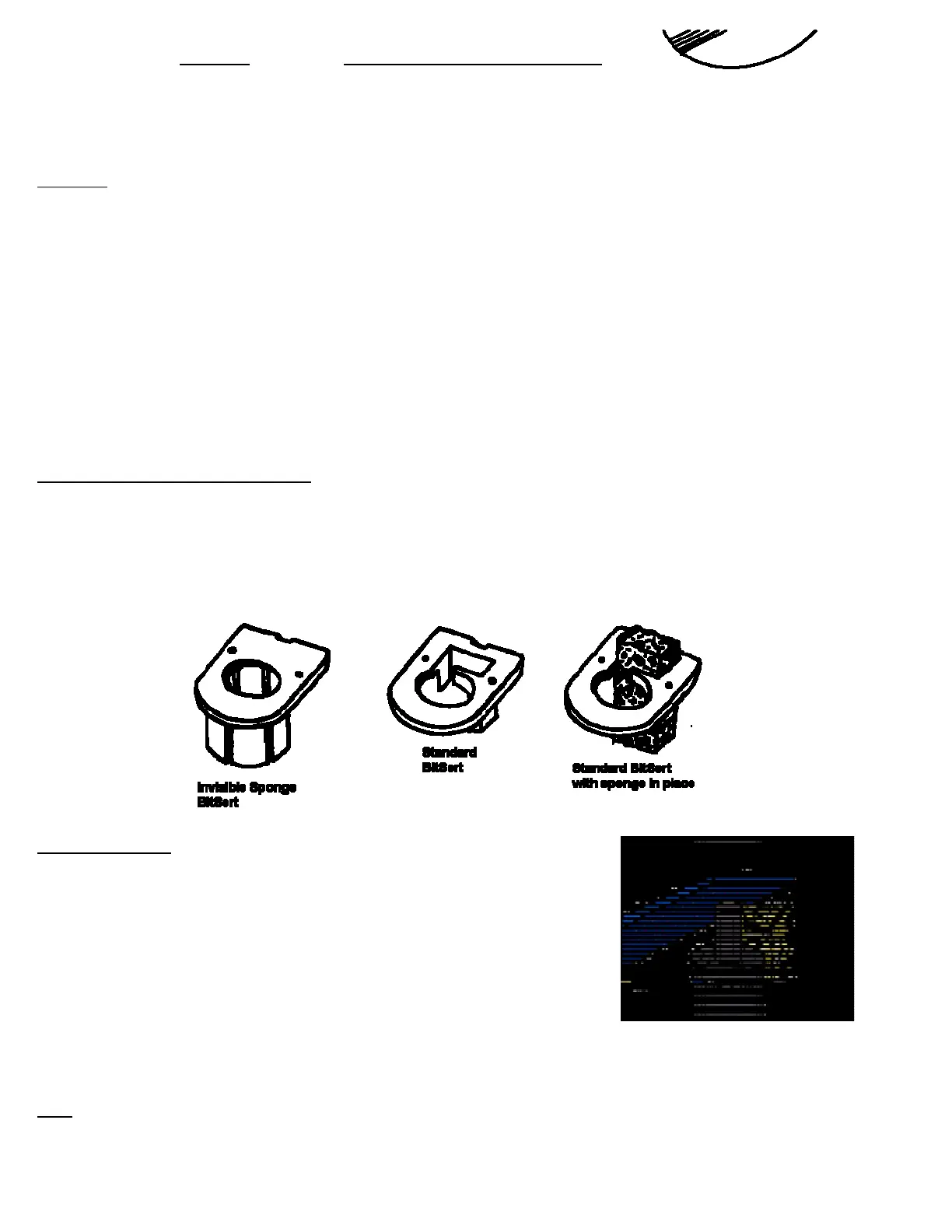
Impulse™ grinders are equipped the InvisibleSponge™ BitSert™ for 1" bits. The InvisibleSponge™ BitSert™
eliminates the need for a sponge most of the time. It works by automatically pumping coolant to the bit while you are
grinding. You will find it more effective to use a standard BitSert™ to use up the lowest section of diamond on the bit.
To use: Remove the standard BitSert™ and sponge and install the InvisibleSponge™ BitSert™ in the work surface.
Adjust the position of the bit if necessary. Turn on an allow water to reach bit surface before grinding.
How to drill a hole:
The Impulse™ includes a 1/4" WB-8bit for intricate grinding and drilling holes.
Place the WB-8bit onto the shaft so it sits on top of the WB-1. Secure to the flat of
the shaft. Begin drilling the hole by holding the glass finished side down to the upper
edge of the bit at about a 45
o
angle. Refer to the diagram on page 7. You will need
to hold a coolant soaked sponge against the bit as you drill the hole. As the bit
begins to grind out the hole, slowly move the glass to a horizontal position. Continue
to press the glass down onto the bit making sure that the sponge is supplying
coolant to the bit. Reload the sponge with coolant as needed. Ease up on the
pressure just before the bit comes through the back of the glass to reduce chipping.
It is advisable to practice on a scrap of glass before you begin drilling on your final project.
Page 6
Bits:
Diamond grinding heads, or bits, have actual diamond crystals. Our 1" and 3/4" standard bits have a 5/8" vertical
section of usable diamond. Since most stained glass is 1/8" thick, by adjusting the bit up and down on the shaft you
http://www.inlandcraft.com/Uguid... 7/13/2013



 To Next Page
 Loading...