D-0125111-A – 2020/04
TRV chair – Instructions for Use - EN Page 31
The posterior canal may also be liberated by pure gravity (Epley’s repositioning maneuver) from
the -45º position immobilized by the electromagnetic lock on the primary frame. The secondary
frame is then rotated 180º towards the healthy side and the otoconia liberated simply by gravity
and a liberatory nystagmus may occur, the patient is left for about one minute in this position,
then sat up, and it is at this point again that a nystagmus may occur. 360º maneuvers are another
way to free the posterior canal. The maneuver is done without the limit stop (locked in the
retracted position). The Dix-Hallpike maneuver is then prolonged to make a complete revolution.
4.3.1 Therapeutic maneuvers: protocol proposal for lateral canal cupulolithiasis
The maneuver (DPRM or the so-called TRV maneuver) using hyper gravity is a six-step
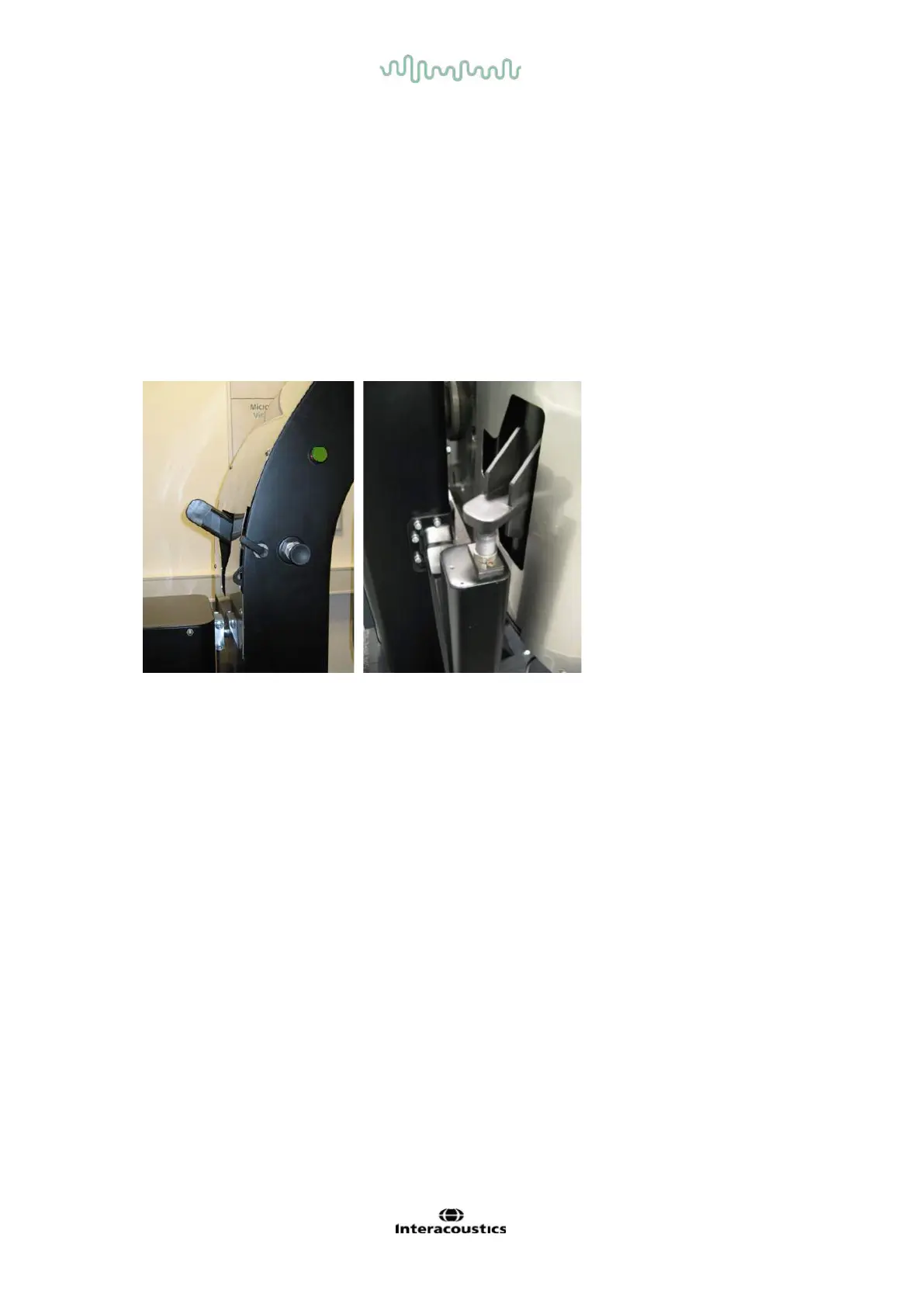
maneuver with a series of eight to twelve smooth shocks. The retractable abutment is locked in
the ‘up’ position.
The chair is tilted backwards to put the patient in the side-lying position with the involved ear
towards the floor.
The first series of eight to twelve shocks is performed with the abutment moving against the
upper hydraulic shock absorber, allowing the particles to migrate from the cupula to the first part
of the lateral canal.
After the first series of shocks, the manual lock on the secondary frame can be released and the
secondary frame turned 45° over the non-involved ear and locked again by means of the manual
locking system.
Then a new series of eight to twelve shocks is performed. The patient is again turned 45° over
the non-involved ear (now the nose is pointing towards the ceiling) and the same series is carried
out. The fourth, fifth and sixth steps are repetitions of the previous step. The sixth step finishes
with the patient in the side-lying position, nose 45° downwards and the non-involved ear also
downwards.
This position enables the stoma of the canal to be in its vertical orientation, allowing the particles
to move into the utricle cavity. The position is maintained for one minute. The chair is then
brought into the upright position, where the patient’s support devices can then be removed.


 To Next Page