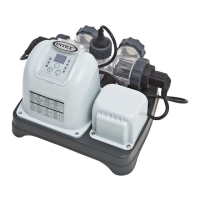
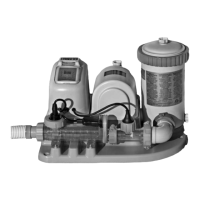
This document describes the Intex Saltwater System with E.C.O. (Electrocatalytic Oxidation), models ECO5110 and 6110, designed for use with portable above-ground pools. It serves as an owner's manual, providing comprehensive instructions for setup, operation, and maintenance, along with important safety rules.
Function Description
The Intex Saltwater System is an advanced pool sanitation device that utilizes salt (sodium chloride) to generate natural sodium hypochlorite, a form of chlorine, for keeping pool water clean and clear. Unlike traditional chlorine systems, this device reduces the need for adding packaged chlorine, offering a more natural and consistent sanitation method. The system incorporates Electrocatalytic Oxidation (E.C.O.) technology, which further enhances water quality by breaking down water molecules into powerful oxidants. These oxidants destroy organic contaminants and bacteria, resulting in cleaner, softer, and safer pool water with fewer harsh chemicals.
The core function involves an electrolytic cell where salt dissolved in the pool water passes through titanium and E.C.O. electrodes. An electrical current is applied, causing a chemical reaction that converts the sodium chloride into sodium hypochlorite. This generated sanitizer is then dispersed throughout the pool by the filter pump. The E.C.O. process simultaneously produces additional oxidants that target and eliminate impurities, contributing to a more thorough and efficient sanitation. The system is designed to continuously recycle the salt, meaning that once the initial salt level is established, only small amounts may need to be added periodically to compensate for splash-out or backwashing.
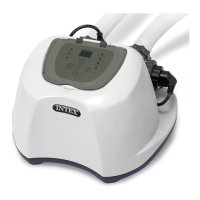
A control station with an LED display allows users to program and monitor the system's operation. It features a built-in timer to set daily operating hours, ensuring consistent sanitation. The system also includes a "Boost" cycle for situations requiring increased sanitizer production, such as after heavy rain or when the pool is particularly dirty. Additionally, an automatic self-clean cycle for the electrodes helps maintain optimal performance by reversing polarity to prevent scale buildup. A flow sensor ensures that the system only operates when there is adequate water flow from the filter pump, protecting the device and ensuring proper circulation.
Usage Features
Before installation, users must ensure they have a compatible filter pump, as the Saltwater System requires a separate pump to circulate water and function correctly. The system should be installed as the last piece of pool equipment in the water return line to the pool, a placement that helps extend the life of the titanium plates. The manual provides detailed setup instructions for connecting the system to various pump and pool hose sizes, including adaptors for smaller diameter connections.
Once installed and the pool is filled, the initial step involves adding the correct amount of sodium chloride salt to the pool water. The manual emphasizes using only pure sodium chloride salt (at least 99.8% pure) and warns against iodized or yellow-colored salts, which can impair performance. An "Intex Pools Salt Table" and "Salt Calculation Formula for All Pools" are provided to help determine the precise amount of salt needed to achieve an ideal level of 2500-3500 ppm (parts per million), with 3000 ppm being optimal. After adding salt, the filter pump must run for 24 consecutive hours to ensure the salt is thoroughly dissolved before the Saltwater System is activated.
The control station is user-friendly, allowing for easy programming of daily operating hours. The LED display will flash "00" when ready for programming, and users can adjust the time from 1 to 12 hours based on pool size and ambient temperature, using the provided "Operating Time Table." It's crucial that the filter pump runs for at least one hour longer than the Saltwater System's programmed time to ensure proper water circulation during the sanitation process. Once the desired operating hours are set, the keypad controls can be locked to prevent accidental changes, indicated by a "WORKING" light.
The "Boost" cycle is a key feature for intensive sanitation. By pressing and holding the "BOOST" button, the system can be activated to run for 8 times the normal programmed duration, providing a powerful surge of sanitizer to address challenging pool conditions. The manual also describes a "Stand-by/Power Saving" mode, where the system automatically enters a low-power state after completing its daily cycle, indicated by a "93" code, and then reactivates after 24 hours.
For optimal performance, the manual recommends adding cyanuric acid (chlorine stabilizer) to the pool water. Cyanuric acid helps reduce chlorine loss due to UV rays, extending the effectiveness of the generated sanitizer. "Cyanuric Acid Tables" are included to guide users on the appropriate dosage.
Maintenance Features
Regular maintenance is crucial for the longevity and efficient operation of the Saltwater System. The manual outlines several key maintenance procedures, starting with the importance of unplugging the power cord and closing plunger valves or inserting plugs to prevent water spillage before any cleaning tasks.
The flow sensor, a critical component that ensures water circulation, requires periodic cleaning. Users are instructed to unscrew its collar, remove it from the electrolytic cell conduit, and wash off any deposits or debris with a garden hose. If necessary, a plastic brush can be used, but metal brushes are to be avoided. Proper reinstallation involves aligning the locator notch with the connection ridge.
The titanium and E.C.O. electrodes, which are at the heart of the sanitation process, have a self-cleaning function built into the system's programming. This reverse polarity action helps prevent scale buildup. However, for pools with hard water (high mineral content), manual cleaning may be necessary monthly to maintain maximum performance. The manual provides detailed steps for this: disconnecting hoses, attaching cell covers, removing the flow sensor, and then pouring kitchen-grade vinegar into the electrolytic cell to immerse the electrodes for one hour. After soaking, the vinegar should be drained and the cell flushed with pool water.
Water chemistry testing is an integral part of maintenance. The system includes "Intex Test Strips" that can measure "Free Chlorine," "pH," "Calcium Hardness," and "Total Alkalinity" levels. The manual advises weekly testing and maintaining a free chlorine concentration between 0.5-3.0 ppm. It provides clear instructions on how to use the test strips and interpret the results, along with a "Pool Maintenance & Chemical Definitions" section that explains the significance of each parameter and how to adjust them if needed. For instance, if the salt level is too low, the system will display "Code 91," prompting the user to add more salt. If the salt level is too high, "Code 92" will appear, requiring partial draining and refilling of the pool.
Troubleshooting guidance is provided through an "LED Code Chart" that explains various error codes and their corresponding solutions, such as "Code 90" for low pump flow or "Code 93" for stand-by mode. The manual also addresses common issues like insufficient sodium hypochlorite production or white flakes in the water, offering practical solutions.
For long-term storage, the manual instructs users to disconnect the power cord, detach the system from the hoses, air-dry the unit, and store it in a dry place with controlled temperatures between 32°F (0°C) and 97°F (36°C). The original packaging can be used for storage. This comprehensive approach to maintenance ensures the Saltwater System remains effective and extends its operational life.


 To Next Page
 General