63
Top-of-range cookware
Aluminum: Medium-weight cookwa-
re is recommended because it heats
quickly and evenly. Most foods
brown evenly in an aluminum skillet.
Use saucepans with tight-fitting lids
when cooking with minimum
amounts of water.
Stainless Steel: This metal alone has
poor heating properties and is
usually combined with copper, alumi-
num or other metals for improved
heat distribution. Combination metal
skillets usually work satisfactorily if
they are used with medium heat or as
the manufacturer recommends.
Cast-Iron: If heated slowly, most
skillets will give satisfactory results.
Enamelware: Under some condi-
tions, the enamel of some cookware
may melt. Follow the cookware
manufacturer’s recommendations
for cooking methods.
Glass: There are two types of glass
cookware—those for oven use only
and those for top-of-range cooking
(saucepans, coffee and teapots).
Glass conducts heat very slowly.
Heatproof Glass Ceramic: Can be
used for either surface or oven
cooking. It conducts heat very slowly
and cools very slowly. Check the
cookware manufacturer’s directions
to be sure it can be used on gas
ranges.
Unused grids for the top of the grill.
Use a flat bottom wok
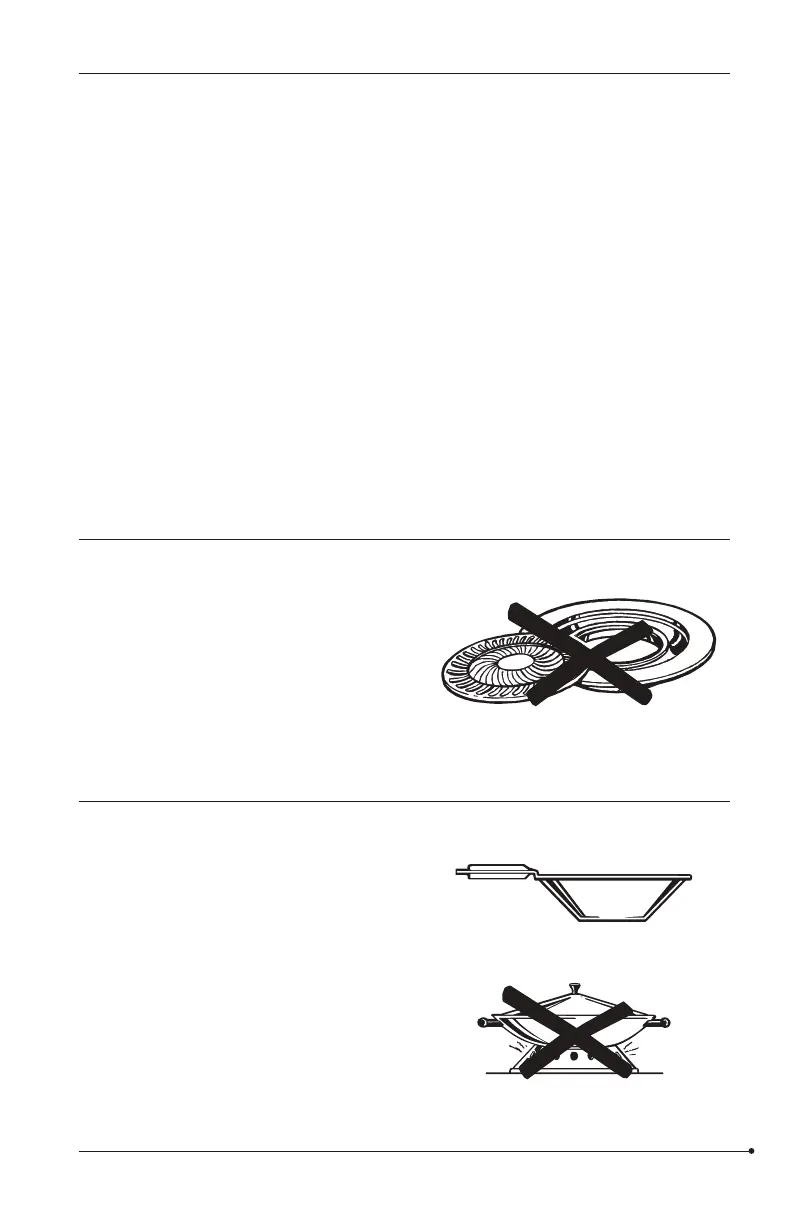
Stove top drills
Do not use an aftermarket stove top
grill on your gas surface burners. A
stove top grill will cause incomplete
combustion resulting in carbon
monoxide levels above allowable
standards.
This could be hazardous to your
health.
Using a wok
Use only a flat-bottomed wok with a
diameter of a 14 inches or less. Make
sure the wok bottom sits flat on the
grate.
Do not use a wok support ring.
Placing the ring over the burner or
grate may cause the burner to work
improperly, resulting in carbon
monoxide levels above allowable
standards.
This could be hazardous to your
health.



 To Next Page