
 Need help?
Do you have a question about the iRobot Roomba i7 and is the answer not in the manual?
Covers general warnings, cautions, and notices for safe operation of the robot.
Safety guidelines specific to the charging station and its use.
Guidelines for safe handling, usage, and disposal of the robot's battery.
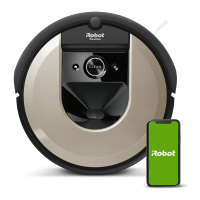
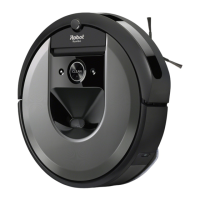
Identifies and describes components visible from the top of the robot.
Illustrates and names the parts of the Home Base charging station.
Identifies and describes components visible from the bottom of the robot.
Explains the function of buttons and indicator lights on the robot.
Guidance on optimal placement of the charging station for effective operation.
Details on how to charge the robot and interpret charging indicators.
Steps to prepare for cleaning and initiate a cleaning cycle using the CLEAN button.
How to understand and respond to error alerts from the robot.
Essential safety precautions when shipping the robot, particularly regarding the battery.
Information and usage instructions for the Dual Mode Virtual Wall barrier.
Explains Virtual Wall and Halo modes for creating barriers.
Step-by-step guide on how to remove and empty the robot's dustbin.
Instructions for removing, cleaning, and replacing the robot's filter.
Steps to clean the sensors that detect when the dustbin is full.
Instructions for washing the robot's dustbin.
How to remove, clean, and reinstall the edge-sweeping brush.
Guide on how to remove, clean, and reinstall the robot's front caster wheel.
Instructions for cleaning the robot's main brushes and brush caps.
Contact information and support resources for customers in the USA and Canada.
Information on how to find local support and resources outside the USA and Canada.
Declarations of conformity for EU and UK radio equipment compliance.
Technical specifications for the robot's radio modules and operating bands.
Information on environmentally sensitive disposal of the appliance.
The iRobot Roomba i7 is a robot vacuum designed for automated floor cleaning, offering a range of features for efficient and convenient home maintenance. It is intended for dry floor use only and should not be used to pick up spills or sharp objects. The robot can be used by children aged 8 and above, as well as persons with reduced physical, sensory, or mental capabilities, provided they are supervised or instructed on safe use and understand the hazards involved.
The Roomba i7 is a robot vacuum that autonomously navigates and cleans floors. It uses a combination of sensors to detect its surroundings, avoid obstacles, and identify dirtier areas for more thorough cleaning. The robot is equipped with Multi-Surface Brushes and an Edge-Sweeping Brush to effectively pick up debris from various floor types. It features a dust bin with a filter to capture dirt and allergens. The robot returns to its Home Base™ Charging Station to recharge automatically when its battery is low or when a cleaning job is complete. The i7 model also supports smart mapping capabilities, allowing it to learn and adapt to your home's layout.
To begin using the Roomba i7, place the robot on its Home Base™ Charging Station to activate the battery. It is recommended to charge the robot for 3 hours before its first cleaning job, even though it comes with a partial charge. The charging station should be positioned at least 4 feet (1.2 meters) away from stairs to prevent the robot from falling. Good Wi-Fi® coverage is also recommended for optimal performance, especially for features accessed via the iRobot HOME App.
The robot can be started by pressing the CLEAN/Power Button. A Spot Clean Button is available for targeted cleaning of specific areas, where the robot will spiral outward about 3 feet (1 meter) and then spiral inward to end where it started. The Light Ring Indicator provides visual cues about the robot's status, such as pulsing white during charging, solid white when fully charged, or red when the battery is low. If the "CLEAN" text is pulsing while charging, it indicates the robot is in the middle of a cleaning job and will resume once recharged.
For long-term storage, the robot should be turned off by removing it from the charging station and holding down the CLEAN button for 10 seconds, then stored in a cool, dry place. The robot uses a small amount of power when on the charging station; a reduced power standby mode is available for further power saving, detailed in the iRobot HOME App.
The Roomba i7 can be controlled and monitored through the iRobot HOME App, which provides additional instructional videos and allows for advanced features like scheduling and custom cleaning preferences. The robot is not a toy, and small children and pets should be supervised when it is operating. Users should avoid sitting or standing on the robot or its charging station. Before using the device, it's important to pick up objects like clothing, loose papers, pull cords, power cords, and fragile items to prevent them from being dragged or pulled off surfaces.
The Dual Mode Virtual Wall® Barrier is an accessory that allows users to create invisible barriers to guide the robot's movement. In Virtual Wall Mode, it creates a linear barrier up to 10 feet (3 meters) long to block openings. In Halo Mode, it creates a circular barrier approximately 12 inches (30 centimeters) from the device's center, useful for protecting pet bowls, vases, or areas under desks. For best results, the barrier should be placed at least 8 feet (2.5 meters) from the charging station. The batteries in the Virtual Wall barrier typically last 8-10 months under normal use; it's advisable to turn the switch to the Off or middle position when not in use for extended periods.
Regular maintenance is crucial for keeping the Roomba i7 running at peak performance. The iRobot HOME App also provides instructional videos for maintenance tasks.
Only use the iRobot Lithium Ion Battery that comes with the robot. Do not use non-rechargeable batteries. For replacement, purchase an identical iRobot battery or contact iRobot Customer Care for alternative options. The battery pack must be removed from the robot before recycling or disposal. Always charge and remove the battery from the robot and accessories before long-term storage.
 General
| Shape | Round |
|---|---|
| Product color | Black |
| Remotely operated | Yes |
| Dust container type | Bagless |
| Noise level | - dB |
| Wet mopping | No |
| Navigation type | iAdapt |
| Dust capacity (total) | 0.4 L |
| HEPA filtration system | - |
| Threshold climbing (max) | 20 mm |
| Charging time | 1.5 h |
| Battery capacity | - mAh |
| Master (outer) case width | 429 mm |
| Master (outer) case height | 540 mm |
| Master (outer) case length | 145 mm |
| Master (outer) case weight | 5900 g |
| Number of cartons per pallet | 32 pc(s) |
| Quantity per master (outer) case | 1 pc(s) |
| Package type | Box |
| Package depth | 510 mm |
| Package width | 410 mm |
| Package height | 129 mm |
| Package weight | 5200 g |




 To Next Page
