
 Need help?
Do you have a question about the ISC APECS and is the answer not in the manual?
Details copyright information and distribution limitations for the APECS documentation.
Explains manual formatting conventions and highlights safety-related notes.
Provides an overview of the APECS system, its family, and design purpose.
Details essential features like menu system, isolated displays, and redundant power.
Describes information displayed, including PO2, temperature, and battery status.
Covers advanced functions like calibration, altitude adjustment, and sensor MV.
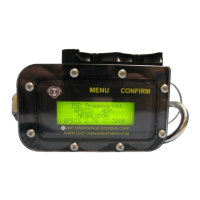
Explains the primary handset's main screen, sensor display, and controls.
Describes the SSI as the system's heartbeat and operational status indicator.
Details how to navigate menus and select options using the MENU/CONFIRM buttons.
Warns about system lock-up and the need to use the secondary display.
Guides menu navigation, set point selection, and related safety considerations.
Highlights critical warnings regarding water entry timing and PO2 maintenance.
Explains the System Monitor menu for diagnosing system status.
Details sensor millivolts (mv) and battery voltage monitoring via System Monitor.
Describes low battery warnings, voltage limits, and system failure modes.
Explains using sensor MV readings to monitor sensor health and performance.
Details temperature sensor functions for ambient and loop temperatures.
Covers options for controlling backlight and display power saving.
Explains OXY INJECT settings and the Adaptive Injection Algorithm.
Discusses PO2 monitoring and system behavior during inactivity.
Covers access to settings menus and pre-dive entry warnings.
Details the secondary handset's features, isolation, and commonality with primary.
Explains the secondary handset's function as an isolated backup for primary failure.
Lists secondary handset menu options and display content.
Highlights the temperature display differences between primary and secondary handsets.
Covers HUD availability, turning it on/off, and brightness adjustment.
Explains the color and blink patterns for HUD sensor status indication.
Describes the dual LED HUD configuration for color blindness.
Explains how to select between metric and imperial units.
Details prerequisites like MAX OXYGEN and ALTITUDE before calibration.
Guides the user on setting the calibration oxygen quality percentage.
Provides details on oxygen percentage setting and warnings against incorrect use.
Explains checks to prevent incorrect maximum oxygen set point selection.
Discusses using sensor MV for analysis and setting altitude for calibration.
Details the step-by-step process for altitude zone calibration.
Covers confirming altitude zone and pre-calibration sensor preparation.
Guides the user through the air point calibration procedure.
Introduces the two methods for performing high point calibration.
Provides detailed steps for loop flush calibration and sensor MV interpretation.
Explains kit advantages, operation, and calibration accuracy warnings.
Warns about system operation, inactivity timeouts, and background processing.
Details the integration of the Shearwater Pursuit Dive Computer.
Covers cell connections, isolation board, and support resources.
Presents a hardware configuration diagram for APECS 2.5A systems.
Provides a record of revisions made to the APECS operational instructions.
 General
| Controller Type | Programmable Logic Controller (PLC) |
|---|---|
| Input Voltage | 24 VDC |
| Programming Language | Ladder Logic, Structured Text, Function Block Diagram |
| Communication Protocols | Ethernet/IP, Profibus |
| Digital Inputs | 16 |
| Communication Ports | Ethernet, RS-485 |

 To Next Page