The ISRI 6830KA/880 is a sophisticated driver's seat designed for commercial vehicles, offering a range of adjustments and features to enhance driver comfort and safety. This repair manual provides comprehensive instructions for its maintenance and repair.
Function Description:
The ISRI 6830KA/880 is an air-suspended driver's seat with various adjustment capabilities, including horizontal adjustment, seat cushion and backrest adjustments, lumbar support, and height adjustment. It integrates electronic controls for many of its functions, including climatic heating and a rotary sensor for precise height adjustments. The seat is designed to provide optimal ergonomic support and comfort for drivers during long hours of operation.
Important Technical Specifications:
- Tightening Torques:
- Complete seat/Horizontal adjustment: 22Nm +/-2Nm (Pos. 4)
- Backrest: 35Nm +/-5Nm (Pos. 2), 4Nm (Pos. 5, 6), 35Nm +5Nm (Pos. 7)
- Cover seat/backrest cushion: 4Nm (Pos. 7, 8), 35Nm +5Nm (Pos. 9)
- Side covers/IPS valve/Switch for climatic/heating: 2Nm (Pos. 1, 2, 3, 8)
- Front cover/Rotation switch height adjustment/Rear cover: 2Nm (Pos. 1)
- Lever for tilt adjustment: Not specified, but involves spring tension and bowden cable adjustment.
- Shock absorber adjustment: 5Nm (Pos. 1)
- Lever for horizontal suspension: 5Nm (Pos. 1)
- Lever backrest/shoulder adjustment: 16Nm +/-2Nm (Pos. 12)
- Tooth segment for backrest adjustment: 22Nm +/-2Nm (Pos. 4)
- Tooth segment for shoulder adjustment: 24Nm +/-3Nm (Pos. 1, 2)
- Electronic unit: 5Nm (Pos. 3)
- Rotary sensor: 3Nm +/-0,5Nm (Pos. 3)
- Compressor: Not specified, but involves a 7mm distance to the cross tube.
- Relais: Not specified.
- Magnetic valve: Not specified.
- Air spring: 5Nm (Pos. 4)
- Electronic unit climatic/heating: 2Nm (Pos. 4)
- Fan for seat cushion: 2Nm (Pos. 3)
- Fan for backrest: 2Nm +/-1Nm (Pos. 7), 2Nm (Pos. 8)
- Belt cover/3-point-belt: 35Nm +/-5Nm (Pos. 1, 7, 8), 4Nm (Pos. 2, 3)
- 2-point-belt: 35Nm +5Nm (Pos. 1, 3)
- Power Supply:
- Nominal voltage: UN=24V DC
- Working voltage: UBat=16-32V
- Current Drain:
- Electronic Unit: The electronic unit (ECU) measures seat height using a rotary sensor and compares it with the adjusted height on the rotary switch. It controls the compressor and magnetic valve to achieve the desired seat height.
- Climatic/Heating System: The seat features heating for both the seat cushion and backrest, and potentially a ventilation function. It is controlled by a switch and integrated with the electronic unit.
- Air Spring System: The compressor blows air into the air spring to adjust seat height based on the driver's weight. The magnetic valve releases air from the air spring to lower the seat.
- Seat Contact Switch: Detects if the driver is seated, influencing automatic readjustment and safety functions.
Usage Features:
- Height Adjustment: The seat height is preselected using a rotary switch, with levels ranging from 1 (lowest) to 7 (topmost). The electronic unit automatically adjusts the air spring to reach and maintain the desired height.
- Lumbar Support: Adjustable via a switch, allowing the driver to inflate or deflate air chambers for personalized lumbar support.
- Horizontal Adjustment: Allows the seat to be moved forward and backward.
- Tilt Adjustment: Enables adjustment of the seat's tilt angle.
- Shock Absorber: Contributes to ride comfort by dampening vibrations.
- Horizontal Suspension: Provides additional suspension in the horizontal plane.
- Backrest and Shoulder Adjustment: Allows for fine-tuning of the backrest angle and shoulder support.
- Climatic/Heating: Provides warmth to the seat cushion and backrest, with adjustable levels.
Maintenance Features:
- Warning Notes: Emphasizes that the seat should be installed or repaired only by workshop specialists, and that only original spare parts should be used. It also highlights the importance of checking seat anchorages and locking mechanisms frequently.
- Caution Notes: Advises against using harsh cleaning agents, soaking upholstery, or blocking objects that could damage the seat. It also warns about potential overheating if heating is improperly handled.
- Repair Manual Structure: The manual is organized into chapters covering general information, system components (with detailed instructions for each part), and electronic components/circuit diagrams.
- Troubleshooting (Checking Electronic Unit):
- Function of electronic unit: Describes how the ECU measures and adjusts seat height.
- Flashcode display of electronic unit: Explains how the LED on the electronic unit flashes to indicate errors. Flash intervals are 0.5 seconds for LED on and 0.5 seconds for LED off.
- Overview error codes (electronic unit): Provides a table of error codes (BC 1-7) with their corresponding meanings and recommended corrections. For example, BC 2 indicates a fault in the electronic unit, BC 3 a fault in the compressor, and BC 4 a fault in the rotary sensor.
- Checking Rotary Switch Height Adjustment: Includes instructions for checking electrical connections, resistor values, and signal voltage of the rotary switch.
- Checking Compressor: Provides guidance on checking electrical connections, resistor values, and the pneumatic function of the compressor.
- Checking Rotary Sensor: Details how to check electrical connections, supply voltage, and signal output of the rotary sensor.
- Checking Magnetic Valve: Instructions for checking electrical connections, resistor values, and pneumatic function of the magnetic valve.
- Checking LS Valve/Seat Contact Switch: Procedures for checking the resistance of the LS valve and seat contact switch.
- Checking Switch Climatic/Heating: Covers electrical connections, flash codes for heating system faults, and signal checking.
- Checking Heating: Provides steps for checking seat cushion and backrest heating, including NTC resistance, supply heating, and external voltage.
- Checking Fan: Instructions for checking electrical connections and supply fans for backrest and seat cushion.
- Circuit Diagrams: Detailed diagrams for the electronic unit height control and climatic/heating systems, including pin assignments and wire colors.
- General Fault Description: Explains common issues such as the seat not staying on its height, not adjusting to the desired height, lumbar support changes, and power supply problems, along with their causes and implications.
- Serial Number Location: The serial number is located on the lower frame of the suspension unit and is visible when lifting the bellows, crucial for ordering spare parts.
- Installation Instructions: Each component section includes specific installation instructions, often emphasizing proper tightening torques and connection procedures. For example, when mounting a new compressor, a foam part must be placed between the compressor and clip, and the compressor must be mounted at a distance of 7mm to the cross tube.
- Safety Precautions: Throughout the manual, warnings are given regarding potential hazards such as bruising during repair and the importance of securing the suspension unit during certain operations.

 Need help?
 General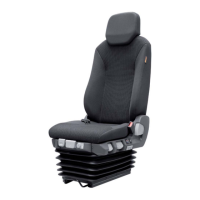

 To Next Page