
 Need help?
Do you have a question about the Janome JEM GOLD 660 and is the answer not in the manual?
Instructions on how to safely connect the sewing machine to a power source.
Step-by-step guide on how to change the needle in the sewing machine.
Detailed instructions for performing straight stitch sewing.
How to select the appropriate thread tension for various fabrics.
How to identify and correct overly tight needle thread tension.
How to identify and correct overly loose needle thread tension.
Guide to performing zigzag stitching and its applications.
How to create shell tuck stitches for decorative finishing.
Guide to performing blind stitch hemming.
Instructions for sewing buttonholes on garments.
Instructions for cleaning essential moving parts of the machine.
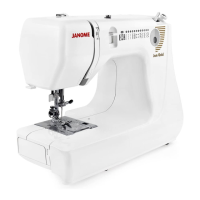
The Janome Jem Gold 660 is a household sewing machine designed for a variety of sewing and quilting tasks. It's a versatile tool suitable for both basic sewing and more decorative stitching, offering features that cater to beginners and those looking for a reliable machine for everyday projects.
The primary function of the Janome Jem Gold 660 is to create stitches on fabric, allowing users to construct garments, home decor items, and engage in quilting. It supports a range of stitch types, including straight stitch, zigzag stitch, triple straight stitch, overcasting, tricot stitch, shell tuck, blind stitch hemming, and buttonholes. This variety enables users to tackle different fabric types and project requirements, from simple seams to more intricate finishes and decorative embellishments.
The machine operates by forming stitches using two threads: a needle thread and a bobbin thread. The needle thread is fed from a spool on top of the machine, through a series of guides and tension mechanisms, and then through the eye of the needle. The bobbin thread is held in a bobbin case located beneath the needle plate. As the needle penetrates the fabric, it carries the needle thread down, where it interlocks with the bobbin thread to form a stitch. This process is repeated rapidly, creating a continuous seam.
The Janome Jem Gold 660 features a pattern selector dial, allowing users to easily choose the desired stitch pattern. The stitch length and width (for zigzag and other adjustable stitches) are predetermined for each pattern, simplifying the selection process. For straight stitch, the machine offers three types of stitch length selection, providing flexibility for different fabric weights and desired seam strength.
The machine includes a reverse stitch lever, which, when depressed, allows the machine to sew in reverse. This feature is crucial for fastening the beginning and end of seams, preventing them from unraveling. The presser foot lifter enables users to raise and lower the presser foot, facilitating the placement and removal of fabric. It can be raised higher than the normal up position, which is particularly useful when working with heavy or bulky fabrics.
For convenience, the machine is equipped with a free arm. This feature is achieved by removing the extension table, revealing a narrower sewing surface. The free arm is ideal for sewing tubular items such as sleeves, pant hems, and small children's clothing, as it allows the fabric to be easily rotated around the arm.
Setting up the Janome Jem Gold 660 for sewing involves several steps, starting with connecting it to a power supply. Users must ensure the machine's voltage and frequency requirements match their electrical power. The machine is controlled by a foot controller, which allows for variable sewing speeds – pressing harder on the control increases the speed.
Preparing the bobbin thread is a fundamental step. This involves removing the bobbin, placing a spool of thread on the spool pin, and winding the thread onto an empty bobbin using the bobbin winder spindle. The machine automatically stops winding when the bobbin is full. Once wound, the bobbin is inserted into the bobbin holder, ensuring the thread runs off counterclockwise and is guided through specific notches and tension springs for proper tension.
Threading the needle thread is another critical process. The thread is guided from the spool through various guides, the tension mechanism, the take-up lever, and finally through the needle bar thread guide. The machine includes a built-in needle threader, which simplifies the task of threading the needle eye, especially for those with vision difficulties or unsteady hands. After both needle and bobbin threads are set, the bobbin thread is drawn up through the needle plate, and both threads are pulled back under the presser foot, ready for sewing.
When starting to sew, the fabric is positioned under the presser foot, and the needle is lowered into the fabric. The presser foot is then lowered, and the foot control is depressed to begin stitching. To change sewing direction, the machine is stopped with the needle down in the fabric, the presser foot is raised, and the fabric is pivoted around the needle. Seam guides on the needle plate and hook cover plate assist users in maintaining consistent seam widths. The machine also provides instructions for turning square corners accurately.
The Janome Jem Gold 660 offers specific settings and techniques for each stitch type. For instance, the triple straight stitch is recommended for areas requiring extra strength and elasticity, such as crotch and armhole seams, and for constructing items like backpacks. Overcasting and tricot stitches are designed for finishing seam allowances to prevent fraying, particularly on synthetics and fabrics prone to puckering. Decorative stitches like shell tucks can be used for finishing hems, sleeves, and neck openings, or for creating scalloped tucks on blouses and lingerie. Blind stitch hemming provides an invisible hem, with specific instructions on how to fold the fabric and position it for the needle to just pierce the folded edge.
Balancing needle thread tension is crucial for forming ideal stitches. The manual provides guidance on how to identify correct tension, as well as when tension is too tight or too loose, and how to adjust the thread tension dial accordingly. The ideal straight stitch shows threads locked between the two layers of fabric without gaps, appearing smooth and even on both sides.
Proper maintenance is essential for the longevity and optimal performance of the Janome Jem Gold 660. Before performing any maintenance, it is crucial to unplug the machine from the power source and ensure the power switch is off. The handwheel should be turned towards the user to raise the needle to its highest position.
Regular cleaning of the hook race and feed dogs is a key maintenance task. This involves removing the presser foot and needle, unscrewing and removing the needle plate, and lifting out the bobbin holder. Once these components are removed, dust and lint can be brushed out from the hook race and feed dogs using a small brush. After cleaning, the areas should be wiped gently with a soft, dry cloth. A vacuum cleaner can also be used to remove debris.
Replacing the bobbin holder is part of the maintenance process if it needs to be removed for cleaning. The bobbin holder is reinserted so that its knob fits next to the stopper in the race. The bobbin is then inserted. Finally, the needle plate is replaced by aligning its guide pins with the holes in the machine and securing it with screws.
The machine also requires occasional light bulb replacement. The sewing light is located behind the face plate. To change the bulb, the face plate is opened by loosening a screw. Users are cautioned to wait for the bulb to cool down before touching it. The bulb can be removed by turning it counterclockwise and replaced by turning a new bulb clockwise. For certain bulb types, removal involves pushing and turning counterclockwise, and replacement involves pushing and turning clockwise.
General care includes not dismantling the machine beyond what is explained in the manual. It should not be stored in high-humidity areas, near heat radiators, or in direct sunlight. The outside of the machine should be cleaned with a soft cloth and neutral soap.
The manual also includes a troubleshooting section to help users diagnose and resolve common issues such as needle thread breaks, bobbin thread breaks, needle breaks, skipped stitches, seam puckering, and the machine not running. For each problem, potential causes are listed, along with references to specific pages in the manual for detailed instructions on how to rectify the issue. This self-help guide empowers users to address minor problems without immediate professional assistance, ensuring a smoother sewing experience.
 General
| Type | Mechanical |
|---|---|
| Buttonhole Style | 4-Step |
| Needle Threading | Automatic |
| Maximum Stitch Length | 4 mm |
| Maximum Stitch Width | 5 mm |
| Free Arm | Yes |
| Bobbin Type | Front-loading |


 To Next Page

