Need help?
Do you have a question about the JBL ES 150P and is the answer not in the manual?
Voltage ranges for US and EU models.
Technical details of the amplifier circuitry.
Sensitivity levels and impedance of inputs.
SNR measurements for audio quality.
Details of low-pass, subsonic filters, and audio limiter.
Implemented features, input config, and signal sensing.
Transients, efficiency, protections, and fuse rating.
Steps for testing the overall unit function.
Procedure for testing frequency response.
Procedure for testing the subwoofer driver.
Component placement guide for the top side of the PCB.
Component placement guide for the bottom side of the PCB.
Copper trace layout for the top side of the PCB.
Copper trace layout for the bottom side of the PCB.
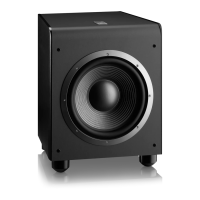
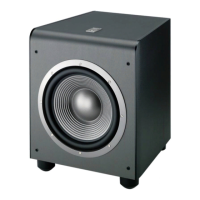
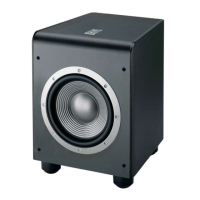
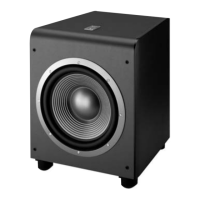
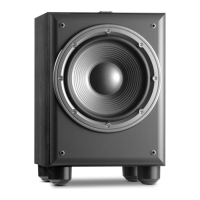
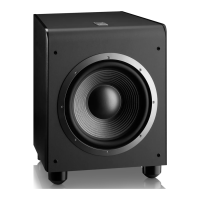
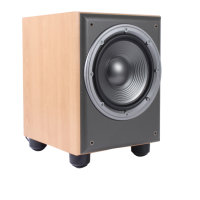
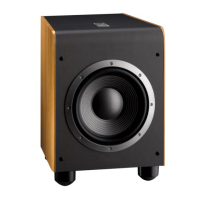
The JBL ES 150P/230V is a powered subwoofer designed to enhance the low-frequency audio experience in a home entertainment system. As a powered unit, it integrates its own amplifier, simplifying setup and ensuring optimal performance tailored to its specific driver. The subwoofer is housed in a cabinet, available in cherry, black, or beech finishes, allowing it to blend with various home décors. The front of the unit features a 10-inch PolyPlas woofer, protected by a plastic grille with a JBL logo, which is designed to deliver deep and impactful bass.
For user interaction, the subwoofer includes a control panel, typically located on the rear, which provides various adjustments to fine-tune its sound output. Key controls include a LEVEL control, which adjusts the overall volume of the subwoofer, allowing users to balance its output with the main speakers in their system. A CROSSOVER control is also present, enabling users to set the upper frequency limit at which the subwoofer operates. This is continuously variable, typically ranging from 50Hz to 150Hz, with a 24dB/octave slope, ensuring a smooth transition between the subwoofer and the main speakers. For systems with a dedicated Low-Frequency Effects (LFE) output, an LFE/NORMAL switch is provided to bypass the internal low-pass filter, allowing the receiver or processor to manage the crossover. A PHASE switch, offering 0-degree and 180-degree options, helps to ensure that the subwoofer's output is in phase with the main speakers, preventing cancellation or reinforcement of bass frequencies at the listening position.
Connectivity options include Line Level RCA input jacks (L/R), which can be used with a Y-cable for mono sources if needed. The subwoofer also features an auto-turn-on (ATO) function, which automatically powers on the unit when an audio signal is detected and puts it into standby mode when no signal is present for a period. This feature enhances convenience and energy efficiency. An LED indicator, typically bicolor (red for standby, green for active), provides visual feedback on the subwoofer's operational status.
The internal design incorporates a Class D amplifier, known for its efficiency and power delivery, capable of producing significant output for dynamic bass reproduction. Protection circuits are integrated to ensure reliable operation and longevity. These include short-circuit protection, which safeguards the amplifier from damage in case of an output short, and thermal protection, which prevents overheating during extended high-power operation. DC offset protection is also included to prevent harmful DC voltage from reaching the speaker. The unit is equipped with a line fuse for electrical safety, with different ratings for USA (120V) and EU (230V) markets.
Maintenance and troubleshooting are facilitated by specific procedures outlined in the manual. For instance, a general unit function test involves connecting a signal generator to the line-level inputs, setting the crossover and level controls, and observing the LED indicator and bass response. A sweep function test helps identify any unusual noises like rattles, clicks, or buzzes by sweeping a signal from 20Hz to 300Hz. For driver function testing, the woofer can be removed to check its DC resistance and to listen for rubbing or buzzing noises during a frequency sweep. These steps allow technicians to diagnose and resolve potential issues efficiently. The modular design, with separate amplifier and pre-amp PCBs, also aids in component-level servicing. The cabinet is designed to be airtight, preventing air leaks that could degrade sound quality. The volume control is strategically placed at the input buffer stage to minimize the possibility of clipping the input section with highly dynamic audio material.
 General
| Type | Powered Subwoofer |
|---|---|
| Driver Size | 12 inches |
| Amplifier Power (RMS) | 150 Watts |
| Amplifier Power (Peak) | 300 Watts |
| Enclosure Type | Bass reflex |
| Weight | 38.5 lbs |
| Crossover Frequency | 50 Hz - 150 Hz |
| Input Connections | Line-level (RCA) |

 To Next Page