EasyManua.ls Logo

jcb JCB116 - User Manual

jcb JCB116
21 pages
Print Icon
To Next Page IconTo Next Page
Loading...
OPERATOR'S MANUAL
ROLLER
JCB116, JCB116D, JCB116DD
EN - 9831/4600 ISSUE 3 - 09/2017
THIS MANUAL SHOULD ALWAYS STAY WITH THE MACHINE

Other manuals for jcb JCB116

Question and Answer IconNeed help?

Do you have a question about the jcb JCB116 and is the answer not in the manual?

Summary

Introduction

About this Manual

Information on understanding and using the operator's manual.

Cross References

Safety

Safety - Yours and Others

General advice on operator and bystander safety, understanding warnings.

General Safety

Covers training, alertness, clothing, alcohol/drugs, feeling unwell, mobile phones, lifting.

Clothing and Personal Protective Equipment (PPE)

Guidelines on appropriate clothing and PPE for safe operation.

About the Product

General

Introduction to operating the machine and identifying controls.

Name and Address of the Manufacturer

Details of the manufacturer's identity and location.

Product Compliance

Information on product compliance with laws and regulations.

Description

Overview of the JCB116 machine, its engine, drive, and steering systems.

Intended Use

Specifies the applications and environmental conditions for machine use.

Danger Zone

Defines the danger zone around the machine and safety precautions.

Overview

The provided document is an Operator's Manual for a JCB Roller, specifically models JCB116, JCB116D, and JCB116DD. This manual, identified as EN - 9831/4600 ISSUE 3 - 09/2017, is intended to stay with the machine and provides comprehensive information for its safe and effective operation and maintenance.

Function Description

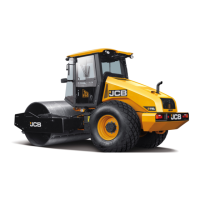
The JCB116 machine is described as a self-propelled, vibratory single drum roller powered by a 4-cylinder diesel engine. Its primary function is to compact various soil types, ranging from stones to silty sand, and asphalt construction materials. This compaction can be performed in both forward and reverse directions, with or without vibration. Applications include road and pavement construction, sub-soil compaction, and similar tasks.

The machine utilizes a hydrostatic drive system, enabling infinitely variable travel speeds. A spring-on, pressure-off brake system is integrated into the drive motor, engaging when the machine is in neutral. The drive motor hoses are protected within steel frame plates. An articulated steering system provides a tight turning radius, enhancing maneuverability. Two scrapers are mounted on the machine to assist in its operation. The hydraulic system is also responsible for turning the machine's vibratory shaft, which is designed with an overturning weight system.

Important Technical Specifications

The manual covers a range of technical data, including static dimensions (dimensions and weights), performance dimensions (general and driving performance), noise emissions (general and noise data), and vibration emissions (general and vibration data). It also details fluids, lubricants, and capacities (general, fuel, and coolant), torque values (general), and electrical system components (general, bulbs, fuses, and relays). Engine specifications are also included.

The machine is designed for compacting soil types with water contents ranging from 40% to 110% of the optimum water content, in accordance with the standard Proctor test DIN 18127. Fine-grained soils or soils with higher water contents may require qualified trial compaction. The manual specifies permissible gradients for operation, emphasizing that driving on gradients greater than the permissible limit is not allowed.

Usage Features

The manual stresses the importance of understanding the machine's controls, safety warnings, and operating procedures before use. It covers various aspects of operation, including:

  • Operator Station: Details component locations, interior switches (ignition, cab interior light, window washer/wiper, engine stop), and console switches (general, road lights, direction indicators, hazard warning lights, work lights, drive mode, park brake, horn, beacon, automatic vibration, vibration amplitude, two-speed range).
  • Safety: Emphasizes operator and bystander safety, proper clothing and personal protective equipment (PPE), and avoiding operation under the influence of alcohol or drugs or when feeling unwell. It also highlights the importance of switching off mobile phones in potentially explosive atmospheres or during refuelling.
  • Pre-Operation Checks: Includes walk-around inspection, checking the battery isolator, and general checks before starting the engine.
  • Operator Comfort: Describes the operator seat (general and basic seat) and seat belt types (general, inertia reel, static).
  • Driving and Steering: Covers steering wheel, hand throttle control, transmission drive lever, and drive mode.
  • Working with the Drum: Instructions for working without vibration, with vibration, and using padfoot shells.
  • Environmental Controls: Information on heating, ventilating, and air-conditioning (HVAC) controls and cab filters.
  • Power Sockets: Details the auxiliary power socket.
  • Emergency Procedures: Guidance on moving a disabled machine, jump-starting the engine, and emergency exit.
  • Transporting and Lifting: Instructions for lifting and transporting the machine, including loading onto a vehicle/trailer.
  • Operating Environment: Advice for operating in low and high temperatures.
  • Refuelling: General guidelines for refuelling, managing low fuel levels, and filling the tank.
  • Security: Information on the Construction Equipment Security and Registration Scheme (CESAR) and LiveLink.

The manual explicitly states that the machine is not intended for use in ways that exceed its permissible gradient, cause wheel/drum spin or skidding on gradients, involve vibrating travel on blocks/rocks/concrete/frozen soil, or in the vicinity of buildings if it could cause damage. It also warns against earth-moving with the pusher blade lowered or operating from outside the operator's seat.

Maintenance Features

The manual provides extensive information on maintaining the JCB Roller to ensure its longevity and safe operation:

  • Maintenance Safety: General safety precautions for maintenance tasks and guidelines for handling fluids and lubricants.
  • Maintenance Schedules: General information on how to use the schedules, maintenance intervals, pre-start cold checks, service points, fluid levels, functional tests, and final inspection.
  • Maintenance Positions: Instructions on how to position the machine safely for maintenance.
  • Service Points and Access: Identification of general service points and access apertures, including the engine compartment cover and cab/canopy.
  • Tools: General information on tools required for maintenance.
  • Component-Specific Maintenance: Detailed instructions for various components:
    • Body and Framework: General maintenance.
    • Operator Station: Maintenance of the operator protective structure, seat, seat belt, doors/hatches, and controls.
    • Engine: General engine maintenance, oil checks, drive belt, and exhaust.
    • Air Filter: General air filter maintenance.
    • Fuel System: General fuel system maintenance, tank, fuel filter, engine fuel filter, lubricity filter, and water separator.
    • Cooling System: General cooling system maintenance, coolant, and cooling pack.
    • Brakes: Maintenance of the park brake and service brake.
    • Axles: Oil checks.
    • Hubs: Oil checks.
    • Wheels and Tyres: General maintenance, tyre sizes, and pressures.
    • Drum: Maintenance of the scraper and dampers.
    • Drive Gearbox: Oil checks.
    • Vibration System: Oil checks.
    • Hydraulic System: General maintenance, services, oil checks, and cylinders/rams.
    • Electrical System: General maintenance, battery, battery isolator, fuses, relays, and window washer.
  • Preservation and Storage: Instructions for cleaning, preparation, checking for damage, and procedures for putting the machine into and taking it out of storage.
  • Support and Documentation: Information on owner/operator support, service/maintenance agreements, initial service and inspection, obtaining spare parts, declaration of conformity, data, and warranty information. A service record sheet is also included.

The manual emphasizes that the manufacturer reserves the right to change machine specifications without notice due to continuous improvement. It also warns against altering the machine in any way that could affect or invalidate its compliance with legislative requirements.

jcb JCB116 Specifications

General IconGeneral
Brandjcb
ModelJCB116
CategoryCompact Loader
LanguageEnglish

Related product manuals